

Half of Western Sydney foodbowl land may have been lost to development in just 10 years
- Written by: Nicky Morrison, Professor of Planning and Director of Urban Transformations Research Centre, Western Sydney University
More and more farming land is being lost to other land uses such as housing on the outskirts of our cities. But how much land is being lost? And why does it matter?
Our newly published research used the Western Sydney region as a case study of land lost since the 2011 census, and newly released Australian Bureau of Statistic (ABS) data allowed us to update our findings. While changes in ABS land-use definitions make precise comparisons difficult, Western Sydney may have lost as much as 60% of its agricultural land over the past ten years.
The significance of these losses is that Western Sydney has long been seen as the foodbowl of Greater Sydney. It produces more than three-quarters of the total value of agricultural produce in the metropolitan region. The city relies heavily on Western Sydney for livestock, vegetables, eggs, grapes and nuts.
Read more: Why 'best before' food labelling is not best for the planet or your budget
We also interviewed people from different tiers of government working in Western Sydney. Our study highlights growing tensions between the New South Wales government and its attempts to manage population growth and housing pressures, and local councils and their efforts to protect food production on the city outskirts. The loss of productive land around our major cities is an increasingly urgent issue for our food security.
Food systems under pressure
Like many cities, Sydney is being hit by many shocks and stresses – drought, bushfires, storms, floods and the COVID-19 pandemic’s impacts on supply chains. This rapid succession of shocks tests the resilience of local food security. Communities face soaring food prices as part of a broader surge in costs of living.
A lack of political will, short-term election cycles with shifting priorities, and low public awareness have meant the importance of retaining farming land close to the city isn’t well understood. Perishable foods grown close to urban markets not only reduce transport and energy costs, and emissions, but also improve a city’s food security.
Read more: We've had a taste of disrupted food supplies – here are 5 ways we can avoid a repeat
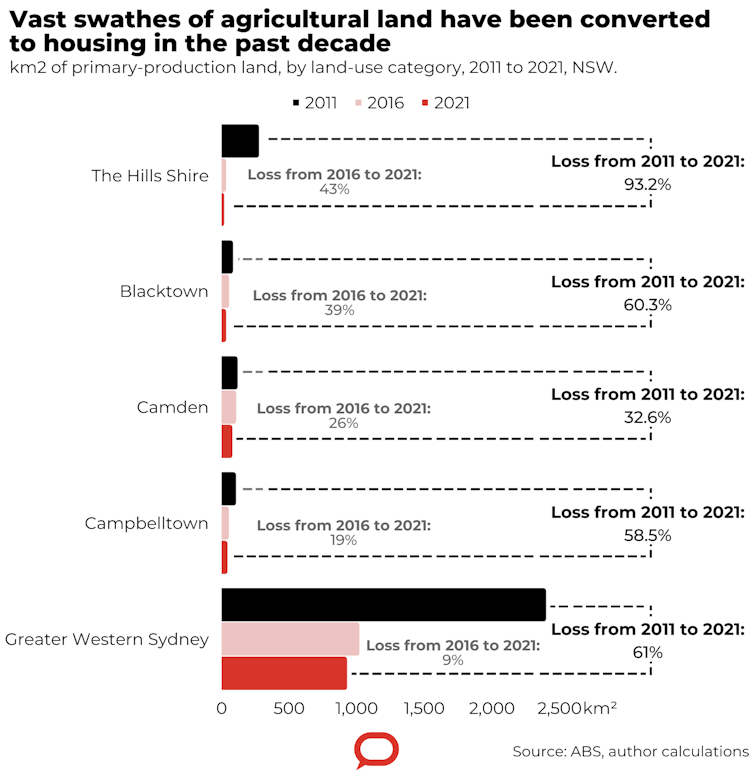
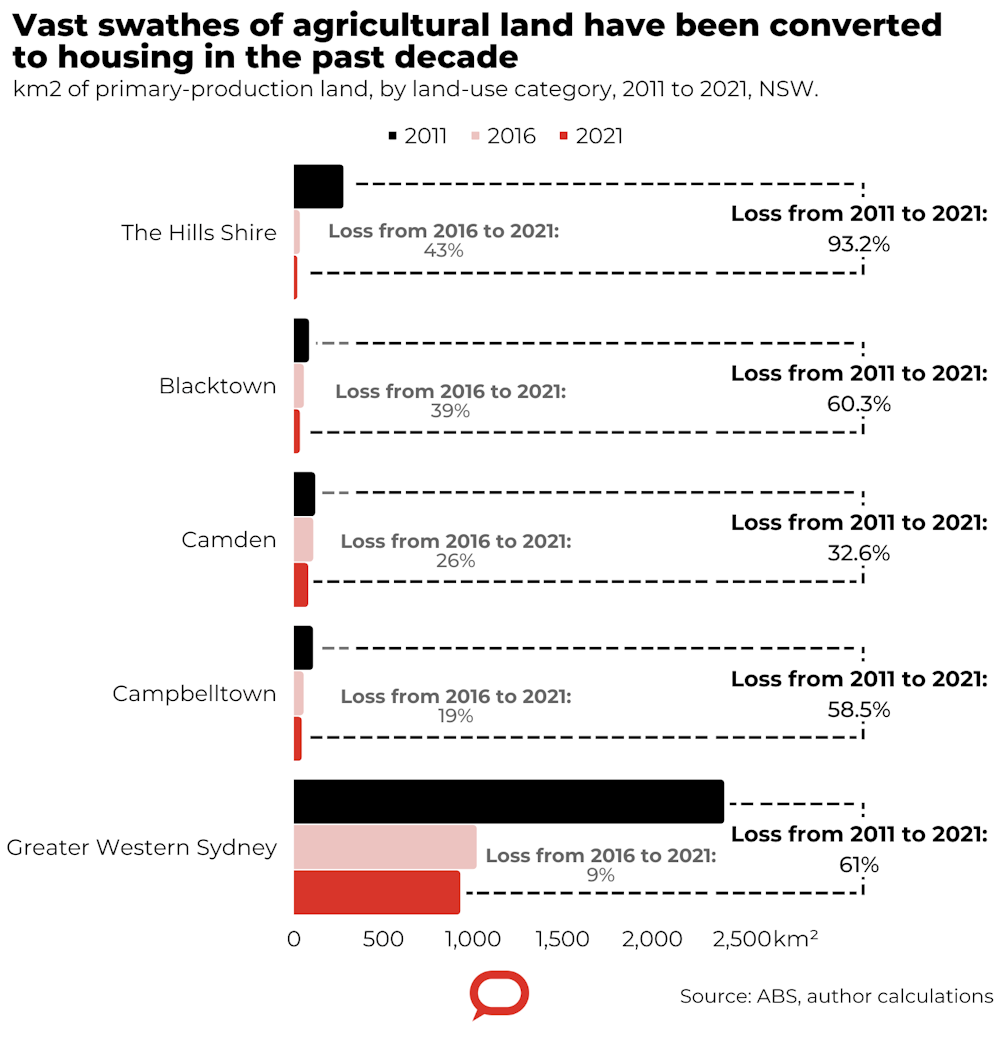
Our study quantifies the loss of land categorised as agricultural or primary production in Western Sydney over time. Based on ABS data for land use by mesh blocks (the smallest geographic areas defined by the ABS), we estimate Western Sydney lost 9% of its primary production land from 2016 to 2021. The worst-affected council areas over this period, The Hills Shire, Blacktown, Camden and Campbelltown, lost 43%, 39%, 26% and 19% respectively.
Changes in ABS mesh block land-use definitions (from “agriculture” in 2011 to “primary production” in 2016 and 2021), as well as changes to mapping standards, make it difficult to accurately calculate the loss of land between 2011 and 2021. However, if these land-use categories in 2011, 2016 and 2021 are assumed to be broadly comparable, we can estimate that Western Sydney lost roughly 60% of its farming land over the past ten years.
Read more: Urban sprawl is threatening Sydney's foodbowl
The pressures of growth
The NSW government has historically looked to Western Sydney to accommodate Greater Sydney’s growing population.
The population in Western Sydney is estimated to increase from 2.4 million residents in 2016 to 4.1 million in 2041. The Department of Planning and Environment’s latest housing supply forecast predicts the region will supply roughly 60% of Greater Sydney’s new dwellings in the period 2021-2025.
Attempts have been made to concentrate new development in two designated growth areas – the North-West and South-West – from 2006 onwards. These locations used to contain swathes of undeveloped greenfield land. But local council policies to retain productive farmland have been put aside to accommodate state government growth plans.
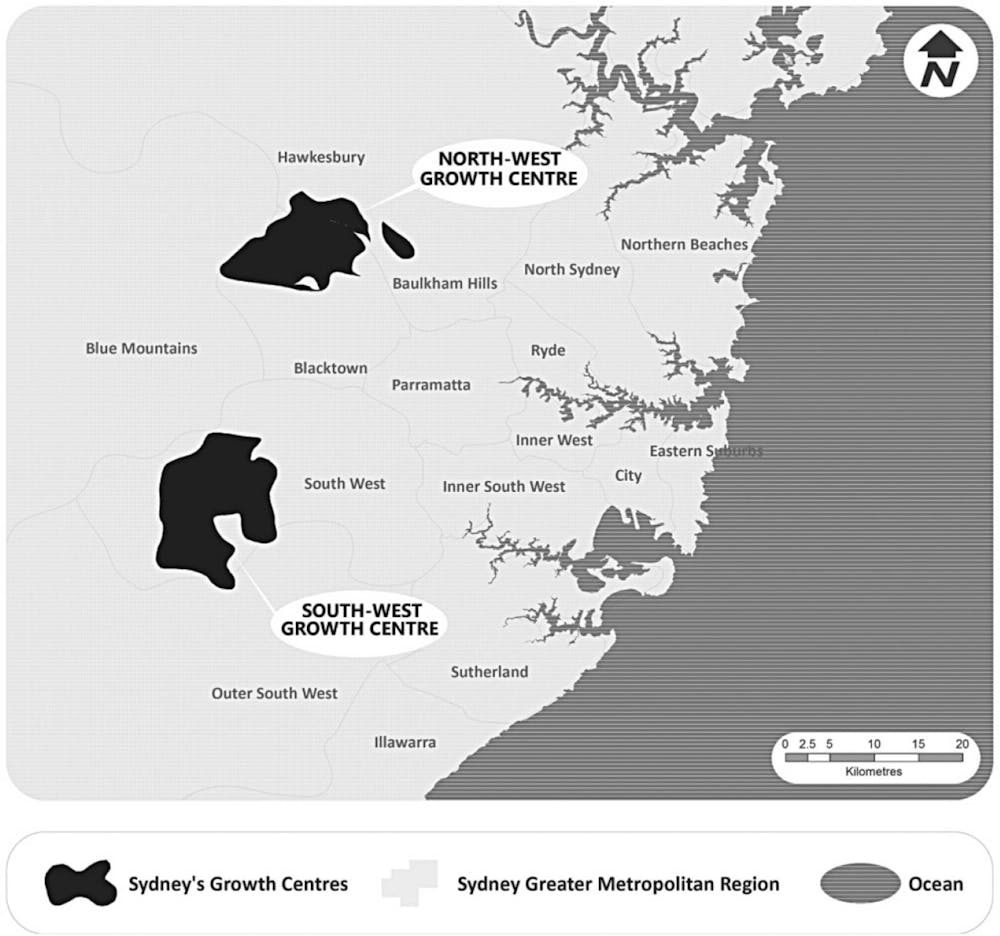 Greater Sydney’s designated growth areas are to the north-west and south-west of the city.
Lawton & Morrison 2022, Land Use Policy, CC BY
Greater Sydney’s designated growth areas are to the north-west and south-west of the city.
Lawton & Morrison 2022, Land Use Policy, CC BY
The Greater Sydney Commission (now the Greater Cities Commission) introduced the concept of Metropolitan Rural Areas (MRAs) to help preserve the remaining peri-urban rural land. The MRA is defined as the land uses outside the established and planned urban areas of Greater Sydney. It broadly comprises rural towns and villages, farmland, floodplains, defence land, national parks and wilderness areas.
Satellite imagery from our research reveals a slow but steady housing sprawl into surrounding rural land. Is the MRA concept too late to stem urban encroachment?
Read more: To protect fresh food supplies, here are the key steps to secure city foodbowls
Why are farmers selling up?
Why is farming land disappearing? Part of the answer lies in the cost-price squeezes farmers face. Costs of farming inputs have risen, while farmgate prices have fallen because of pressure from major retailers and competition.
As the cost of land and farming costs increase, low returns mean many farmers consider selling up to capitalise on land speculation. We estimate price differences between rural and residential land plots of up to 200% in Western Sydney (using the NSW Valuer General online tools).
The potential value uplift is a big incentive for farmers to approach the council and seek land rezoning to convert their rural holdings to more profitable land uses, such as housing and other urban uses. It makes financial sense. Who can blame them?
Read more: Feeding cities in the 21st century: why urban-fringe farming is vital for food resilience
Local food production has been undervalued
Our study suggests some questioning of a pro-urban growth agenda has begun. There is growing recognition of the importance of preserving agricultural and rural land on the outskirts of our major cities to help us withstand and recover from crises.
We are seeing shortages of essential items, supply-chain disruptions and rises in the prices of foods affected by climate-related events. These developments highlight the need to reduce dependence on distant food supplies.
Australian cities must find ways to maximise the sustainable use of available natural resources for more localised food production. We should also consider more carefully the role that farming land plays in other land-use functions, including flood mitigation.
Read more: What's causing Sydney's monster flood crisis – and 3 ways to stop it from happening again
Amy Lawton, consultant in the advisory team at the Institute for Public Policy and Governance at UTS, was a co-author of this article, and of the journal publication while at WESTIR Ltd.
Authors: Nicky Morrison, Professor of Planning and Director of Urban Transformations Research Centre, Western Sydney University


 Daily Bulletin


