

Having ‘good’ posture doesn't prevent back pain, and 'bad' posture doesn't cause it
- Written by: Peter O'Sullivan, Professor of Musculoskeletal Physiotherapy, Curtin University

Back pain is the leading cause of disability worldwide. Most people experience an episode of back pain in their lifetime. It often emerges during adolescence and becomes more common in adults.
For 25% of people who develop back pain, it can become persistent, disabling and distressing. It can affect a person’s ability to participate in activities of daily living, physical activity and work. Activities such as sitting, standing, bending and lifting frequently aggravate back pain.
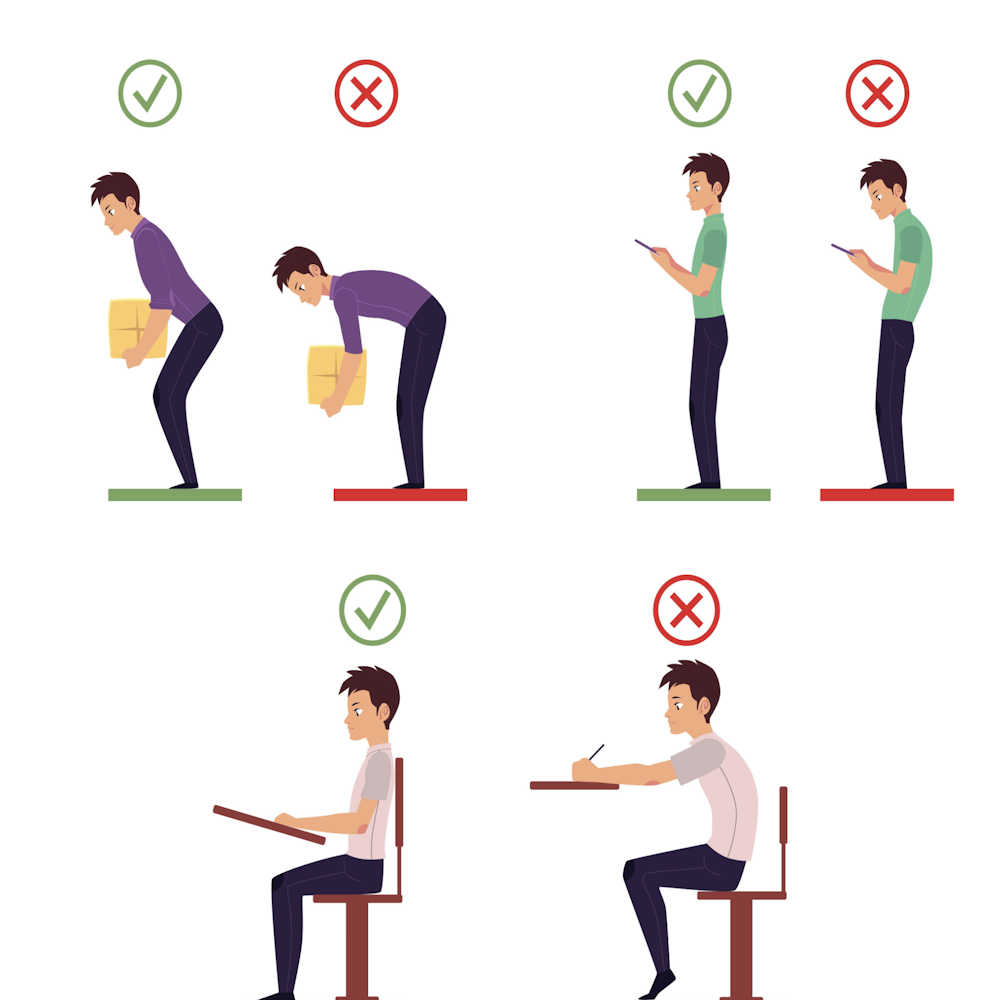
There is a common belief that “good” posture is important to protect the spine from damage, as well as prevent and treat back pain. Good posture is commonly defined as sitting “upright”, standing “tall and aligned”, and lifting with a squat technique and “straight back”.
Conversely, “slump” sitting, “slouch” standing and lifting with a “round back” or stooped posture are frequently warned against. This view is widely held by people with and without back pain, as well as clinicians in both occupational health and primary care settings.
Surprisingly, there is a lack of evidence for a strong relationship between “good” posture and back pain. Perceptions of “good” posture originate from a combination of social desirability and unfounded presumptions.
Systematic reviews (studies looking at a number of studies in one area) have found ergonomic interventions for workers, and advice for manual workers on the best posture for lifting, have not reduced work-related back pain.
Read more: Ouch! The drugs don't work for back pain, but here's what does
Sitting and standing posture
Our group has conducted several studies exploring the relationship between spine posture and back pain. We investigated whether “slump” sitting or “non-neutral” standing postures (overarching or slouching the back, for example), in a large population of adolescents, were associated with, or predicted future back pain. We found little support for this view.
These findings are consistent with systematic reviews that have found no consistent differences in sitting or standing posture between adult populations with and without back pain.
People adopt a range of different spine postures, and no single posture protects a person from back pain. People with both slumped and upright postures can experience back pain.
Lifting posture
Globally accepted occupational health practices about “good” or safe back postures during lifting also lack evidence. Our systematic review found no evidence lifting with a round-back posture is associated with or predictive of back pain.
Our recent lab study found people without back pain, employed in manual work for more than five years, were more likely to lift with a more stooped, round-back posture.
In comparison, manual workers with back pain tended to adopt more of a squat lift with a straighter back.
In other words, people with back pain tend to follow “good” posture advice, but people who don’t lift in the “good” way don’t have more back pain.
In a small study, as people with disabling back pain recovered, they became less protective and generally moved away from the “good” posture advice.
If not posture – what else?
There is no evidence for a single “good posture” to prevent or reduce back pain. People’s spines come in all shapes and sizes, so posture is highly individual. Movement is important for back health, so learning to vary and adopt different postures that are comfortable is likely to be more helpful than rigidly adhering to a specific “good” posture.
While back pain can be intense and distressing, for most people (90%) back pain is not associated with identifiable tissue damage or pathology. Back pain can be like a sprain related to awkward, sudden, heavy or unaccustomed loads on our back, but can also occur like a bad headache where there is no injury.
 There is currently no evidence for a single ‘good posture’ to prevent pain or injury.
Shutterstock
There is currently no evidence for a single ‘good posture’ to prevent pain or injury.
Shutterstock
Importantly, people are more vulnerable to back pain when their health is compromised, such as if someone is:
Back pain is more likely to persist if a person:
Read more: Put down the paracetamol, it's just a placebo for low back pain
What can people do about back pain?
In a small group (1-5%), back pain can be caused by pathology including a fracture, malignancy, infection or nerve compression (the latter is associated with leg pain, and a loss of muscle power and sensation). In these cases, seek medical care.
For most people (90%), back pain is associated with sensitisation of the back structures, but not identifiable tissue damage.
In this situation, too much focus on maintaining “good” posture can be a distraction from other factors known to be important for spine health.
These include:
moving and relaxing your back
engaging in regular physical activity of your preference
building confidence and keeping fit and strong for usual daily tasks
maintaining healthy sleep habits and body weight
caring for your general physical and mental health.
Sometimes this requires some support and coaching with a skilled clinician.
So if you are sitting or standing, find comfortable, relaxed postures and vary them. If you are lifting, the current evidence suggests it’s OK to lift naturally – even with a round back. But make sure you are fit and strong enough for the task, and care for your overall health.
Authors: Peter O'Sullivan, Professor of Musculoskeletal Physiotherapy, Curtin University


 Daily Bulletin


