

The next COVID wave is here. Why for some of us it's OMG and for others it's meh
- Written by: Sophie H Li, Senior Clinical Research Manager and Clinical Psychologist, UNSW Sydney

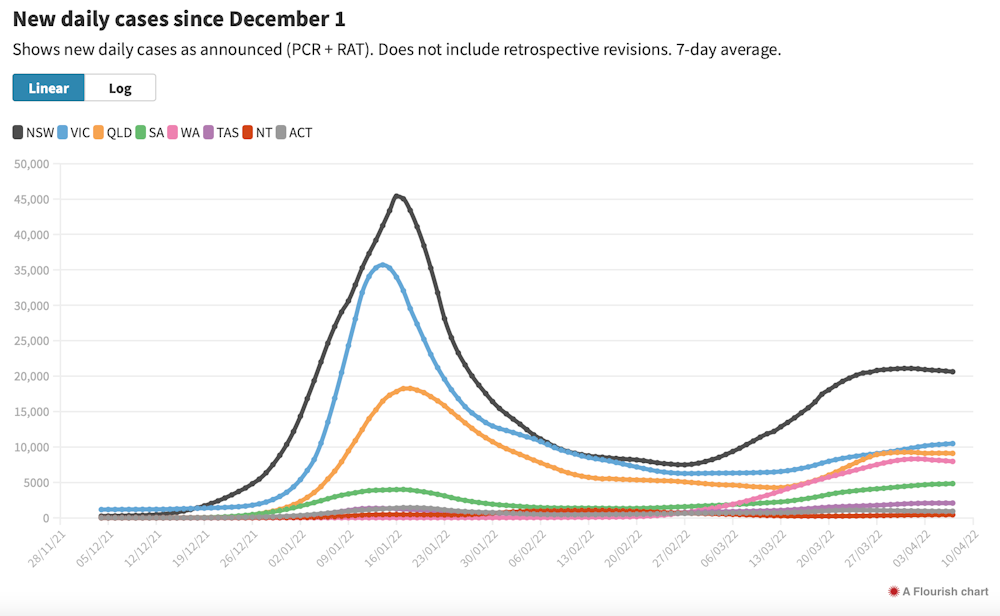
Depending on where you live, you may have been warned to brace for the next COVID wave, driven by the new Omicron subvariant, more of us being out and about, and fewer people wearing masks.
Alternatively, you may be living somewhere already approaching the peak of the wave.
You may have noticed a range of responses. For some people, the prospect of another COVID wave prompts a “meh” and shoulder shrug. For others, it’s an anxious “OMG!”.
Why do people’s responses differ?
Two main reasons why
Two psychological factors influence how people respond to the same situation differently:
how likely you think there’ll be a bad outcome If you think there’s a high chance you’ll contract COVID, you’ll likely be more frightened and actively avoid situations where you think you might catch it
how bad you think the bad outcome will be If you expect huge “costs” from becoming infected – such as becoming so sick you’ll end up in hospital – this can also affect your response. The greater the anticipated cost, the greater the fear and avoidance.
In other words, even though we may face the same situation, people will differ in how they expect things to pan out. In turn, this affects how fearful they are and how they behave.
Read more: COVID cases are rising but we probably won't need more restrictions unless a worse variant hits
From OMG to meh (or the other way around)
More than two years into the pandemic the world is a very different place. We now know more about the virus and its effects. A larger proportion of the community has been infected and recovered. We have high vaccination rates, protecting us from severe illness. The dominant Omicron variant is reportedly less severe than previous variants.
So, for many people, this has resulted in a shift in the anticipated cost of catching COVID. For some, becoming infected with COVID might seem inevitable. However, this prospect is no longer considered bad enough to prevent them from being out and about.
Then there’s the impact of more than two years of expecting to get infected, but not actually contracting COVID. This reduces our expectation of infection, our fear and our avoidance.
For example, loosened restrictions and re-engagement in pre-pandemic activities may have initially been anxiety provoking. But over time, in the absence of catastrophe (such as being hospitalised with COVID), our fears decline.
 You know what? Let’s book a table.
Shutterstock
You know what? Let’s book a table.
Shutterstock
This is called “extinction learning” and is the basis for exposure therapy – the gold standard treatment for anxiety.
However, if someone is unexpectedly hospitalised with COVID, this can increase their belief in the likelihood and cost of contracting COVID. Once recovered, they’re then more likely to be afraid and avoid being exposed to more risk.
COVID also no longer dominates the news cycle. This reduced opportunity to consume threatening COVID information may have also reduced COVID-related fear. However, this may have been superseded by other recent threats in the news – floods and war.
All these factors account for why people’s responses to COVID can change over time. What used to be OMG a few months ago might now be a meh, or vice-versa.
Read more: Feeling socially anxious about returning to the office? You're not alone
Are some people more prone to OMG, then meh?
For some, OMG is an appropriate response, for instance, if they are vulnerable or are protecting a vulnerable person.
An OMG response may also have been appropriate earlier in the pandemic, when we knew so little about the virus and we weren’t certain vaccines would arrive. Avoiding risk made sense when we were unable to accurately determine the likelihood and cost of contracting COVID.
However, at this stage of the pandemic some people may be prone to overestimating the likelihood of contracting COVID and its consequences – independent of both the actual risk and their experience of COVID so far.
 Some people are stuck in a cycle of fear.
Shutterstock
Some people are stuck in a cycle of fear.
Shutterstock
These people are likely to seek out and pay greater attention to negative or threatening information around them. This is a process known as attentional bias and is linked to anxiety.
People with this characteristic are also more likely to avoid situations that provoke anxiety. This prevents opportunities to adjust their expectations about the chance of contracting COVID and the cost.
This creates a perpetual cycle of fear and avoidance that does not dissipate over time.
Read more: How to stop fixating on the daily COVID numbers
Is your response appropriate?
A rational response is one that accurately reflects both the likelihood and the cost of a negative consequence. The threat posed by COVID will vary between individuals. So it is important to accurately assess the threat for you.
If the threat is high, more caution may be warranted to prevent contracting COVID by physically distancing, wearing masks or reducing social contact.
Alternatively, if the threat is low, less caution may be required.
Here are some practical steps to help you accurately determine the likelihood and cost of contracting COVID and align your response accordingly:
assess the evidence. Stay well informed from credible sources about infection rates and rates of serious illness requiring hospitalisation
talk to medical professionals about your personal risks and how to manage them
if your fear of COVID is having a serious negative impact on your life, seek support from a mental health professional. Cognitive behaviour therapy is a psychotherapy that teaches people how to evaluate threat and reduce avoidance. Alternatively, you can access cognitive behaviour therapy at MindSpot or This Way Up.
If this article has raised issues for you, or if you’re concerned about someone you know, contact Lifeline (13 11 14), Beyond Blue or eheadspace.
Authors: Sophie H Li, Senior Clinical Research Manager and Clinical Psychologist, UNSW Sydney


 Daily Bulletin


