

Universities had record job losses, but not as many as feared – and the worst may be over
- Written by: Andrew Norton, Professor in the Practice of Higher Education Policy, Australian National University

Many universities, facing revenue losses due to COVID-19, announced major staff cuts over the past two years.
Estimates of the job losses have ranged from 12,000 by October 2020 to as high as 35,000 in the year to May 2021.
Read more: After 2 years of COVID, how bad has it really been for university finances and staff?
These estimates drew on university announcements and a general ABS labour force survey. I explain the problems with these estimates in more detail here. Ideally, we should use statistics collected on a standard basis from all universities, such as the Department of Education, Skills and Employment’s higher education staff data, which had a long-overdue release this week.
The department’s statistics are best on permanent and fixed-term contract staff. It lets us compare employment levels on March 31 2021 with the same day in 2020. It shows a net loss of 9,050 permanent and fixed-term contract employees, a 6.9% decline.
This is only the third decrease in university staff since 1989. It’s much bigger than the previous largest fall of 1.8% in 1997.
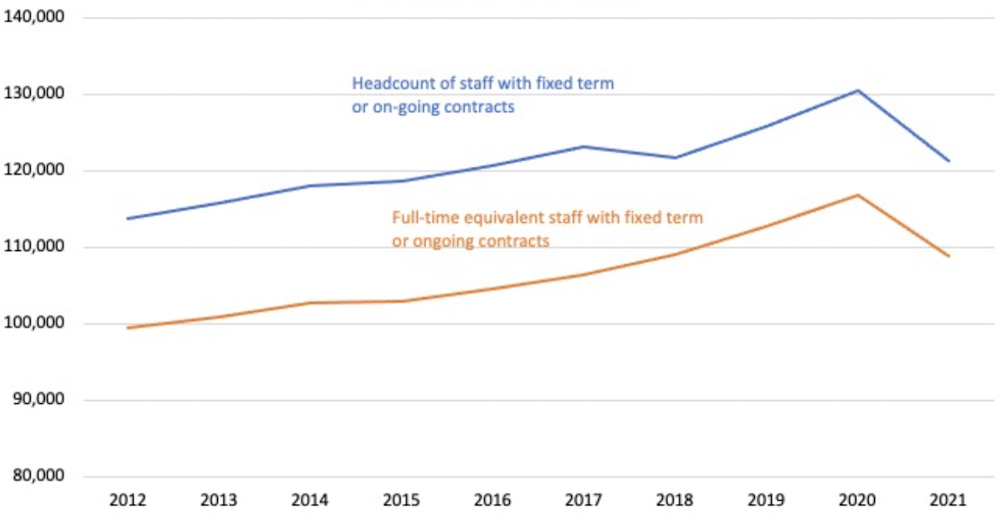
Casuals and non-academic staff bore the brunt of losses
The department’s statistics report casually employed staff on a full-time equivalent basis, with no count of distinct jobs or persons. Casual staff typically work part-time or for limited periods such as semesters. This means it takes several of them to add up to one full-time equivalent, the hours worked by a full-time employee.
For universities needing to save money casuals were an easy option. They are employed on flexible short-term contracts, so universities could act quickly as borders closed to international students in February and March 2020.
Casual job losses are clear in the department’s statistics for 2020 compared to 2019. For other staff the March 31 census date hides retrenchments later in the year, which are only revealed in the 2021 to 2020 comparison.
Casual staff fell by 4,258 full-time equivalents in 2020 compared to 2019, a 17.5% decrease. In data going back to 1991, all previous casual staff decreases have been by less than 1%.
But casual staff losses may be over. In March 2021 universities estimated casual staff numbers, in full-time equivalent terms, would be stable in 2021 at 2020 levels.
Other datasets include more detailed but still imperfect information on casual numbers. Australia’s universities probably had nearly 100,000 casual employees before the pandemic.
Read more: COVID hit casual academics hard. Here are 5 ways to produce a better deal for unis and staff
Significant problems with all potential data sources make confident estimates of how many casual employees lost jobs impossible, but a 15,000–20,000 range seems plausible. Additional statistics due later this year may improve on this estimate.
Non-academic staff accounted for nearly three-quarters of all university permanent or fixed-term contract job losses on a headcount basis between 2020 and 2021. Normally, non-academic employees make up around 57% of university permanent or fixed-term staff.
It was a similar story with casual non-academic staff. They usually make up about 35% of casual full-time equivalents, but accounted for 47% of lost hours.
What types of academics lost their jobs?
Universities tried to protect their core academic activities, but job losses were not spread evenly among all types of academics.
The largest drop in academic employment – down 1,837 positions, or 5.9% – was in combined teaching and research roles. The next largest was teaching-only (-321, -4.8%), then research-only (-254, -1.5%).
While academics with teaching and research contracts still outnumber specialised teaching or research-only staff, they are a threatened species. This employment model was built on a previous funding system that combined government grants for teaching and research. But over the past 30 years policymakers have separated out teaching and research funding, making it much harder to line up teaching and research dollars to pay the salaries of academics who are supposed to do both.
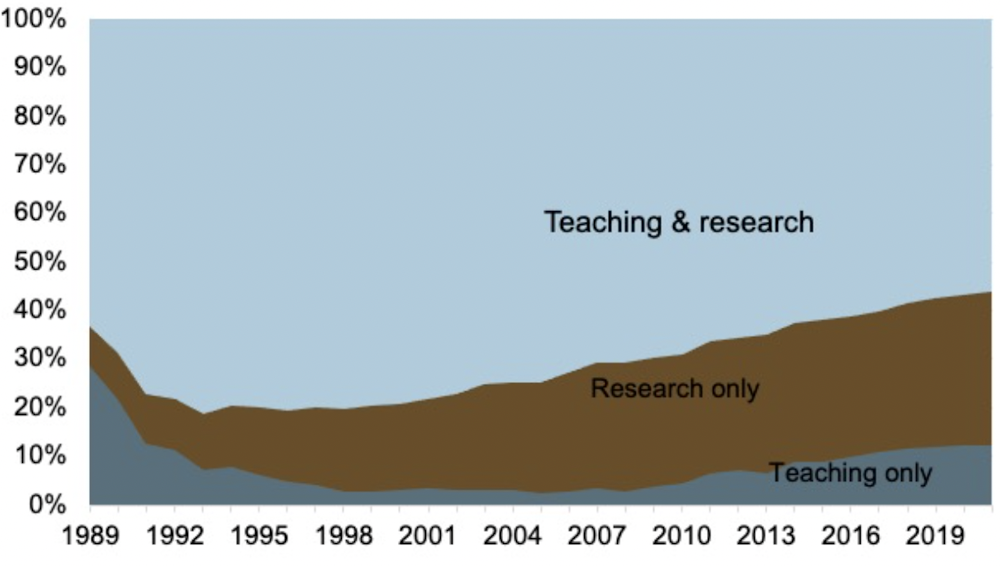 Proportions of academic staff (ongoing or fixed-term contract) by job function. (Note: UNSW excluded 2001-17 due to significant errors in its data submission. Excludes non-academic staff with a research-only function.)
Source: Author provided/ANU. Data: Department of Education, Skills and Employment
Proportions of academic staff (ongoing or fixed-term contract) by job function. (Note: UNSW excluded 2001-17 due to significant errors in its data submission. Excludes non-academic staff with a research-only function.)
Source: Author provided/ANU. Data: Department of Education, Skills and Employment
The trend towards more specialised academic employment was slowed because the high fees paid by international students partially reunited teaching and research income. With that revenue source in decline, teaching-and-research positions became more difficult to sustain.
Read more: Universities lost 6% of their revenue in 2020 — and the next 2 years are looking worse
Research-only academic employment was relatively protected. This might seem surprising given how reliant Australian university research has been on international student profits.
One reason might be that by October 2020 universities knew they were getting an extra $1 billion in Commonwealth government research assistance. With that funding not available for 2022, research-only jobs could be more vulnerable.
Young staff were hit hard
One early fear as COVID-19 struck university income was that this would affect early career staff the most. They are often employed on fixed-term contracts, which make them relatively cheap to retrench. Contractual vulnerability was a factor in who lost jobs, with a 10% decline in staff on fixed-term contracts compared to 5% of those on permanent contracts.
Age data show 20-something university staff suffered heavy job losses. Some older staff were sent off into retirement, with mid-career staff at the lowest risk of job loss.
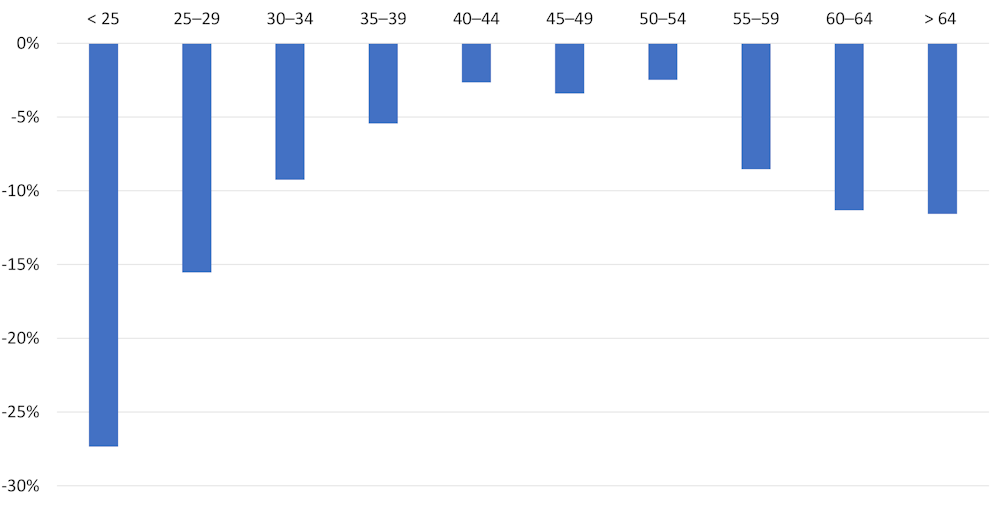 Staff losses by age, showing percentage decrease in each age group in 2021 compared to 2020. (Note: numbers are for permanent and fixed-term staff only. Includes Avondale College/University, Notre Dame, Bond, Torrens.)
Source: Author. Data: Department of Education, Skills and Employment
Staff losses by age, showing percentage decrease in each age group in 2021 compared to 2020. (Note: numbers are for permanent and fixed-term staff only. Includes Avondale College/University, Notre Dame, Bond, Torrens.)
Source: Author. Data: Department of Education, Skills and Employment
Among academic staff, level B (lecturer) academics had the largest reduction in employment (-1,009) and percentage decline (-5.9%) of all academic levels. This is consistent with job losses being greatest for young university staff.
Read more: Hit hard by the pandemic, researchers expect its impacts to linger for years
Job losses varied by university
Job losses varied greatly across the higher education sector. Universities in Victoria and New South Wales were affected the most, reflecting their high international student enrolments.
At the upper end of the range, UNSW, Monash, RMIT and UTS each lost more than 500 staff.
Charles Darwin and Southern Queensland went against the trend and added small numbers of employees.
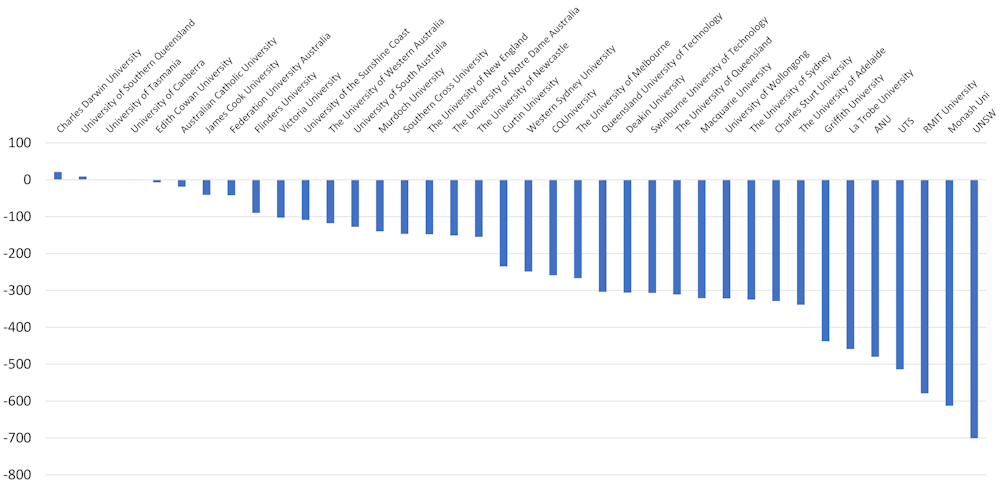 Net job losses or gains by university, 2020 to 2021. (Note: fixed-term and permanent contract staff only.)
Source: Author. Data: Department of Education, Skills and Employment
Net job losses or gains by university, 2020 to 2021. (Note: fixed-term and permanent contract staff only.)
Source: Author. Data: Department of Education, Skills and Employment
When will university employment recover?
The newly released data used above are already nearly a year old. There is some evidence that employment in the second half of 2021 improved on earlier in the year.
An analysis of academic job advertisements found that by June 2021 they were at more than 90% of June 2019 levels, after having crashed during 2020. Australian Taxation Office payroll data show that in tertiary education, which includes vocational as well as higher education, more people were being paid in the last quarter of 2021 than at the same time in 2020.
Commonwealth research funding returning to normal will reduce university income in 2022, but increased revenue from international students will partly offset this loss. International student numbers are slowly recovering after Australia’s borders reopened to them in December 2021, but still have a long way to go to get back to 2019 levels.
The worst is almost certainly over for university staff, but the long COVID of university employment will not clear for some time.
Authors: Andrew Norton, Professor in the Practice of Higher Education Policy, Australian National University


 Daily Bulletin


