

Indonesia will take a big step on the global stage this year – are Australians paying enough attention?
- Written by: Ian Kemish, Former Ambassador and Adjunct Professor, School of Historical and Philosophical Inquiry, The University of Queensland
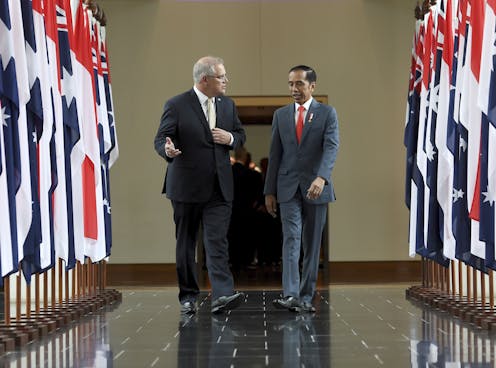
Many Australians are probably unaware that neighbouring Indonesia has assumed the G20 presidency and will host the crucial meeting of the world’s largest economies for the first time in October.
The theme for the summit in Bali will be “Recover Together, Recover Stronger”. We can all hope this will more closely match global realities by then.
Indonesia is well-positioned to ensure the world focuses on the gap in the global pandemic response between developed and lower-income countries, which threatens to prolong the crisis. Its overall growth trajectory has earned it international respect, and it has made solid efforts to combat extremism and maintain a vibrant democracy at home.
Jakarta has also showed diplomatic skill on the international stage, for example, in mustering ASEAN support for the Regional Comprehensive Economic Partnership – a free-trade agreement among more than a dozen countries in the Asia-Pacific region.
And it has carved out a potentially influential role in the region by maintaining constructive relations with both China and the United States.
Public disengagement
But this isn’t the way Australians tend to think about their next-door neighbour. Australians seem little engaged in what is generally considered a very important relationship for the country.
The Lowy Institute’s poll of Australian attitudes to the world reveals limited knowledge about Indonesia’s system of government and national experience. Recent annual surveys indicate only 39% of Australians agree that Indonesia is a democracy, and just 37% believe its government has worked hard to fight terrorism.
Read more: Jokowi’s visit shows the Australia-Indonesia relationship is strong, but faultlines remain
Another sign of this disengagement is the steady decline in Indonesian language enrolments in Australian universities. Only 178 university students were undertaking Indonesian language studies in 2019, down 63% from a peak of 503 in 1992.
Australian businesses also lack interest or capability when it comes to Indonesia. There has been little evidence of change since an Asialink business report in 2017 found 90% of the top Australian public companies were not adequately equipped to do business in Asia.
Australia isn’t front of mind for many Indonesians, either. They are naturally more focused on the pressing challenges and opportunities in the rest of Asia, specifically Southeast Asia and China.
Bipartisan efforts to prioritise the relationship
It wasn’t always like this. Enthusiasm for Bahasa Indonesia grew rapidly in the early 1990s when it became the third-most studied language in Australian schools.
Its rise was spurred by a national languages policy introduced by the Hawke government, which highlighted the importance of Indonesian. The establishment of the New Colombo Plan by Foreign Minister Julie Bishop provided fresh momentum after 2013, supporting significant numbers of Australians to study Indonesian and other regional languages while extending their studies abroad.
Governments can clearly play a role in stimulating public interest.
Successive Australian administrations have certainly prioritised the official relationship between the countries, with both the Keating and Howard governments signing security agreements with Indonesia in 1995 and 2006, respectively.
The Morrison government has joined its predecessors in prioritising Jakarta as a destination for ministerial travel. During a recent visit by Foreign Minister Marise Payne and Defence Minister Peter Dutton to Jakarta last September, the two countries agreed to collaborate more closely on defence training and efforts to combat terrorism and cybercrime.
And a new trade agreement, called the Indonesia-Australia Comprehensive Economic Partnership Agreement, came into force in mid-2020, which built on a range of important economic and security arrangements between the countries.
By reducing barriers to trade, this agreement provides the framework to boost bilateral trading links – if business is willing.
Read more: It's more than a free trade agreement. But what exactly have Australia and Indonesia signed?
Fresh opportunities for trade
Despite these efforts, the two countries are still “strangers next door.” Australians stand to lose most if the two countries remain this way.
Indonesia is projected by some to be the world’s fifth-largest economy by 2030, and fourth-largest soon after that. It is already host to many mega-cities and a thriving digital economy. In fact, a number of tech “unicorn” companies are developing relationships with the largest global tech platforms.
There are other areas of growth potential in the trade relationship, including textiles, fashion, food processing, healthcare services and infrastructure development.
But, overall, bilateral trade remains too skewed towards “traditional” items, such as petroleum, minerals and live animals. The economic relationship is under-performing as a result.
In fact, trade between the two countries has declined to the point where Indonesia is now Australia’s 14th largest trading partner, behind Thailand, Vietnam and Malaysia. This cannot be fully explained by the pandemic’s impact on the tourism and education markets.
Indonesia should be factored into any Australian strategy to diversify its trading links away from China. But Australians will be poorly positioned to take advantage of these opportunities unless something is done to address the lack of knowledge about Indonesia’s language, culture and governance.
Greater public awareness is what’s needed
A truly mature relationship requires high levels of public participation and awareness, and this needs work.
The challenge is for Australians to stay informed about what Indonesia is becoming. This involves understanding the effort it has made to put its security challenges in the past, while also recognising there are some areas where we may differ. The death penalty is an obvious case in point, and a really strong relationship should allow for frank discussion on this and other human rights concerns.
Read more: Indonesians' support for the death penalty declines with more rigorous survey methods
While there’s a lot of ground to make up, there are some positive ingredients to work with. The 2021 Lowy Institute poll indicates Australian trust in Indonesia as a nation has lifted recently, even if Australian knowledge of the country and trust in its leaders remain low.
Science and technology ties remain strong, with some exciting joint research projects by Australian and Indonesian universities underway through the Partnership for Australia-Indonesia Research. And programs such as the Australia-Indonesia Youth Association indicate growing interest by young people in both countries to learn more about each other.
Before the last Australian federal election in 2019, there were calls for any incoming government to stimulate fresh community understanding and awareness of this important relationship. This case remains strong. Indonesia is changing, and Australians need to keep up.
Authors: Ian Kemish, Former Ambassador and Adjunct Professor, School of Historical and Philosophical Inquiry, The University of Queensland


 Daily Bulletin


