

Feeling stressed? It's 'a bit weird', but tapping helps – and it's easy to learn
- Written by: Peta Stapleton, Associate Professor in Psychology, Bond University
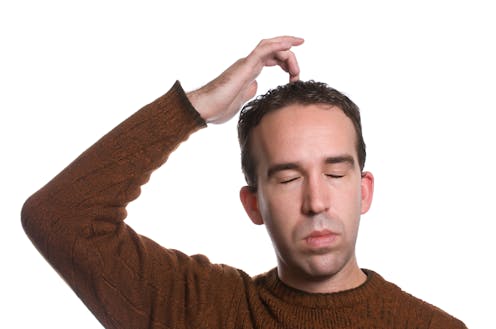
This article is part of a series explaining how readers can learn the skills to take part in activities that academics love doing as part of their work.
Almost two decades ago a colleague in the counselling field spoke of a technique that he said would help reduce stress. As a young academic and only a few years into my clinical career as a psychologist, I was keen to learn approaches that would help relieve stress. However, he added these words: “But it’s a bit weird.”
Those words did prevent me from exploring further for another year and I still did not know what this stress-relief technique was! Fast forward and the same colleague was helping me at a community support group for women with eating issues. During the session a young lady had a panic attack. My colleague took her outside to calm.
They returned within a few minutes and the young woman was indeed calm and composed! I was very surprised. After the session my colleague said: “I showed her the stress-relief technique I have been talking about.”
I proceeded to learn all about the approach known as Emotional Freedom Techniques (EFT) and have researched its use in clinical trials for many years now. It’s commonly called “tapping” because the technique stimulates acupressure points on the face and body with a gentle two-finger tapping process. I have now used tapping myself for more than 15 years.
The author goes through the technique of EFT tapping to reduce stress.What is the evidence for tapping?
The evidence for this simple approach to stress reduction has been growing exponentially. Research now shows tapping is beneficial for food cravings, depression, anxiety, phobias and post-traumatic stress disorder.
What is even more interesting is that tapping affects the body’s biochemistry such as immunity and blood pressure. Just one hour of tapping decreases the stress hormone cortisol by 43%.
Better still, follow-up studies show the benefits of tapping last over time, even up to two years later.
It’s suggested tapping affects the stress centre in the brain (the amygdala) and the memory centre (the hippocampus). Both play a role in the decision-making process when someone decides if something is a threat.
Research has now examined primary school children who have used tapping in schools and found it helps with their focus and concentration. I was very interested in anything that would help my children at school and taught them tapping too.
So how can you get started?
Usually tapping is done when you have a feeling you would like to reduce. If you feel stressed, this would be a perfect time to start tapping. There are five steps:
Step 1. Rate your level of stress out of ten, where ten is the highest level and zero would represent complete calm. You can guess this number as it is just a way of you rating your feeling.
Step 2. We encourage people to state their feeling out loud in order to engage with it and pay attention to how you feel. Typically, you would say: “Even though I feel really stressed at the moment because of ______, I accept this is how I feel.”
It is important to be specific about why you feel stressed and think about that as you do the tapping process. As you say this statement out loud, tap on the point at the side of the hand, as shown below. Saying your problem out loud will not reinforce it; you are actually being honest with yourself in this moment and acknowledging how you feel.
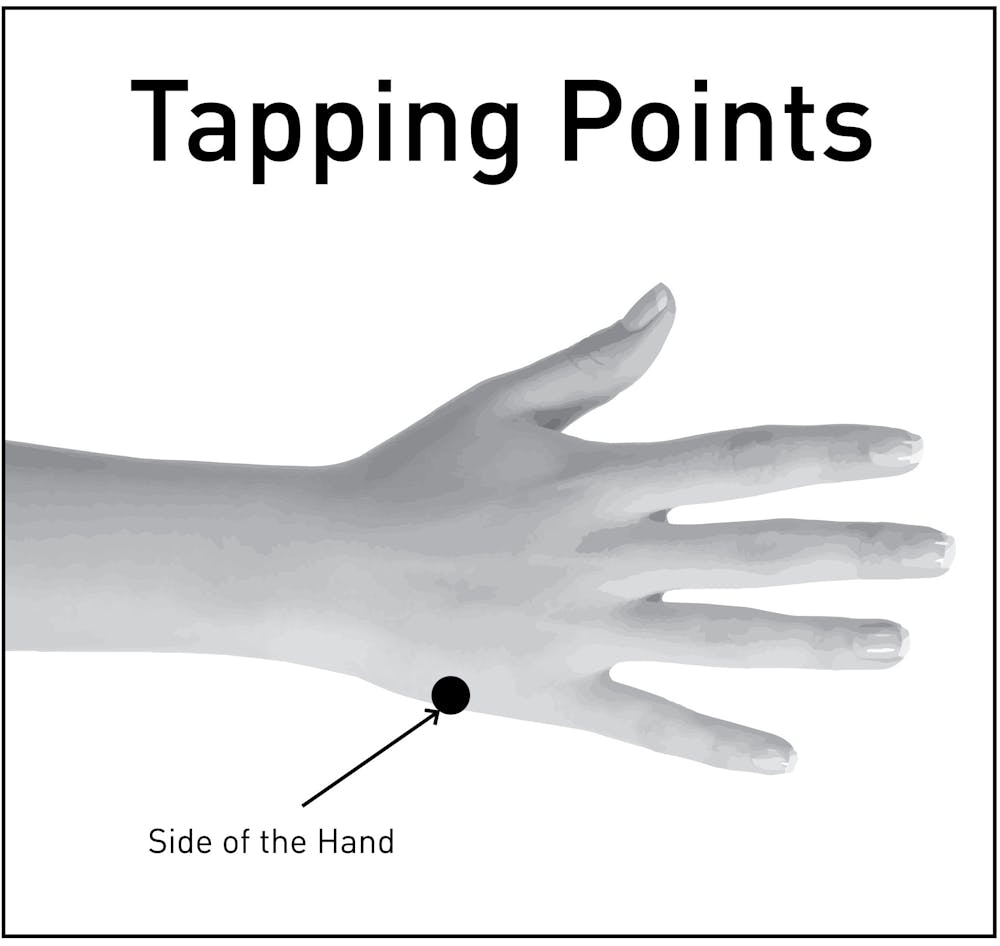
 Author provided (no reuse)
Step 4. When you finish tapping on the last acupoint (top of the head), pause and take a breath. Re-rate your level of stress after that single round.
Step 5. If your rating out of ten is still high, continue tapping as many rounds as you want until it feels lower in number, or you notice a shift. If you were to think of other feelings as you are tapping, you can change the words. For example, you might start tapping on feeling stressed about a work task, but after a few rounds you notice you really feel overwhelmed and wishing you had support. You can change the words to reflect this and say “I feel overwhelmed” instead.
The underlying mechanism is that the tapping at these acupoints sends activating or deactivating signals to brain areas that have been aroused by the phrases. Tapping generates these electrical signals via the principle of “mechanosensory transduction”.
As a brief intervention that can be self-applied, tapping is now backed by more than 100 randomised clinical trials (the most accepted form of research). It appears highly effective and rapid compared to conventional treatments.
So, while it may look a little strange, tapping is equivalent or comparable to gold-standard approaches such as Cognitive Behavioural Therapy (CBT). It’s worth trying next time you feel stressed!
You can read other articles in this series here.
Authors: Peta Stapleton, Associate Professor in Psychology, Bond University
Author provided (no reuse)
Step 4. When you finish tapping on the last acupoint (top of the head), pause and take a breath. Re-rate your level of stress after that single round.
Step 5. If your rating out of ten is still high, continue tapping as many rounds as you want until it feels lower in number, or you notice a shift. If you were to think of other feelings as you are tapping, you can change the words. For example, you might start tapping on feeling stressed about a work task, but after a few rounds you notice you really feel overwhelmed and wishing you had support. You can change the words to reflect this and say “I feel overwhelmed” instead.
The underlying mechanism is that the tapping at these acupoints sends activating or deactivating signals to brain areas that have been aroused by the phrases. Tapping generates these electrical signals via the principle of “mechanosensory transduction”.
As a brief intervention that can be self-applied, tapping is now backed by more than 100 randomised clinical trials (the most accepted form of research). It appears highly effective and rapid compared to conventional treatments.
So, while it may look a little strange, tapping is equivalent or comparable to gold-standard approaches such as Cognitive Behavioural Therapy (CBT). It’s worth trying next time you feel stressed!
You can read other articles in this series here.
Authors: Peta Stapleton, Associate Professor in Psychology, Bond University


 Daily Bulletin


