

Tourism operators are reeling from lockdowns, but the barriers to a full post-COVID recovery go far deeper
- Written by: Gabrielle Lindsay-Smith, Research Fellow, Victoria University
With much of Australia in and out of lockdowns over the past month, tourism operators are reeling.
The current lockdown in Sydney has been disastrous for operators during what is normally one of the busiest times of the year — school holidays. Tourism and hospitality-related business are eligible for government grants up to $10,000, but for some, this still may not be enough.
The same goes for tourism operators along the Western Australia coast, due to the snap lockdown in the Perth and Peel regions. Said one lodge owner in the resort town of Kalbarri:
The lockdown for Perth will, I won’t say kill us, but it will hurt us really bad.
When Victoria was plunged back into lockdown over a month ago, it threatened to derail the entire ski season.
Almost half of the businesses surveyed by the Victoria Tourism Industry Council (VTIC) estimated they would lose more than $1,000 in spoiled food and other expenses during a seven-day lockdown, while 45% estimated revenue losses of more than $5,000.
A real concern was that 20% would lose more than $50,000.
Even after the lockdown was lifted, restrictions remained. Melbourne residents are mandated to have a COVID test within 72 hours of leaving the city and show the negative result on entry to the ski fields.
As a result of all of these stop-and-start lockdowns and ongoing restrictions, traveller confidence has declined and many people are no longer booking in advance, affecting cash flow. Many business owners are at an emotional and financial breaking point. As one Victoria business told VTIC:
…this will be the financial end of us. We have fought so hard, pivoted, and haven’t had a day off in 12 months, no staff to allow us to, and now this. All losses are self-funded again, but this time it is worse as we have no JobKeeper. We won’t open. We can’t. We’re tired. We’re over it.
Staff shortages, skyrocketing insurance and mental anguish
Our research on the second Victoria lockdown in 2020 found that a one-size-fits-all approach to restrictions, recovery, and support does not work for the industry. One business told us,
compensation needs to be proportional to business losses. A one-size-fits-all compensation approach is not effective.
For example, businesses that rely on international and local business travellers in Melbourne and Sydney have been hit far harder than the sectors of the industry, such as caravan parks, that are bouncing back well with domestic tourism. Tourism and hospitality businesses in our CBDs need real support.
And despite government efforts to incentivise people to return to tourist areas — such as Victoria’s $32.2 million tourism support package — our research shows there are deeper underlying issues preventing a full recovery for tourism operators.
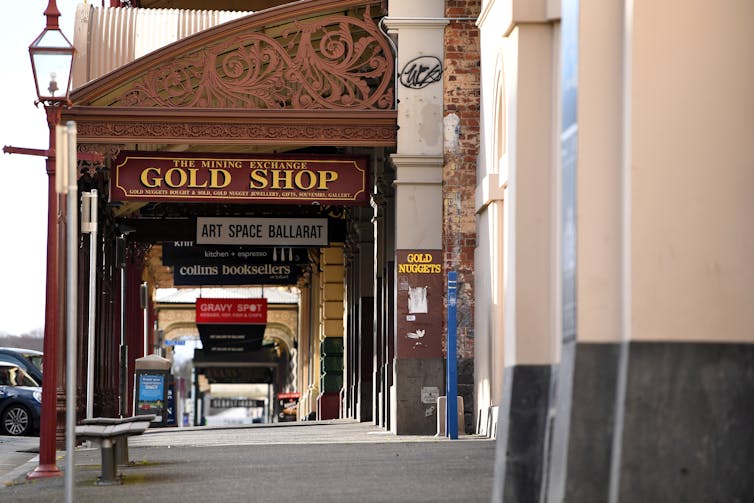 Regional Victorian tourist towns like Ballarat were hit hard during the 2020 Victoria lockdown.
James Ross/AAP
Regional Victorian tourist towns like Ballarat were hit hard during the 2020 Victoria lockdown.
James Ross/AAP
According to our research, these issues in Victoria include:
severe staff shortages, due to a lack of affordable housing in tourist destinations, the absence of international temporary workers and a loss of approximately 54% of casual staff during the pandemic. Many former employees have found work in other, more stable industries
Job Keeper was considered a “lifesaver” by 91% of businesses we surveyed, but replacement support options in successive lockdowns have not been accessible
unaffordable business insurance, with some premiums rising by up to 400% following the bushfires
the impact of the long-term strain on people, with 45% of tourism business owners and managers telling us they were suffering mental health concerns. Many were also unlikely or unable to reach out for help.
Not just a Victorian problem
The staff and accommodation shortages are more severe in Victoria, but are also being felt nationwide.
In the last month, staffing shortages have been emphasised in Tasmania, Queensland and New South Wales, primarily because of the lack of backpackers and international students.
The lack of affordable accommodation options for tourism staff, who are typically casual and low-paid, is also an ongoing issue across Australia, especially in places like Byron Bay.
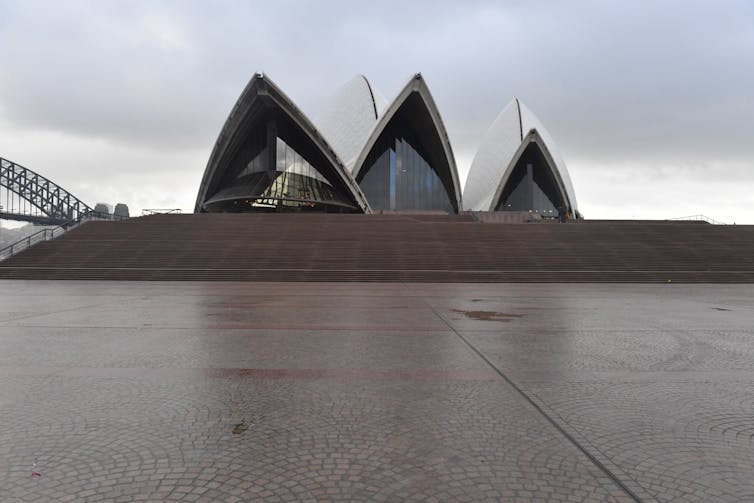 An empty Sydney Opera House during the current lockdown.
Mick Tsikas/AAP
An empty Sydney Opera House during the current lockdown.
Mick Tsikas/AAP
What can get the industry back on track?
There is more that can be done to improve the outlook and resilience of the tourism industry, which adds $60.8 billion to Australia’s GDP every year and supports 5% of Australia’s total workforce.
Our recommendations to governments are to address both the short- and long-term issues arising from the pandemic.
For example, the problem of skyrocketing business insurance is a matter of urgency. This is a case of market failure — if the private insurance sector cannot offer a product that is affordable, regulatory measures must be introduced.
Other short-term measures are necessary, such as wage subsidies for tourism operators to retain their staff, as well as grants for business innovation and growth. And as regional housing prices escalate, social housing or subsidised accommodations for tourism workers are becoming increasingly important.
The longer-term problems resulting from the pandemic require a more thoughtful, strategic approach in order to reduce the burden being felt by the industry.
To start, this means much better engagement and communication between governments and tourism operators so they fully understand the effects health regulations will have on their businesses and can plan accordingly. Recent bushfires have shown how effectively emergency services can work directly with communities. Similar models could be replicated in the tourism industry.
A comprehensive and nationally relevant workforce review is also needed to examine how the industry can attract workers into the future.
Read more: Tourism desperately wants a return to the 'old normal' but that would be a disaster
Most of all, there is a need to focus on developing resilience to all forms of crises, as highlighted by the recent Gippsland floods.
Our research shows that to build industry resilience, we need stronger risk management planning and leadership for both businesses and destinations. Promoting such planning, along with being accredited by industry bodies like VTIC, can lead to greater resilience to crises and speedier economic recovery.
Regional risk management also needs to be a part of strong regional tourism plans that are coordinated across local governments, regions and state borders.
Australia’s visitor economy is too important for economic recovery, job creation and the health of our communities to let it flounder as it has been over the last 18 months. If we, as a community, are going to reap the social and economic benefits of tourism again when we do open the borders, the industry needs support.Long-term development strategies are necessary to not just recover but to build resilience to the inevitable future shocks we are yet to face.
Authors: Gabrielle Lindsay-Smith, Research Fellow, Victoria University


 Daily Bulletin


