

Comprehensive Indigenous health care in prisons requires federal funding of community-controlled services
- Written by: Megan Williams, Associate Professor, University of Sydney
The Royal Commission into Aboriginal Deaths in Custody Report made over 200 directives about improving the health of people in prisons in its 339 recommendations in 1991. One of these recommendations included additional funding to provide better health services for Aboriginal and Torres Strait Islander people in prison.
Aboriginal and Torres Strait Islander people are over-represented in prisons. They are 15.6 times more likely to be incarcerated than non-Indigenous Australians.
Yet, there are virtually no staff skilled in engaging with cultural protocols in health services in prisons. And current policies and procedures do little to extend cultural care to families when the death of an Aboriginal or Torres Strait Islander person in prison has occurred.
The royal commission and the United Nations recommend people in prisons have access to health care equivalent to what is available in the community. However, the system is still strained, as the multiple deaths of Aboriginal people in custody in recent months, inquests revealing gaps in health care, and a health report tabled to NSW Parliament make clear.
A critique of the royal commission’s implementation of recommendations also highlights several areas for urgent attention.
National frameworks silent on prisoner health
The restructure of prisoner health care from state correctional services to state health departments in the last two decades in most Australian jurisdictions has been touted as one positive reform after the royal commission.
But it failed to recognise that state health departments make miniscule allocations to health care for Aboriginal and Torres Strait Islander people – the commonwealth largely has responsibility for this.
And because prisons fall under state and territory responsibility, prison health is also rarely mentioned in national frameworks. The National Strategic Framework for Chronic Conditions makes no mention of prisons, despite people in prison disproportionately experiencing chronic conditions.
The National Aboriginal and Torres Strait Islander Health Plan acknowledges the over-representation of Aboriginal and Torres Strait Islander people in prison and their greater risk of suicide and drug overdose after being released, but it offers no leadership on state and territory action.
The recent inclusion of a justice target in the Closing the Gap framework is likewise not focused on improving health services in prisons. It only aims to reduce Indigenous adult prison numbers by 15% and youth detention by 30%.
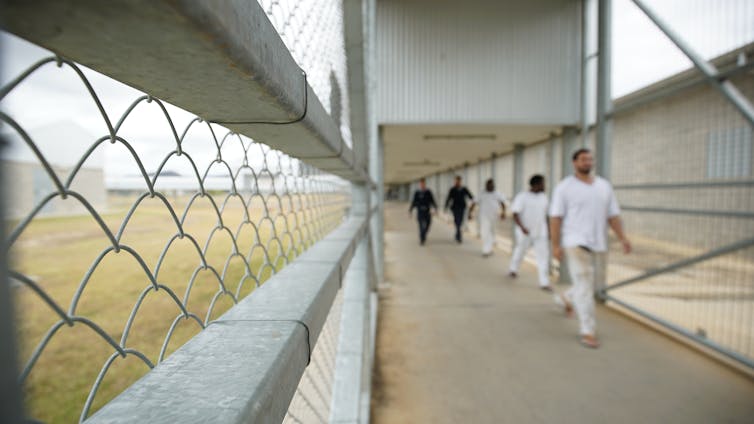 Most policies and procedures do little to extend cultural care to families when the death of a family member in prison has occurred.
AAP
Most policies and procedures do little to extend cultural care to families when the death of a family member in prison has occurred.
AAP
Currently, over 140 Aboriginal and Torres Strait Islander community-controlled health organisations operate across Australia, with membership to the National Aboriginal Community Controlled Health Organisation.
Data indicate Aboriginal and Torres Strait Islander people have low levels of access to mainstream government services compared to community-controlled health services. These health services are also allocated disproportionately less funding than mainstream services.
And since the royal commission, there have been few funding schemes to support these health services to work in or with prisons.
Read more: The families of Indigenous people who die in custody need a say in what happens next
Indigenous health care barriers in prisons
There are other barriers to Aboriginal and Torres Strait Islander people receiving adequate health care in prison settings.
Prison health organisations rarely meet Aboriginal and Torres Strait Islander staff targets, or retain them in leadership roles. Members of the prison workforce have often acknowledged they “need cultural competence training”.
It is little wonder Aboriginal and Torres Strait Islander people report frequent experiences of racism in mainstream services.
Aboriginal and Torres Strait Islander health services also rely on fee-for-service income via payments from Medicare. But prisoners do not have access to Medicare.
As Professor Peter O’Mara, the chair of the Royal Australasian College of General Practitioners Aboriginal and Torres Strait Islander Health Council, explains,
If you’re a prisoner, you lose your right to Medicare. That means if an Aboriginal health service wants to provide support, they can’t bill Medicare.
This essentially locks Aboriginal and Torres Strait Islander community-controlled health services out of delivering health care in prisons. A change has repeatedly been sought, but has not occurred.
In addition, prisons face new challenges due to Australia’s ageing prisoner population. Research highlights a long-term shortage of mental health clinicians in prisons. Palliative care specialists and nurses with palliative care training are almost entirely missing.
Aboriginal community-controlled organisations in prisons
Reducing the over-representation of Aboriginal and Torres Strait Islander people in prisons is one part of addressing health inequity.
Another is improving people’s overall health and wellbeing in the community, which could potentially reduce their contact with the criminal justice system. Recommendation 188 of the royal commission said the self-determination of Aboriginal and Torres Strait Islander people is key to this.
The royal commission also outlined how Aboriginal health services could deliver self-determined improvements in prison health services.
It recommended governments invite Aboriginal health services to deliver care in areas where they already operate, or where Indigenous people are particularly over-represented in the prison population. That hasn’t happened.
The royal commission also recommended Aboriginal health services be included in health planning decisions, including:
recommendations 127 and 252: examining delivery of medical services to people in police custody and hospitals
recommendation 152: assisting with reviews and guiding prison health standards, including on cultural matters
recommendations 154 and 133: training prison health staff and police
recommendation 265: integrating Aboriginal health care with mental health and psychiatry
recommendation 283: operating early intervention programs to reduce the numbers of Indigenous people incarcerated
 The National Strategic Framework for Chronic Conditions makes no mention of prisons, despite people in prison disproportionately experiencing chronic conditions.
nguy n hi p ufwC cmbaaI unsplash, CC BY
The National Strategic Framework for Chronic Conditions makes no mention of prisons, despite people in prison disproportionately experiencing chronic conditions.
nguy n hi p ufwC cmbaaI unsplash, CC BY
Prisons need culturally safe care
I’ve come to know an Aboriginal family whose loved one was diagnosed with a terminal illness in prison. The process for his release was under way, but there were gaps in communications and decisions between prison officials and his family.
He was so immobile and frail it was hard to believe he was still ultimately seen as a threat to community safety. He died alone in prison, despite his family having community-based end-of-life care arrangements approved on the traditional Country of his ancestors, according to their protocols.
His case notes were minimal, and there was no evidence of cultural care. The autopsy report still causes major confusion and trauma for his family, and they have had no support.
The family has lost all trust for governments, who they believe betrayed their own policies about culturally safe care.
This case illustrates why Aboriginal people with health issues should be diverted from police custody into health services where possible. This is vital because so many deaths in custody have been as a result of preventable health issues.
A nationally coordinated scheme is also required that funds prisons to work with Aboriginal and Torres Strait Islander community-controlled health services. These services could also provide relevant data in health planning for prisons.
The federal government must lead change; it is not interference in state and territory criminal justice systems when the focus is on Aboriginal and Torres Strait Islander people’s health and wellbeing.
Authors: Megan Williams, Associate Professor, University of Sydney


 Daily Bulletin


