

Men are from Mars, women are from... Mars? How people choose partners is surprisingly similar (but depends on age)
- Written by: Stephen Whyte, Deputy Director, Centre for Behavioural Economics, Society and Technology, Queensland University of Technology
As behavioural scientists, we have a keen interest in how people make decisions, and particularly how these decisions incorporate a range of emotional, cognitive and psychological factors.
Choosing a life partner is arguably one of the most important decisions a person can make. And research has shown the most common way to do this these days is to go online.
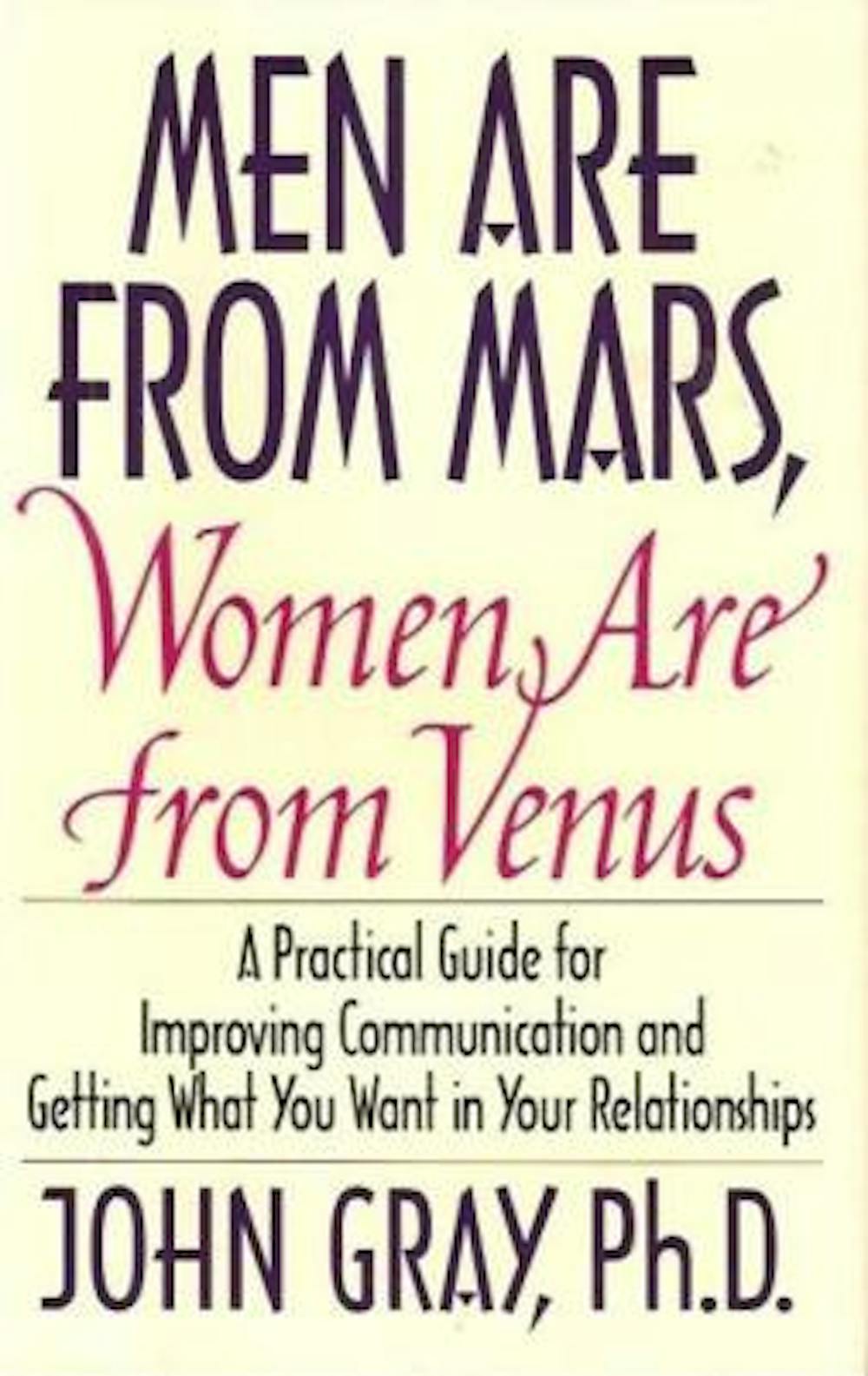 John Gray’s famous 1992 book purports that men and women have innately different natures.
Wiki
John Gray’s famous 1992 book purports that men and women have innately different natures.
Wiki
As increasing numbers of people wade cautiously through the digital dating market, many still subscribe to stereotypical ideas about what men and women find attractive in a partner.
Our latest research, published today in PLOS One shows the truth, as ever, is more nuanced.
Using survey data from 7,325 heterosexual users of dating websites, aged 18 to 65, we show there is no absolute difference between the preferences of men and women when it comes to choosing a mate. Both essentially desire the same qualities, but prioritise them slightly differently.
The democratisation of dating?
Dating in the 21st century is a truly unique experience. For millennia, the human search for companionship had been constrained by access, distance and resources. Most people had to find a partner through close or extended family, or religious, cultural or social organisations.
Today, online dating allows seemingly unrestrained and “nonsequential” decision-making.
Imagine if you met someone at a bar and told them to wait around for two hours, just in case you managed to find someone better. It sounds bizarre, but that’s what online dating allows. You can search through thousands of people and never have to make a decision.
This is good news for researchers of human behaviour. With such a vast and growing pool of data, we can study mating choices in a way we never could before.
Pressure to play the evolutionary game
Obviously, a huge part of sexual attraction comes down to personal preference regarding what makes someone “sexy”. That said, there are many stereotypes relating to what heterosexual men and women find sexy.
It’s often assumed women favour more emotional, personality, intelligence and commitment-based traits in men, while men are often said to prefer physical attractiveness.
From an evolutionary psychology angle, these stereotypes aren’t unfounded. In the game of life, the main aim is to pass on your genes — and once you do, to ensure your offspring achieve the same success.
Naturally, men and women play different roles in the reproduction process. From an evolutionary standpoint, it makes sense for women to seek a man with traits that will benefit her offspring in both the short and long term, as women bear a bigger reproductive cost than men.
They have internal gestation for nine months and then must successfully give birth, all while facing discomfort and risk. They will then continue to nurse and care for the child.
 Throughout the evolution of our species, mothers on average have had a far greater parenting responsibility across their offspring’s lives.
Shutterstock
Throughout the evolution of our species, mothers on average have had a far greater parenting responsibility across their offspring’s lives.
Shutterstock
Men, at its simplest, need only to invest time into copulation to have offspring. Theoretically, then, the specific selection pressures on men and women to pass on their genes should be observable in the characteristics of the mates they choose.
Many of these assumptions fall under a school of thought called “parental investment theory”, developed in the early 1970s by evolutionary biologist Robert Trivers.
More recent theories in gender studies and social and evolutionary psychology have countered the notion of absolute differences. They demonstrate men and women are far more similar in their preferences than previously thought.
Our research reinforces one such theory, referred to as “mutual mate choice”. We found both men and women essentially desire the same qualities in a partner, differing only in the relative emphasis placed on each trait at different life stages.
If men are from Mars, women are too
We asked survey participants to rate from 0 to 100 the importance they placed on nine traits when looking for a mate. They fell into three categories:
- aesthetics, such as age, attractiveness and physical features
- resources, such as intelligence, education and income
- and personality, such as trust, openness and emotional connection.
Both genders rated aesthetics as highly important, along with all three personality traits, while income was much less important.
Women, however, rated factors including age, education, intelligence, income, trust and emotional connection about 9 to 14 points higher than men. Men placed relatively more emphasis on attractiveness and physical build.
Importantly, the way both genders prioritised traits changed with age. Both cared less about physical attractiveness as they got older, whereas emphasis on personality increased. This makes sense, considering we require different things from a partner at different life stages.
Our findings reinforce that both men and women tend to give similar emphasis to certain traits, depending on their individual needs at a particular stage in life.
 On dating apps, users can at times be spoilt for choice. This may result in us not placing as much emphasis on the actual search for a partner that older generations historically did.
Shutterstock
On dating apps, users can at times be spoilt for choice. This may result in us not placing as much emphasis on the actual search for a partner that older generations historically did.
Shutterstock
Men and women can both be very picky
One interesting revelation came when we grouped participants’ preference data together.
Of those individuals who said one specific trait was very important to them, it turned out the majority of traits were very important to them. On the other hand were respondents who said they didn’t have a strong preference for any particular trait at all.
So while some people were happy to go with the flow, many of the participants actually cared a lot about a lot of different factors. For men, the likelihood of having such stringent preferences was most common between ages 20 and 40. Among women it was more likely between the ages of 35 and 50.
Personal circumstance and preference is key
The bottom line is there is no single unified theory of mate choice. Attractiveness matters to everyone to some extent. Resources and intelligence matter to everyone to some extent.
Beyond human biology and evolution, it’s likely our individual personal constraints — such as employment, education, family and social circle — still have a huge impact on how we choose a mate, even if we are dating online.
While dating apps and websites may come with an element of “cognitive overload”, they are ultimately just conduits for human communication. They let people search far and wide for a mate who will help them achieve their own relationship goals.
And our relationship goals, just as is the case with the importance we place on our preferences, change over time.
Authors: Stephen Whyte, Deputy Director, Centre for Behavioural Economics, Society and Technology, Queensland University of Technology
&media=https://dailybulletin.com.au/https://images.theconversation.com/files/401526/original/file-20210519-21-kk0ghq.jpg?ixlib=rb-1.1.0&q=45&auto=format&w=237&fit=clip&description=Men%20are%20from%20Mars,%20women%20are%20from...%20Mars?%20How%20people%20choose%20partners%20is%20surprisingly%20similar%20(but%20depends%20on%20age) "Pin It")

 Daily Bulletin


