

Managing retreat: why New Zealand is drafting a new law to enable communities to move away from climate risks
- Written by: Catherine Iorns, Professor of Law, Te Herenga Waka — Victoria University of Wellington
The government’s recently announced overhaul of major environmental legislation will result in a new law focused solely on climate change adaptation.
The 30-year-old Resource Management Act (RMA) was groundbreaking when it was passed in 1991 — the first in the world to be based on the concept of sustainable management. But it has been subject to many criticisms, and amendments, from all angles.
On one hand, it hasn’t protected the environment enough, allowing the degradation of waterways and loss of indigenous biodiversity. On the other hand, its procedures are slow and cumbersome, making development difficult. It has also been partly blamed for the current housing shortage in New Zealand.
In this documentary, directed by Magnolia Lowe, the author covers legal issues around water, from climate change to pollution.An extensive independent review of the legislation recommended replacing the RMA with three separate pieces of new legislation, with one focused on climate adaptation.
Perhaps most significantly, the review recommended a new government fund to pay for managed retreat, to better ensure change happens fairly and consistently across the whole of Aotearoa New Zealand.
Sued if you do and sued if you don’t
Current laws in both Australia and New Zealand are hindering adaptation to the effects of climate change.
The Australian Productivity Commission found as far back as 2012 that the law was a barrier to effective climate change adaptation. Significantly, local governments are responsible for adaptation measures, but their precise abilities and responsibilities are not clear enough.
Therefore, they face a “liability dilemma” where they are sued if they take action and sued if they don’t. The fear of being sued has stopped them from taking action and, for some local councils, concern about liability has been described as the single most important issue to resolve.
Read more: When climate change and other emergencies threaten where we live, how will we manage our retreat?
Research in New Zealand has found the same thing: New Zealand’s local authorities have been sued when they take action to adapt to climate change, and sued when they haven’t acted boldly enough. Fear of liability has also prevented New Zealand’s local government from taking measures they know are necessary.
Coastal hazard adaptation guidelines issued by the Ministry for the Environment have helped but are not enough.
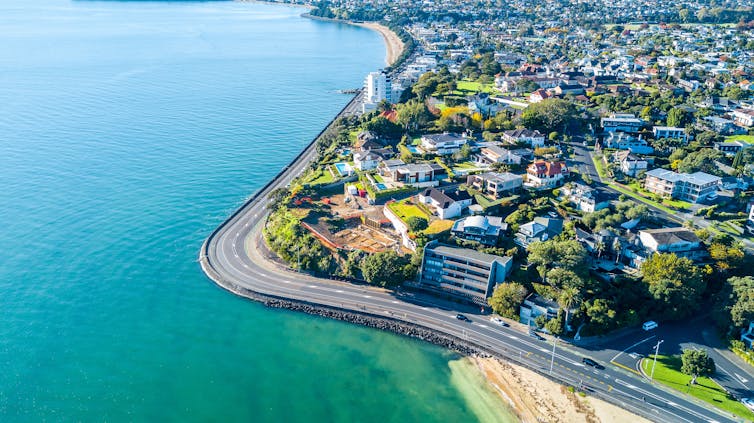 The devolution of climate change measures to local government has inhibited national strategic land use planning.
Shutterstock/Krug
The devolution of climate change measures to local government has inhibited national strategic land use planning.
Shutterstock/Krug
Barriers and gaps to effective adaptation
It isn’t just fear of liability, there are many legal barriers that leave local authorities unsure of what they can or cannot do. In some cases, they are legally prevented from doing what they need to do.
In 2019, an extensive New Zealand study identified numerous barriers and gaps in the law and recommended many changes to the relevant legislation, mostly the RMA.
The RMA includes several barriers to adaptation generally as well as managed retreat in particular. For example, it is not always clear who is responsible for taking particular climate adaptation measures — whether that involves building hard seawalls, imposing conditions on building permits to ensure future resilience, or simply revising where housing and other structures may be built in the face of increasing risks from sea level rise.
Even where the responsibility is clear, the extent of the powers may be unclear, or the most appropriate measure may not be defined or leave too much flexibility about what needs to be done.
There are also strong barriers to adaptation measures that involve interference with existing, permitted land uses. In some cases it does not appear possible to force landowners to move to retreat from the coast in the face of rising sea levels. If they do move, it’s unclear if they are entitled to compensation, and if so, who should pay.
Other research focused solely on managing existing uses (particularly retreat) has also found the law needs to change if we are to enable government to take the measures necessary for communities to adapt to climate change.
The law also needs to change if we are to do this fairly and with dignity, and without transferring the risks and burdens to the most vulnerable.
Law reform
The RMA is a huge statute of 836 pages. It governs most uses of land, natural resources and the coastal marine area in New Zealand. It provides for national policies and standards, as well as regional and local ones.
But the devolution to local government has inhibited national strategic planning for land uses. For example, cities have sacrificed the best food-producing land for housing on urban fringes. Importantly, the RMA has not provided for the growing risks of climate change.
The RMA reform panel made several recommendations to fix barriers to climate adaptation, including:
Mandatory national direction on climate adaptation measures
spatial plans including provision for adaptation
funding to enable managed retreat
flexible planning regimes
and the power to modify existing land uses and permits.
There is not enough detail yet to assess how this will be achieved. The Ministry for the Environment is currently figuring out precisely how these new statutes should be drafted.
But this could be another world first: laws to provide for climate adaptation, including a fund to enable communities to manage their retreat from climate risks. New Zealand is small and it often experiments with new ideas and initiatives. This may well be one Australia should be watching.
Authors: Catherine Iorns, Professor of Law, Te Herenga Waka — Victoria University of Wellington


 Daily Bulletin


