

Indigenous recognition is more than a Voice to Government - it's a matter of political equality
- Written by: Dominic O'Sullivan, Adjunct Professor, Faculty of Health and Environmental Sciences, Auckland University of Technology and Professor of Political Science, Charles Sturt University
The government earlier this year released a discussion paper exploring how an Indigenous Voice to government might work.
The Voice to government is not the same as the Voice to parliament that the Uluru Statement from the Heart proposed in 2017. This is because the government doesn’t support the Uluru idea of a distinctive Indigenous body enshrined in the constitution.
Instead, it prefers a body set up by an act of parliament. The government of the day could change its powers, or even abolish it, as it pleases. The powers could be expansive, but equally, they could be meaningless.
A Voice established under the constitution, meanwhile, would have the authority of the Australian people. This idea has attracted majority support in public opinion polls.
Read more: Toxicity swirls around January 26, but we can change the nation with a Voice to parliament
Recognition goes beyond mere symbolism
The government’s discussion paper is open for consultation. Indigenous people will form views on how it compares with the aspirations of the Uluru Statement.
But either way, constitutional recognition for Indigenous people is an important concept for every citizen. How and where political authority is exercised — and by whom — determines how fairly and effectively Australian democracy works.
A symbolic act that just acknowledges Indigenous prior occupancy without making any substantive changes to the constitution or opportunities for meaningful Indigenous political participation isn’t enough.
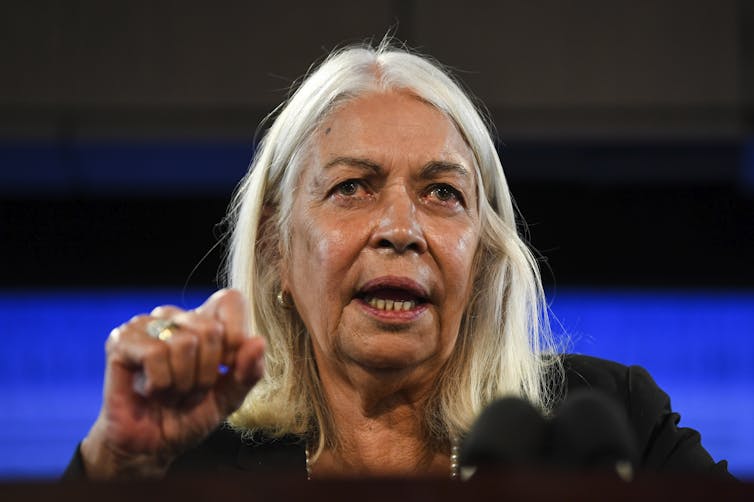 Professor Marcia Langton is designing the Voice proposal with Tom Calma.
Lukas Coch/AAP
Professor Marcia Langton is designing the Voice proposal with Tom Calma.
Lukas Coch/AAP
The Canadian First Nations’ writer, Glen Coulthard, argues strongly against recognition because he says symbolism makes the state feel like it’s being inclusive, but doesn’t actually mean that Indigenous people have real influence over policies that matter to them.
In my recently published book, Sharing the Sovereign: Indigenous Peoples, Recognition, Treaties and the State, I take a different view.
I argue that recognition is a theory of political freedom, which means that every person is equally entitled to help influence the society in which they live. And equally entitled to make decisions about how they will live.
A Voice to Parliament is an example of what these ideas could mean in practice.
Voice is more than a right to ‘input’
The government’s consultation paper says Indigenous people are entitled to “input” into these decisions.
Input, however, is a limited political authority. It makes recognition a small ambition, just as it was when the Howard government proposed that recognition could be satisfied by an amendment to the constitution
honouring Aborigines and Torres Strait Islanders, the nation’s first people, or their deep kinship with their lands and for the ancient and continuing cultures which enrich the life of our country.
Recognition, rather, is really about sovereignty, or how political authority is distributed. In Australia, sovereignty is often understood as an absolute political authority that the state exercises over and above the people. But in practice, sovereignty actually refers to the people’s authority to determine how and by whom they will be governed.
It is the authority to elect parliaments and to amend the constitution. The authority to share in public decision-making. This is much more than the right to have an “input”.
Sharing the sovereign means ensuring political structures give people meaningful opportunities to influence and make decisions. It isn’t just a matter of recognising Indigenous people were living here before the British settlers arrived.
Read more: The government is committed to an Indigenous voice. We should give it a chance to work
Everybody’s right to political participation
Recognising everybody’s right to be equal participants in deciding how society works is a complex task, but it is not beyond a liberal democracy’s capacity to work out.
In New Zealand, Maori have had guaranteed representation in parliament since 1867, and five of the 20 ministers in Prime Minister Jacinda Ardern’s cabinet are Maori.
This week, parliament passed legislation to remove a discriminatory obstacle to Maori representation in local government.
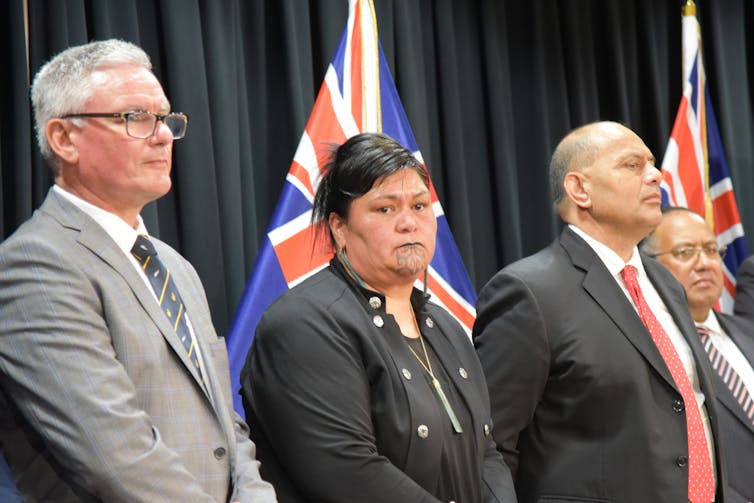 Local government minister Nanaia Mahuta has been fighting to increase representation for Māori in local government in New Zealand.
Ben McKay/AAP
Local government minister Nanaia Mahuta has been fighting to increase representation for Māori in local government in New Zealand.
Ben McKay/AAP
In British Columbia, Canada, a law has been passed to implement the UN Declaration on the Rights of Indigenous Peoples, which is focused on ensuring Indigenous peoples enjoy the right to self-determination.
The purpose of a liberal democracy is to manage the differences in what people say they want politics to achieve — and differences in people’s understandings of what it means to be free and equal.
In this light, recognition can be transformative — not merely a symbolic step.
Ultimately, whether they are supported or not, the Commonwealth’s proposals for a Voice to government have provided us with a way of thinking about the meaning of political equality.
But the proposal to establish a representative body only by legislation is limited and limiting.
Recognition, on the hand, should be enduring and certain. Denying a referendum to give constitutional certainty to the Voice means the government is standing between Indigenous and non-Indigenous people on this question of political equality.
Authors: Dominic O'Sullivan, Adjunct Professor, Faculty of Health and Environmental Sciences, Auckland University of Technology and Professor of Political Science, Charles Sturt University


 Daily Bulletin


