

Climate-protected citadels, virtual worlds only for the privileged: is this the future of inequality?
- Written by: Matthew Finch, Adjunct Research Fellow, University of Southern Queensland
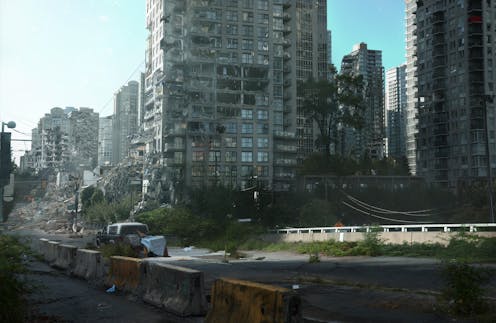
Imagine visiting the Europe of 2048. The cities are strangely silent. Desperate communities in Paris, London and Berlin struggle in the shadow of hollowed-out buildings. The once-popular coastal resorts have also been abandoned, as rises in sea level have taken their toll.
Heading out to rural areas, you find where the fortunate few have gone: shining citadels, high-tech gated communities designed to protect residents from the ravages of climate change and ongoing pandemics.
That doesn’t mean life in 2048 is always grim. The world is gearing up for the 39th Summer Olympics, to be held in Kuala Lumpur, Malaysia. The greatest athletes will be attending, but also thinkers, artists and heroes nominated from around the globe for their work fighting the climate crisis.
Europeans, Americans and Australians are hoping for a great medal haul, but this year, as in most others, the country expected to dominate is China, the world’s leader in the fight to survive climate change.
Is this the future we face? Even if it isn’t, what can imagined scenarios like this teach us about the challenges we face in the present?
Read more: There are many good ideas to tackle inequality – it's time we acted on them
Identifying inequality blindspots
Researchers from 13 countries are currently thinking about such questions as part of the IMAJINE project, funded by the European Commission’s Horizon 2020 programme. IMAJINE’s aim is to explore inequality and injustice across the European Union’s member states.
Inequality isn’t just the gaps between the haves and have-nots in the present. As the world changes and societies evolve, different forms of unfairness can arise.
Read more: Inequality in the OECD is at a record high – and society is suffering as a result
COVID-19 has fuelled uncertainty and, as both the pandemic and our response to it have reshaped societies, made these issues more urgent. We need to anticipate new and emerging forms of inequality and injustice — and understand how we can counter them.
To do this, IMAJINE uses scenario planning, a tool for envisioning different future worlds.
Scenarios aren’t predictions; they are valuable even if they never come to pass. The aim of the four visions we’ve created isn’t to forecast what will certainly happen, but to find our blindspots when it comes to planning for the future of inequality.
A future of digital citizenship or five-person marriages
In our first scenario, outlined above, we picture a world in which cities are abandoned and today’s rural backwaters become the most desirable places to live.
The fight against climate change is a global priority and next-generation clean manufacturing technology is expanding rapidly. Inequality here is based on who has the means to protect themselves from the changing climate.
Read more: We live in a world of upheaval. So why aren't today's protests leading to revolutions?
Another scenario explores a world in which citizenship is entirely digital. It becomes so removed from your place of residence that you might be a European citizen online, even though you physically live in Australia.
The haves and have-nots in this future aren’t defined by where they call home, but where they’re allowed to work, play and gather in virtual space. Advanced technology lets the privileged explore, enjoy and profit from these digital environments, while the less fortunate are locked out.
Yet another scenario explores a breakdown of trust driven by “fake news”, which leads to a fragmentation of cultures and values.
In that future, some parts of Europe celebrate five-person marriages, while others double down on traditional values. Where you live might hold you back from exploring your identity — or create new opportunities to define and celebrate who you are.
Learning from imagined futures
Each of these scenarios shows how inequality isn’t just a question of how wide the gap is between the haves and have-nots. It’s also about the changing ways we understand injustice.
The IMAJINE team are inviting stakeholders to explore these worlds and consider how they relate to social challenges in the present. We want to inspire fresh solutions, not impose our own.
Policy decisions are still often based solely on the numbers: what policies cost, who and how many people benefit. Yet changing social and cultural values also steer people’s perceptions of what is fair and acceptable, beyond the numbers.
The scenarios we’ve created test our sense of what matters when the world changes. They provide a stage on which to play out new ways of thinking when it comes to policy ideas. They help us devise policies that are broadly accepted and can be adapted to local needs.
These imagined futures may never happen, but they might keep us from sleepwalking into new kinds of inequality and prepare us for whatever shocks our world will inevitably encounter.
Authors: Matthew Finch, Adjunct Research Fellow, University of Southern Queensland


 Daily Bulletin


