

'Jewel of nature': scientists fight to save a glittering green bee after the summer fires
- Written by: Katja Hogendoorn, University of Adelaide
This article is a preview of Flora, Fauna, Fire, a multimedia project launching on Monday July 13. The project tracks the recovery of Australia’s native plants and animals after last summer’s bushfire tragedy. Sign up to The Conversation’s newsletter for updates.
The green carpenter bee (Xylocopa aerata) is an iconic, beautiful native species described as a “jewel of nature” for its metallic green and gold colouring. Carpenter bees are so named because they excavate their own nests in wood, as opposed to using existing holes.
With a body length of about 2 centimetres, it is among the largest native bees in southern Australia. While not used in honey farming, it is an important pollinator for several species of Australian native plants.
Last summer’s catastrophic bushfires significantly increased the risk of local extinctions of this magnificent species. We have studied the green carpenter bee for decades. For example, after the 2007 fires on Kangaroo Island, we bolstered the remaining population by providing nesting materials.
To see our efforts - and more importantly, most of the habitat these bees rely on - destroyed by the 2020 fire was utterly devastating.
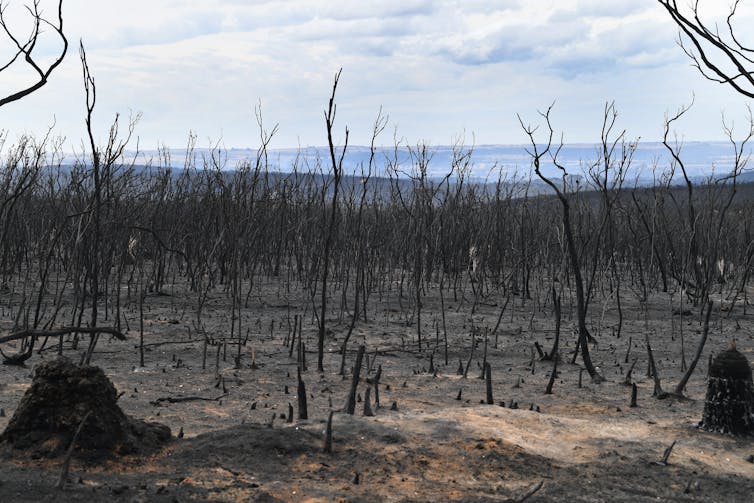 Much of Kangaroo Island was incinerated by the summer bushfires.
Daniel Mariuz/AAP
A crucial pollinator on the brink
The green carpenter bee is a buzz-pollinating species. Buzz pollinators are specialist bees that vibrate the pollen out of the flowers of buzz-pollinated plants.
Many native plants, such as guinea flowers, velvet bushes, Senna, fringe, chocolate and flax lilies, rely completely on buzz-pollinating bees for seed production. Introduced honey bees do not pollinate these plants.
Read more: Our field cameras melted in the bushfires. When we opened them, the results were startling
The green carpenter bee went extinct on mainland South Australia in 1906 and in Victoria in 1938. It still occurs on the relatively uncleared western half of Kangaroo Island in South Australia, in conservation areas around Sydney, and in the Great Dividing Range in New South Wales.
Local extinctions were probably due to habitat clearing and large, intense bushfires. The last time the green carpenter bee was seen in Victoria was early December 1938 in the Grampians, which burnt completely during the Black Friday fires of January 1939.
There are several reasons green carpenter bees are vulnerable to fire, including:
- the species uses dead wood for nesting, which burns easily
- if the nest burns before the offspring matures in late summer, the adult female might fly away but won’t live long enough to reproduce again, and
- the bees need floral resources throughout the year.
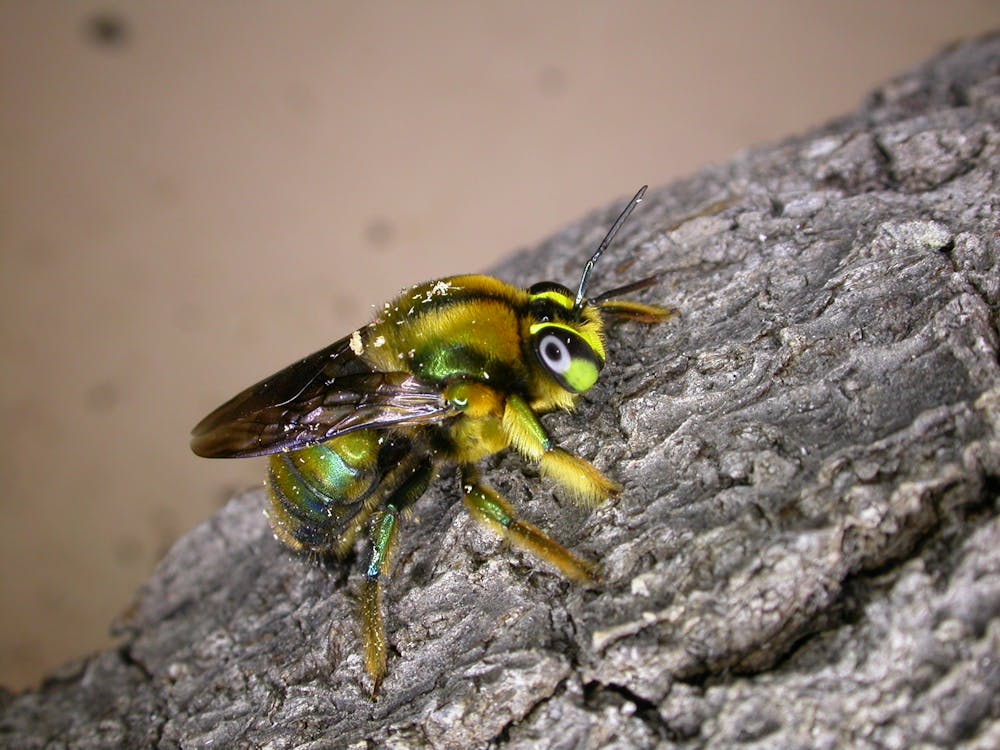 A male green carpenter bee.
Remko Leijs, Author provided
Nowhere to nest
The bees mainly dig their nests in two types of soft wood: dry flowering stalks of grass trees and, crucially important, large dead Banksia trunks. The availability of both nesting materials is intricately connected with fire.
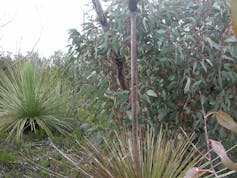 Green carpenter bees sometimes nest n the dried flowering stalks of grass trees, also known as Xanthorrhoea.
Remko Leijs, Author provided
Grass trees flower prolifically after fire, but the dry stalks are only abundant between two and five years after fire. Banksia species don’t survive fire, and need to grow for at least 30 years to become large enough for the bees to use.
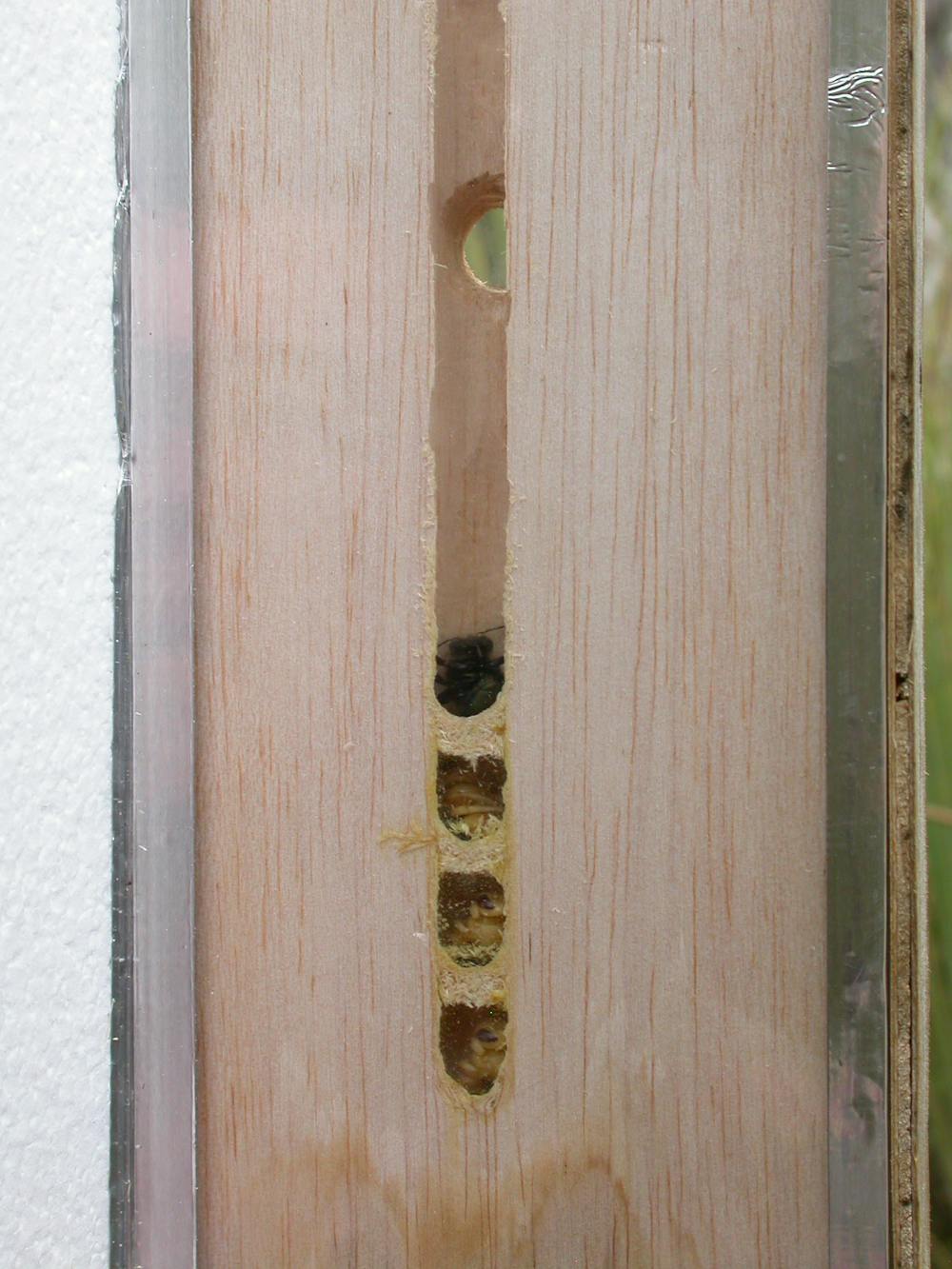 Bees nesting in an artificial stalk.
Remko Leijs, Author provided
With increasingly frequent and intense fires, there’s not enough time for Banksia trunks to grow big enough, before they’re wiped out by the next fire.
A helping hand after the 2007 fires
In 2007, Flinders Chase National Park on Kangaroo Island burnt almost entirely.
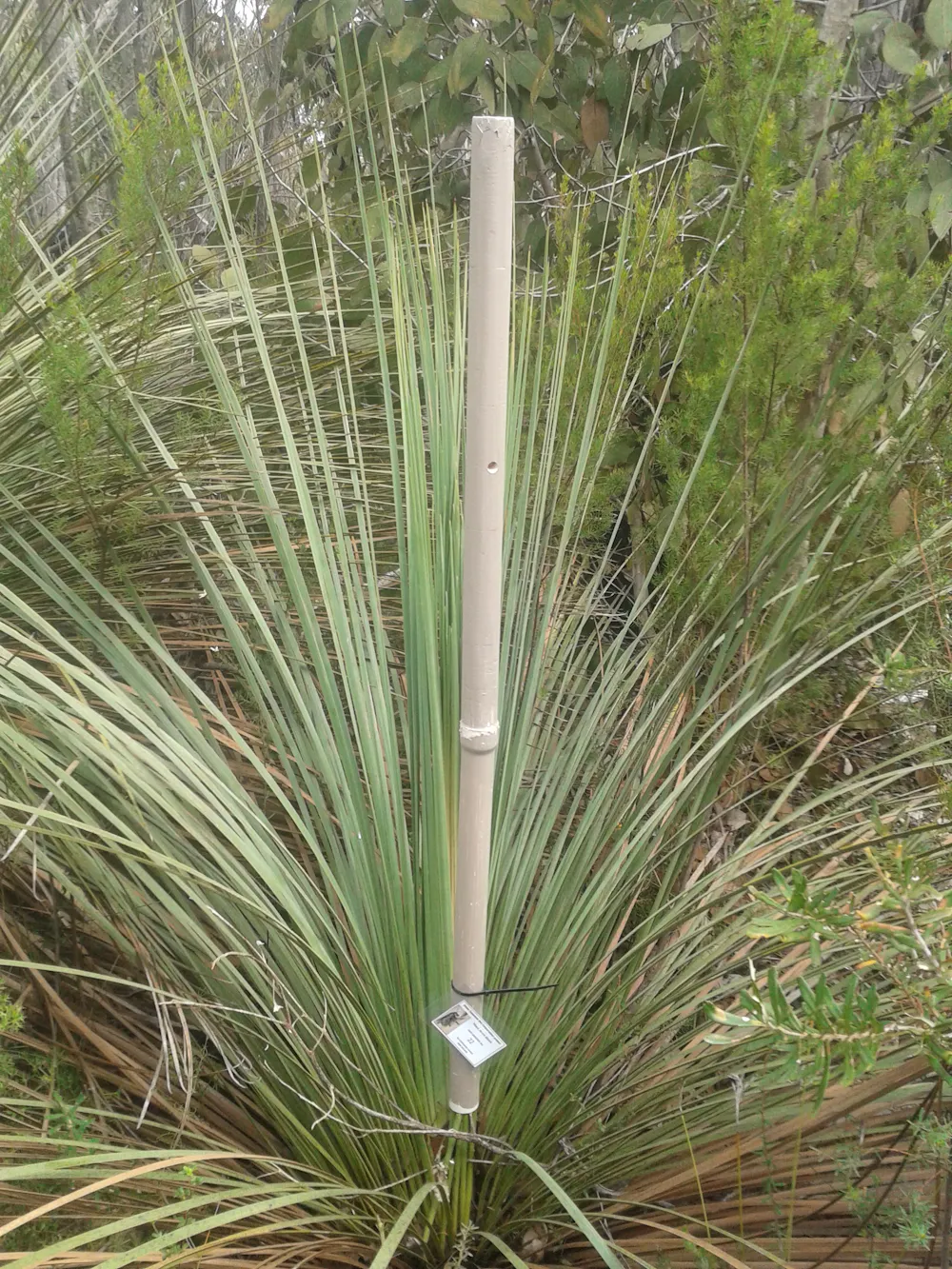 An artificial stalk nesting site installed in a Xanthorrea.
Remko Leijs, Author provided
However, in long-unburnt areas adjacent to the park, carpenter bee nests were still present. From there, they colonised the many dry grass tree stalks that resulted from the fire in the park.
In 2012, most flowering stalks had decayed. In an attempt to bolster population size, we successfully developed artificial nesting stalks to tide the bees over until new Banksia, suitable for nesting, would become available.
Since then, each year we’ve placed artificial nesting stalks in fire-affected areas where the bee still occurred. Almost 300 female carpenter bees have successfully used our stalks to raise their offspring.
Then came the January 2020 fires
At the time of the 2020 fires on Kangaroo Island, there were more than 150 nests containing mature brood in the stalks we had provided.
We’d placed these in 12 sites in and around Flinders Chase National Park, to spread risk - to no avail, as they all burnt.
We were horrified to see the intensity and speed of the fire that turned our efforts to ash, along with most of the remnant, long (more than 60 years) unburnt Banksia habitat the bees rely on. In New South Wales, much of the species’ natural range was also burnt.
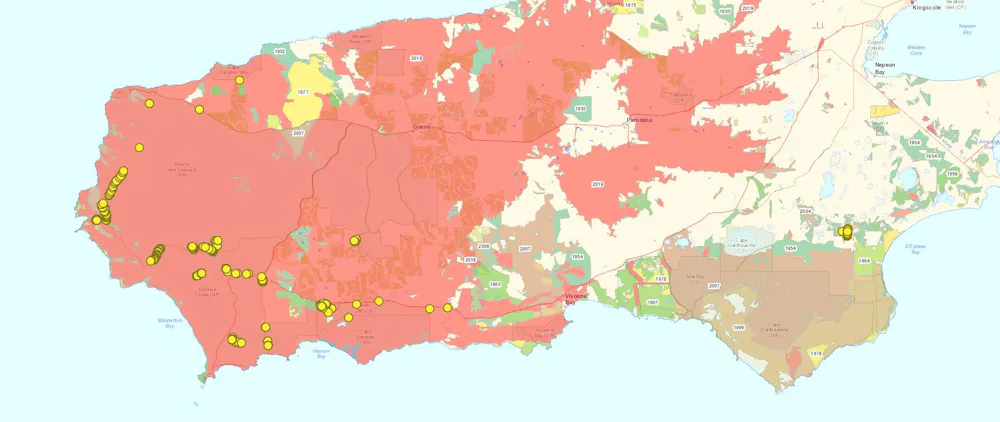 The yellow dots represent known green carpenter bee nests. In red: the area burnt in 2020. Only a subset of the remaining green and yellow patches still have the right vegetation for the green carpenter bee.
Nature Maps SA/Remko Leijs, Author provided
What’s next for the green carpenter bee?
To fully appreciate the impact, we need to survey the remaining long unburnt areas on Kangaroo Island and in NSW.
Encouragingly, we have already found a few natural nests on Kangaroo Island, but the remaining suitable areas are small and isolated, and densities are likely to be low.
With funds raised through the Australian Entomological Society and the Wheen Bee Foundation, and with help of the Kingscote Men’s Shed, we are making new nesting stalks.
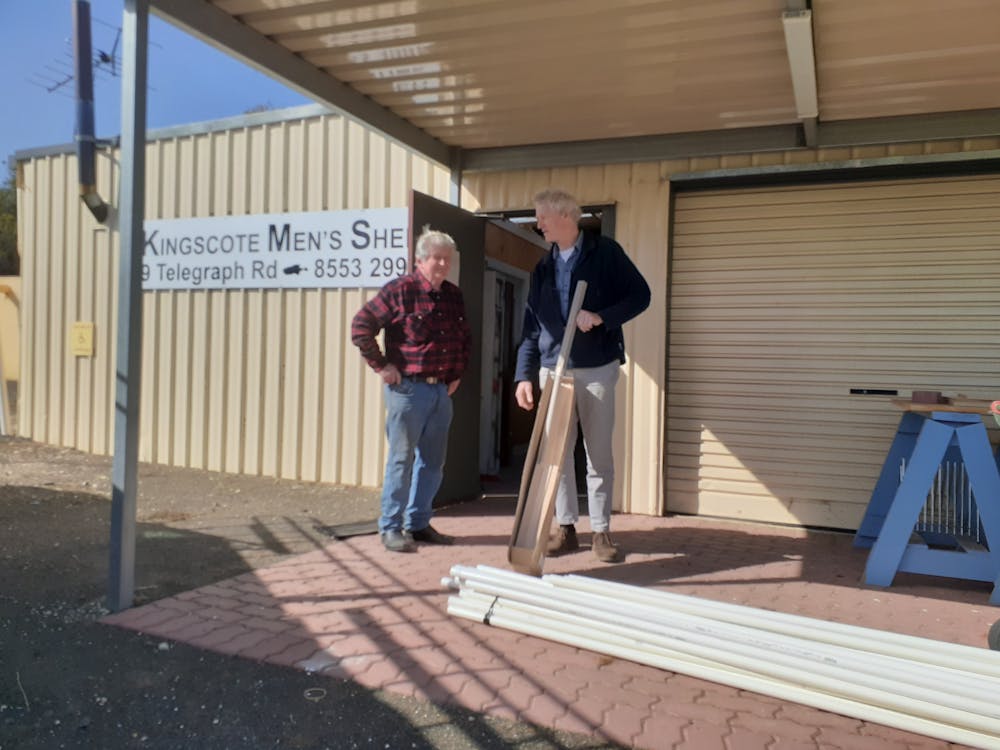 The Kingscote Men’s Shed on Kangaroo Island is helping build new nesting stalks.
Remko Leijs, Author provided
With permission of landholders, we’ll place these new stalks in areas with good floral support, to enhance reproduction and help the bees disperse into conservation areas once suitable.
As we have learnt, success is not guaranteed. Extensive and repeated bush fires, combined with asset protection and fuel reduction burns, are making longtime unburnt habitat increasingly rare. It is this lack of old, continuous, unburnt forest that severely threatens the green carpenter bees’ existence.
The future of fire-vulnerable biodiversity
The carpenter bee is not the only species facing this problem. Many Australian plants and animals are not resilient to high frequency fires, no matter their intensity or time of year.
The ecological importance of longtime unburnt forest needs urgent recognition, as increased fire frequency – both of natural and “managed” fires – is likely to drive a suite of species to extinction.
For Kangaroo Island, this could include several small mammals, glossy black cockatoos, and a range of invertebrate species, including the green carpenter bees.
Given the expected increase in fire frequency and intensity associated with global heating, it’s time we recognise fire-vulnerable species as a category that requires urgent habitat protection.
Read more: After last summer's fires, the bell tolls for Australia’s endangered mountain bells
Authors: Katja Hogendoorn, University of Adelaide


 Daily Bulletin


