

Putting stimulus spending to the test: 4 ways a smart government can create jobs and cut emissions
- Written by: Thomas Longden, Research Fellow, Crawford School, Australian National University
The COVID-19 recession is coming, and federal and state governments are expected to spend more money to stimulate economic growth. Done well, this can make Australia’s economy more productive, improve quality of life and help the low-carbon transition.
In a paper released today, we’ve developed criteria to help get this investment right. The idea is to stimulate the economy in a way that creates lasting economic value, reduces greenhouse gas emissions and brings broader social benefits.
An Organisation for Economic Cooperation and Development (OECD) outlook report released this week predicts an economic slump this year in Australia and globally.
Governments will be called on to invest. In this article, we investigate how stimulus spending on infrastructure can simultaneously achieve environmental, economic and social goals.
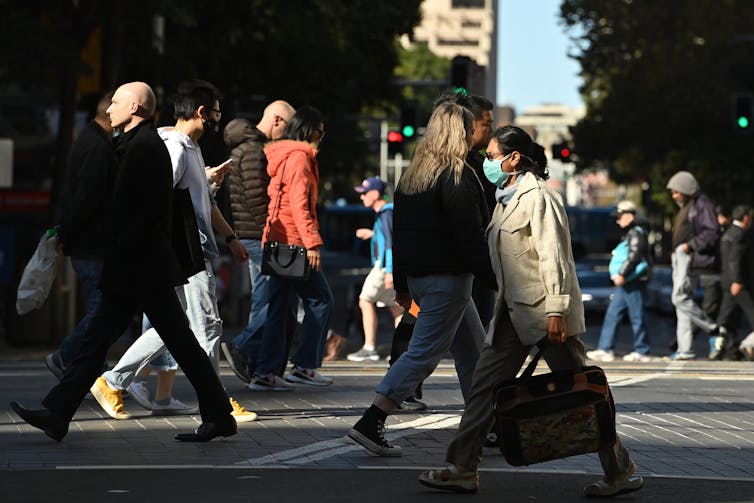 Stimulus spending can help the economy, the environment and the community.
Dean Lewins/AAP
Stimulus spending can help the economy, the environment and the community.
Dean Lewins/AAP
Best practice
Europe has already embraced a “green stimulus”. For example, Germany plans to spend almost one-third of its €130 billion stimulus package on renewable power, public transport, building renovations and developing the hydrogen and electric car industries.
In response to the pandemic, New South Wales and Victoria produced criteria for priority stimulus projects which include environmental considerations.
Whether the federal government will follow suit is unclear.
Read more: HomeBuilder misses a chance to make our homes perform better for us and the planet
Most federal stimulus spending has been on short-term JobKeeper and JobSeeker payments, plus the HomeBuilder scheme that will largely benefit the construction industry and those who can afford home improvements.
So how should governments decide what to prioritise in a COVID-19 stimulus package?
Our criteria
We developed a set of criteria to guide stimulus spending. We did this by comparing ten proposals and studies, including current proposals by international organisations and think tanks, and research papers on fiscal stimulus spending after the 2008 global financial crisis. Synthesising this work, we identified nine criteria and assessment factors, shown below.
Before the pandemic hit, Infrastructure Australia and other organisations had already identified projects and programs that were strong candidates for further funding.
We applied our criteria to a range of program/project categories to compare how well they perform in terms of achieving economic, social and environmental goals. We did not assess particular programs and projects.
The four most promising categories for public investment are shown in this table, and further analysed below.
1. Renewable energy and transmission
The electricity system of the future will be based on wind and solar power – now the cheapest way of producing energy from new installations. Australia’s renewables investment boom may be tailing off, and governments could step in.
The Australian Energy Market Operator, in its 2018 Integrated System Plan, assessed 34 candidate sites for Renewable Energy Zones – which are places with great wind and solar potential, suitable land and access to the grid.
Read more: Really Australia, it's not that hard: 10 reasons why renewable energy is the future
The NSW government has committed to three such zones. These could be fast-tracked, and other states could do the same.
Investment in power transmission lines is needed to better connect these zones to the grid. It’s clear where they should go. Governments could shortcut the normally lengthy approval, planning and commercial processes to get these projects started while the economy is weak.
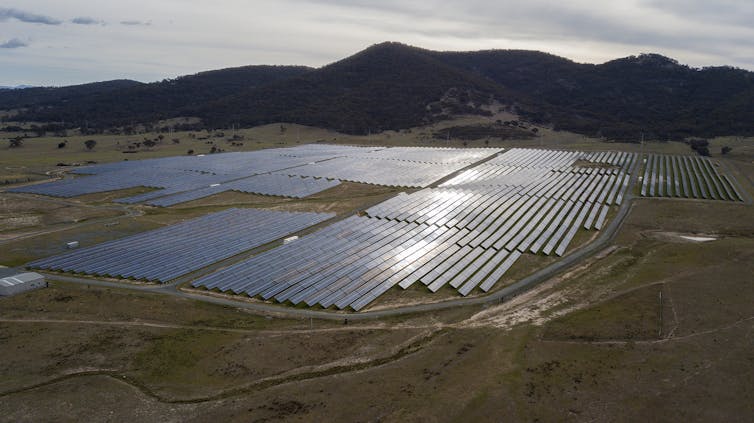 Now is a good time for governments to invest in large-scale renewable energy.
Mick Tsikas/AAP
Now is a good time for governments to invest in large-scale renewable energy.
Mick Tsikas/AAP
2. Energy efficiency in buildings
There’s a strong economic, social and environmental case for investment in retrofitting public buildings to improve their energy efficiency. Schools, hospitals and social housing are good candidates.
Building improvement programs are quick to start up, opportunities exist everywhere and they provide local jobs and business support. And better energy efficiency means lower energy bills, as well as reduced carbon emissions.
Read more: Coronavirus is a 'sliding doors' moment. What we do now could change Earth's trajectory
One existing program is showing the way. Under the Queensland government’s Advancing Clean Energy Schools program, which involves solar installation and energy-saving measures, 80 state schools have been brought forward to the project’s first phase as part of COVID-19 stimulus.
A focus on public buildings will bring long-lasting benefits to the community, including low-income households. This would bring far greater public benefit than programs such as HomeBuilder.
3. Environmental improvements
Stimulus initiatives also provide an opportunity to boost our response to last summer’s bushfires. While the federal government has announced A$150 million of funding for recovery projects and conservation, more could be done.
The ACT has shown how. As part of COVID-19 stimulus, 26 people who’d recently lost their jobs were employed to help nature reserves recover after the fires. Such programs could be greatly scaled up.
In New Zealand, the government is spending NZ$1.1 billion on creating 11,000 “nature jobs” across a range of regional environmental projects.
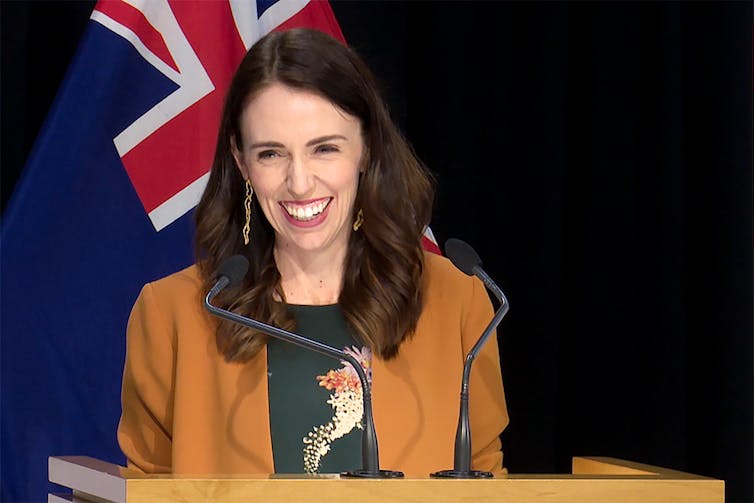 In New Zealand, Jacinda Ardern’s government has created
Daniel Hicks/AAP
In New Zealand, Jacinda Ardern’s government has created
Daniel Hicks/AAP
4. Transport projects
Several transport projects on the Infrastructure Australia priority list are well developed, and some could be fast-tracked.
Smaller, local projects such as building or refurbishing footpaths and cycle paths, and improving existing transport infrastructure, can be easily achieved. The NSW government is already encouraging councils to undertake such projects.
Sound analysis and transparency is needed
Our analysis is illustrative only. A full analysis needs to consider the specifics of each project or program. It must also consider the goals and needs in particular regions or sectors - including speed of implementation, ensuring employment opportunities are spread equally, and social and environmental priorities.
This is the job of governments and agencies. It should be done diligently and transparently. Australian governments should lay out which objectives their stimulus investments are pursuing, the expected benefits, and why one investment option is chosen over another.
This should improve public confidence, and taxpayers’ acceptance of stimulus measures. This is good practice for governments to follow at any time. It’s even more important when they’re spending billions at the drop of a hat.
Authors: Thomas Longden, Research Fellow, Crawford School, Australian National University


 Daily Bulletin


