

Baby Jesus in art and the long tradition of depicting Christ as a man-child
- Written by: Angela McCarthy, Senior Lecturer in Theology, University of Notre Dame Australia
A 900kg baby Jesus statue in Mexico that looks remarkably like musician Phil Collins recently became a social media phenomenon. But in considering art history, we can gain some interesting insights into how we have come to this man-like baby.
The appearance of baby Jesus in art, along with his mother Mary, began after the Council of Ephesus in 431, which emphasised Mary was the Mother of God. We mostly see them together in paintings, although there are some famous images of Mary without her son.
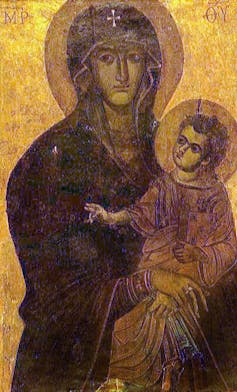 A portrait of Mary and baby Jesus, painted in the fifth or sixth century, in the Santa Maria Maggiore Basilica in Rome.
Wikimedia Commons
A portrait of Mary and baby Jesus, painted in the fifth or sixth century, in the Santa Maria Maggiore Basilica in Rome.
Wikimedia Commons
In the Eastern Orthodox tradition, from around the sixth century until the present, the child Jesus looks like a little man. The idea behind this depiction is to take away one’s emotional response to the baby. Instead, the viewer is drawn into the more important understanding of the action of God in becoming human.
Part of the understanding of the church from the Council of Chalcedon (451) was Jesus’s state of being as fully human and fully divine. Some theologians interpreted this to mean he was fully formed from the beginning, with full knowledge of his godliness. This was difficult to portray in art and hence the man-child.
This interpretation of the two natures of Christ is not part of current teaching, but it dominated how the baby Jesus was depicted.
Many of those images are quite ugly. The art is not interested in naturalism but rather in theological expression.
In Western art throughout the Middle Ages in Europe, the influence of this theology was also evident with images of the baby Jesus either sitting up with a mature stance or tightly swaddled. The latter was an attempt to depict biblical references to a swaddled child or the shroud placed on Jesus after his death.
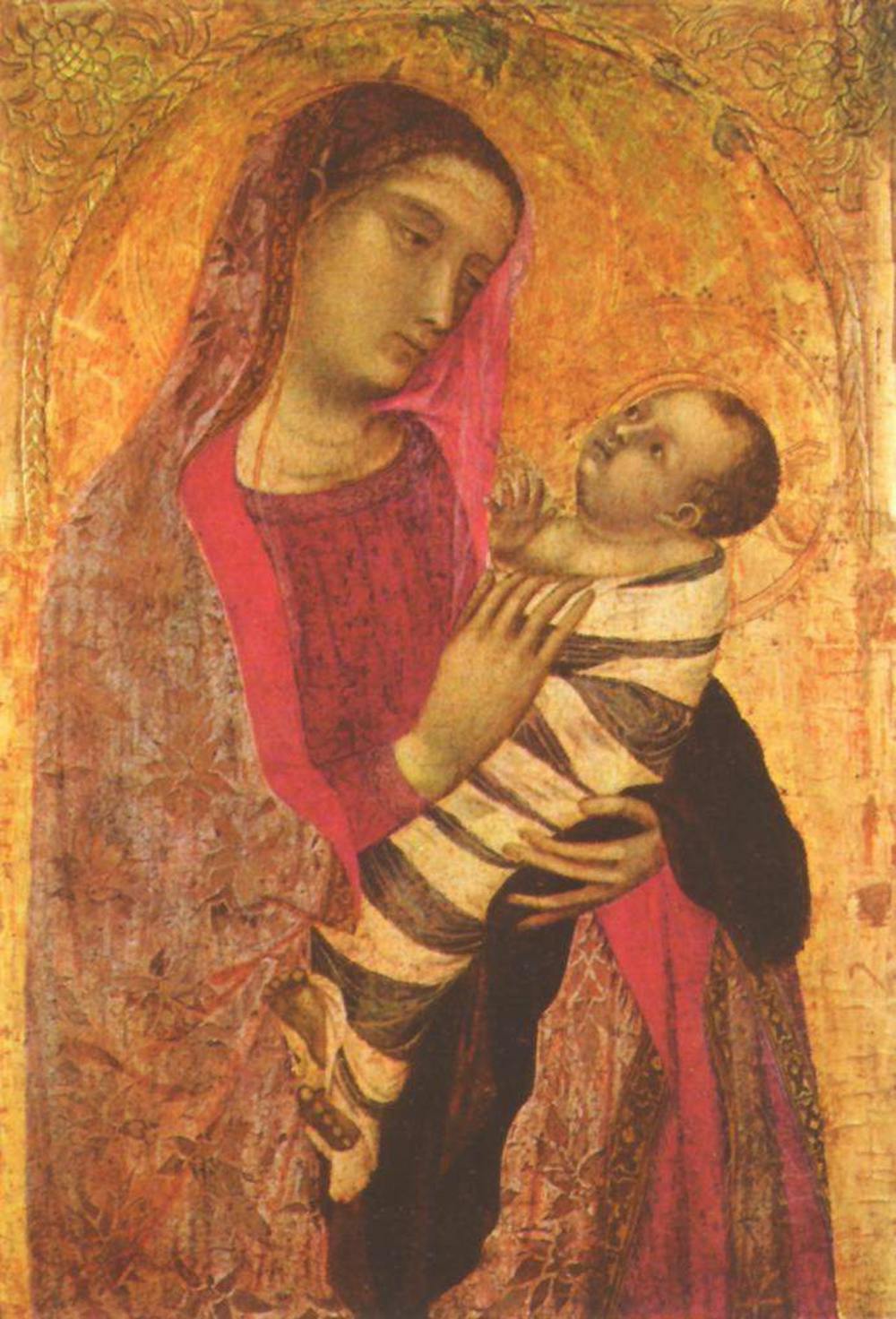 Ambrogio Lorenzetti’s Madonna and Child c.1319, where Jesus is swaddled.
Wikimedia Commons
Ambrogio Lorenzetti’s Madonna and Child c.1319, where Jesus is swaddled.
Wikimedia Commons
In the High Middle Ages in Assisi, Italy, St Francis altered the way the life of Jesus was viewed and experienced by creating dramatic events that showed in a realistic way how Jesus had come into this world. (In most art prior to this, the focus on Jesus had been his suffering on the cross and his divinity.)
Instead of Jesus being part of an austere God at a distance, St Francis introduced the life of Christ – particularly his birth – in a very realistic way, by staging street dramas re-enacting the birth of Jesus.
These were later shown in sculptural forms, becoming the first nativity scene. In these street dramas, re-enacted by local people, a real baby was placed in a crib to stand in as Jesus. It was felt people would be closer to God if they understood the humanity of Jesus.
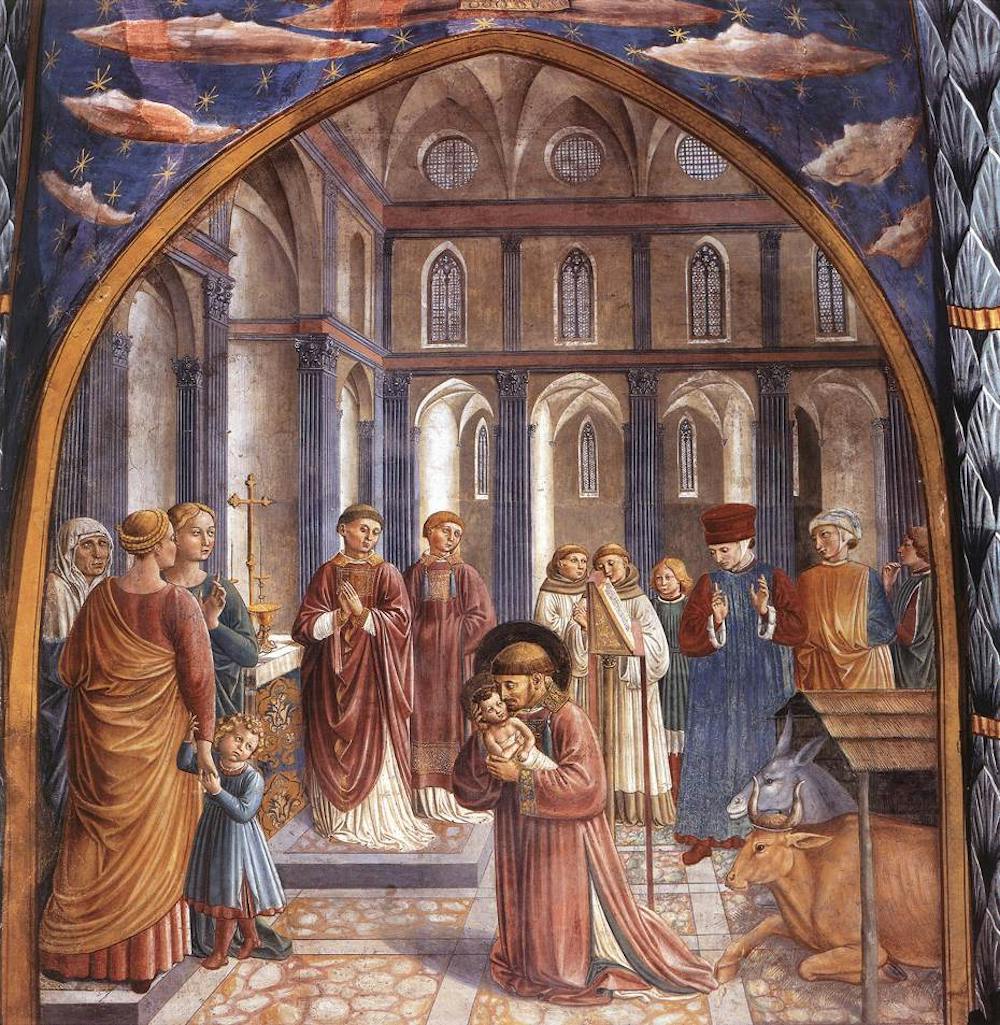 This fresco by Benozzo Gozzoli, c.1452, depicts St Francis at the first nativity scene.
Wikimedia Commons
This fresco by Benozzo Gozzoli, c.1452, depicts St Francis at the first nativity scene.
Wikimedia Commons
Cherubic bambino
With the arrival of the Renaissance in Italy from the 14th century, the depiction of the baby became much more lifelike. This image of the “bambino” of great beauty has been evident in the centuries since.
In Italy, a rising middle class wanted family portraits with their babies looking natural and beautiful. The rise of naturalism and realism in art also radically changed depictions of baby Jesus.
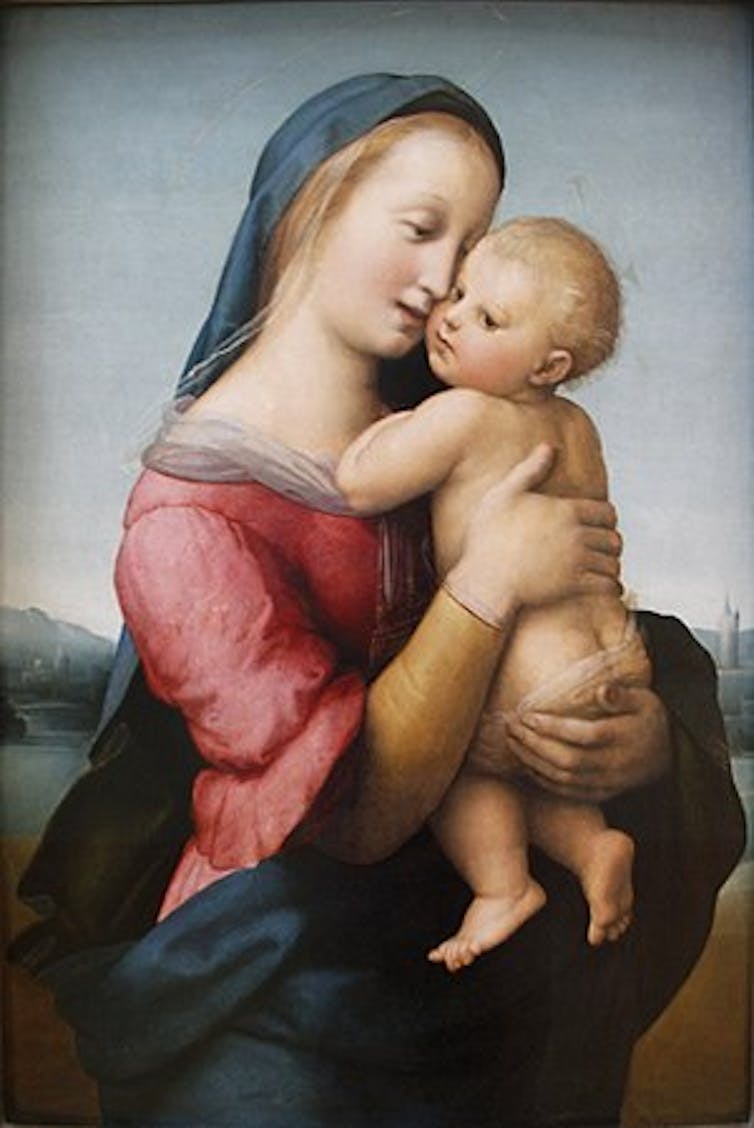 Tempi Madonna by Raphael, c.1508, shows Jesus as natural and beautiful.
Wikimedia Commons
Tempi Madonna by Raphael, c.1508, shows Jesus as natural and beautiful.
Wikimedia Commons
Following the Renaissance, Baroque images of Jesus were very splendid and ornate. In the late Baroque, or Rococo style, these images became even more extravagant and sensual. A typical baby Jesus of this period reaches out to the world with arms outstretched, chubby faced and lying on gold-plated straw.
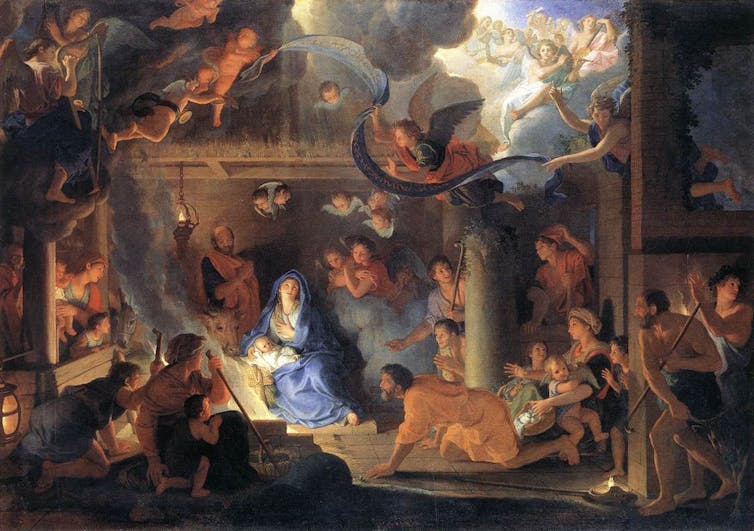 In Adoration of the Shepherds by Charles Le Brun, c.1689, the baby Jesus shines in the dark stable.
Wikimedia Commons
In Adoration of the Shepherds by Charles Le Brun, c.1689, the baby Jesus shines in the dark stable.
Wikimedia Commons
The eventual rejection of this extravagance by the church and cultural establishment from the late 1700s led to the development of neoclassicism, where a more moral and serious view of the world and religious notions became dominant. Mary and Jesus faded from view as subjects during this time.
One effect of the Reformation was the destruction of much art throughout Europe and a huge reduction in commissions for sacred works.
Into the modern period, secularism rose rapidly and the focus of art shifted towards non-religious subjects.
In the 19th century, most Christian art was either reproductions of earlier paintings or romanticised devotional art. Pretty images that had little symbolic content or religious relevance proliferated.
Going back
This huge new sculpture in a Mexican church has been placed on the wall behind the altar and totally diminishes everything else in the surrounding environment.
For the people who gather in this sacred space this would seem overwhelming: the altar is supposed to be the focus of worship but has been eclipsed by the sheer size of the work. Usually, a crucifix would be hanging on the wall behind the altar.
Perhaps most interesting is the way the huge adult face does not seem to match the body. We might laugh, but we could perhaps also ask: is this a deliberate return to the “little man”, a Jesus who was born a fully formed man?
Authors: Angela McCarthy, Senior Lecturer in Theology, University of Notre Dame Australia


 Daily Bulletin


