

So your kid's finished their first year of school. Here's what they should have learnt
- Written by: Jenny Johnston, Lecturer in Primary Education, Southern Cross University
It’s the end of the first year of school for many children and proud parents. Some children may be reading quicker than their classmates, others slower; some can add double digits, others only single. What’s normal?
Not all babies talk, walk and are toilet-trained by the same age and it’s the same thing as the progress each child makes at school. A child’s particular circumstances may affect their learning.
Children may have vision or physical constraints; big social, family, or emotional upheaval; or other issues that might impact on progress. This is why comparisons are tricky and the idea of “normal” or “typical” is subjective.
But generally speaking, if your English-speaking child is at least six years old by the end of the year, there are some standard things the Australian curriculum outlines they should know and be able to do.
1. Know letter names and sounds
Children need to know letters are the building blocks of words. They should know individual letter names and sounds (a is said as “ay” and is the short sound in cat; b is “bee” and the short sound in but). They should know the sound of a letter doesn’t change when it is capitalised.
 Having familiar books is important for word recognition.
Annie Spratt/Unsplash
Having familiar books is important for word recognition.
Annie Spratt/Unsplash
By the end of year one, children should understand there is a predictable relationship between sounds and letters. And they should have phonemic awareness.
Phonemes are the sounds in language – like br, th, sh, ay, ee, eye, oh and you – so phonemic awareness is the awareness of sounds. It is the ability to hear and manipulate sounds in spoken language. Your kid should be able to know things like:
changing sh in the word shack to get track or snack
hearing the difference between jet and pet
knowing mat rhymes with cat and rat, but that dog doesn’t rhyme with cat
combining sounds like m + a + n to make man
separating sounds such as in d-i-g
identifying the sounds when they are written on the page.
2. Recognise ‘sight words’
Sight words are the most frequently occurring words in the English language. By the end of the first year of school, most children will be familiar with about 100 of these. They should know them without having to sound them out, and how to write them.
The easy words include: the, me, my, Mum, and, this, is, and a. Then they progress to: with, once, want, put and were.
Your six year old is expected to know how to recognise familiar words and have a range of strategies to manage unfamiliar words. These strategies start with sounding out and looking at known letters, sounds and letter combinations. They extend to using pictures for clues and a developing understanding of how sentences work to guess the word.
For instance, the child can look at the image, noticing a garage, identify that the unknown word starts with a “g”, and deduct the word is “garage” without really being sure that’s what it says. Successful guestimations build confidence.
A child’s speed of word identification, accuracy and appropriate expression in reading aloud will develop across the year. Being read to and reading for themselves – using known stories with repeating lines of text – will help.
Such stories include: Where is the Green Sheep, The Gruffalo, We’re Going on a Bear Hunt and The Very Hungry Caterpillar.
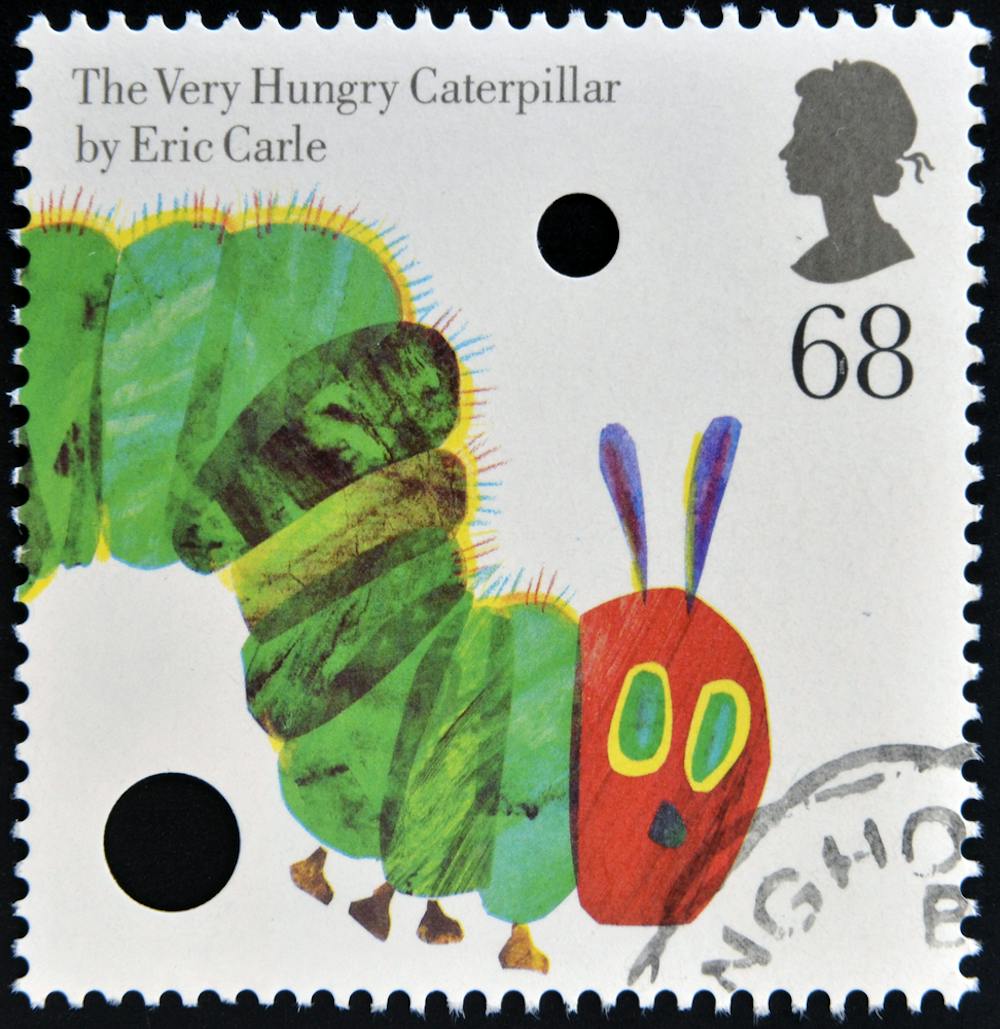 The Very Hungry Caterpillar uses many sight words.
from shutterstock.com
The Very Hungry Caterpillar uses many sight words.
from shutterstock.com
Children’s vocabulary should improve as they engage in quality conversations and books. Regularly reading a variety of books with your children supports development. Talk about pictures, words, the story-line, the author and illustrator. Inspire your child to get involved.
Write complex sentences
By the end of year one, children should be able to write increasingly complex sentences, using their letter and sound knowledge for good approximations of unfamiliar words. They should apply known sight words to write about their experiences.
They can sequence events (“I had breakfast and then came to school”) and show cause and effect (“My dog was sick and we had to clean it up”). You might see humour appearing in written work.
Handwriting by the end of the first year should show your kid knows how to control their pencil by:
correctly forming letters (top to bottom, and anti-clockwise circles for letters such as c, a, d, g)
writing using upper and lower case letters in the appropriate places (capitals at the beginning of names)
printing on the lines.
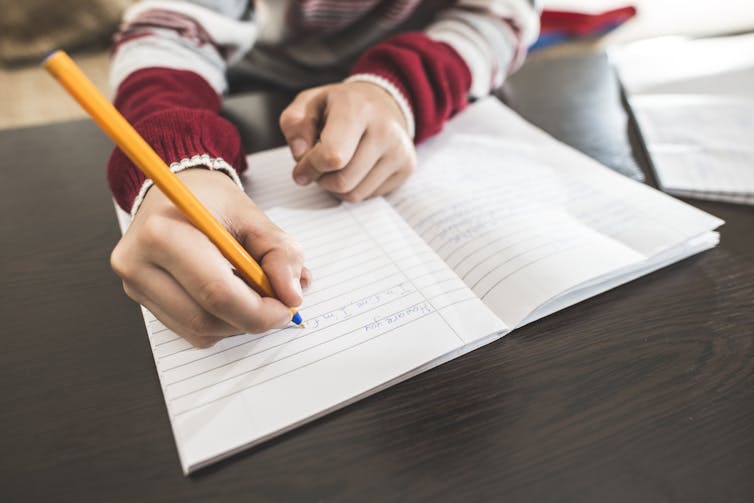 Can your kid stick to the lines?
from shutterstock.com
Can your kid stick to the lines?
from shutterstock.com
Know numerals and what they represent
By the end of year one a child should know what numbers mean (3 = three items), as well as number patterns and sequences. This includes:
seeing that numbers 11-19 have a one at the front and the other digit changes
recognising a number is consistent regardless of the item (7 dogs vs 7 lollies – it’s still seven)
beginning computation (understanding “my hat” and “your hat” means there are two hats)
and multiple addition is multiplication (2 dogs, plus 2 dogs, plus 2 dogs = 6 dogs and is the same as 3x2 dogs).
Know the basics of colours, shapes, money and time
Some other things your kids should be doing by the end of year one:
investigating nuances of colour (unless colour confusion is a known issue) and water
understanding shapes (2D = square and 3D = cube)
know the basics of money (a house and a car cost a lot of money; parents pay money to use electricity)
getting the hang of time – clock faces (analogue time) and digital clocks, and how to read and estimate time as it passes (yesterday, next week, days of the week, months of the year)
understand a metre is a 100 centimetres, and a kilometre is a long walk
have well-established social skills, including sharing, problem solving and team work.
Perhaps the skills and knowledge parents can be nurturing are problem solving, curiosity, and imagination. These are the basics which set children up for success.
Authors: Jenny Johnston, Lecturer in Primary Education, Southern Cross University


 Daily Bulletin


