

Māori and Pasifika scholars remain severely under-represented in New Zealand universities
- Written by: Tara McAllister, Research Fellow, University of Auckland
The number of Māori and Pasifika students attending New Zealand universities has been increasing steadily, with 75,625 Māori and 32,465 Pasifika enrolled in 2018.
But for many of these students, they will not be taught by Māori or Pasifika throughout their degree. And depending on their discipline, they may not get to work with a Māori or Pasifika advisor during their postgraduate years either. This not only affects Māori and Pasifika but also reinforces to all of New Zealand that “experts” are not Māori and Pasifika but most likely Pākehā (New Zealanders of European descent).
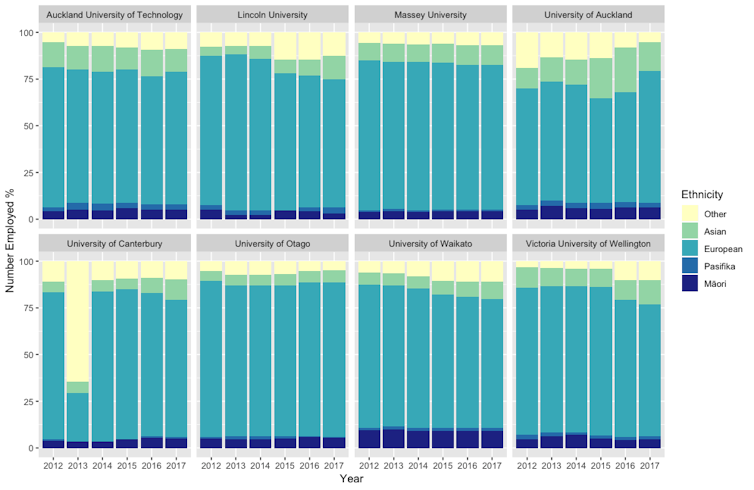
In our research published this week, Why isn’t my professor Māori? and Why isn’t my Professor Pasifika?, we analysed the number of Māori and Pasifika faculty at New Zealand’s eight universities – and highlight that Māori and Pasifika scholars are severely under-represented, making up only 5% and 1.7% of the academic workforce, respectively. This is in contrast to 15% identifying as Māori and 7.4% as Pasifika in the 2013 census.
Read more: Diversity is indispensable to excellence: The Canada Research Chairs program
Influencing thinking
Universities are charged with being the conscience of society, creating new technologies, informing policy development and providing ways for us to understand the world we exist in. If all of these roles are carried out with little to no Māori and Pasifika input, then Pākehā views will go on to influence the wider New Zealand society.
Of further concern is that, despite the universties’ expressed values of diversity and equity, these percentages have remained unchanged for six years.
Certain universities are doing better than others. From 2012 to 2017, 9-10% of the University of Waikato’s academic staff were Māori, whereas only 2.5-5% of Lincoln University’s staff were Māori.
But many of the Māori and Pasifika academics employed by New Zealand universities are in short-term contracts. Very few are in senior leadership roles.
 CC BY-ND
Key patterns in data
As you increase the level of academic seniority from tutorial assistant to professor, the numbers of Māori get fewer. Most Māori academics are employed as lecturers or tutors and senior lecturers. Very few Māori get promoted to the highest academic level of professor.
In 2012, about 25 of a total of 975 professors were Māori. This only increased to 35 out of 1045 in 2017. It is important for Māori and Pasifika students to see themselves represented by the people who teach them. Instead, Pākehā people are training the next generation of Māori and Pasifika doctors, teachers and lawyers, who would benefit by being taught by their own people.
The benefits would ripple through our communities and society. We argue, that the impact of having more Māori and Pasifika academics would result in a positive transformation for our own communities.
Read more:
Strong sense of cultural identity drives boom in Māori business
Pasifika academics are also centred in Auckland, which is to be expected given demographic trends. This puts pressure on Auckland-based universities to lead the way in recruitment, retention and promotion of Pasifika academics. A change in one of these universities can impact numbers nationally, as was the case for the University of Auckland which lost 40 Pasifika academics between 2015 and 2016. This represented a loss of 20% across New Zealand.
Most Pasifika academics are in temporary contracts (55 Pasifika out of 3005 academic staff and tutorial assistants across the country), with very few in professor and dean positions (five Pasifika out of 1045 professors and deans across the country). The same can be said for Māori. This is unsurprising and aligns with global experiences of diverse people engaging in work that is not valued by the university but is valued by their communities.
This can include attending a gathering to talk about community aspirations and how a Pasifika academic can leverage their position or social capital to help the community reach their goals. This may not be valued by the university unless it comes with research funding.
What to do about it
Not all of this is bad news. Some universities and organisations are beginning to address this. AUT’s Māori and Pasifika early-career academic programme shows promise. Cohort hiring ensures that new Māori and Pasifika academics have a collective which provides them with mentors to guide them through the promotions process.
The work of Ngā Pae o te Māramatanga, New Zealand’s Māori centre of research excellence, has significantly increased the number of Māori graduating with PhDs. But although Māori and Pasifika in the academy are working together to recruit and retain more Maori and Pasifika academics, this should not be their burden alone.
Significant structural change is needed in the recruitment, retention and promotion of Māori and Pasifika academics. Universities in New Zealand have made commitments to Māori and Pasifika communities and need to begin to address the inequities outlined in our research.
The data on Māori and Pasifika faculty show that in spite of work to recruit more Māori and Pasifika students, universities are falling short on delivering more Māori and Pasifika academics in leadership positions. This means we either need government intervention similar to those made for Māori and Pasifika students where institutions are resourced to provide better learning environments, or universities need to consider how their current structures continue to exclude Māori and Pasifika.
Traditionally, New Zealand has led the way in decolonising universities, with many of our Maori and Pasifika academics being sought-after international speakers. We should continue to lead in ensuring that our universities embrace all learners, esteem all modes of knowledge and serve all communities.
This may mean that instead of universities relying on international models of excellence, we design our own that reflect our unique place in the world.
CC BY-ND
Key patterns in data
As you increase the level of academic seniority from tutorial assistant to professor, the numbers of Māori get fewer. Most Māori academics are employed as lecturers or tutors and senior lecturers. Very few Māori get promoted to the highest academic level of professor.
In 2012, about 25 of a total of 975 professors were Māori. This only increased to 35 out of 1045 in 2017. It is important for Māori and Pasifika students to see themselves represented by the people who teach them. Instead, Pākehā people are training the next generation of Māori and Pasifika doctors, teachers and lawyers, who would benefit by being taught by their own people.
The benefits would ripple through our communities and society. We argue, that the impact of having more Māori and Pasifika academics would result in a positive transformation for our own communities.
Read more:
Strong sense of cultural identity drives boom in Māori business
Pasifika academics are also centred in Auckland, which is to be expected given demographic trends. This puts pressure on Auckland-based universities to lead the way in recruitment, retention and promotion of Pasifika academics. A change in one of these universities can impact numbers nationally, as was the case for the University of Auckland which lost 40 Pasifika academics between 2015 and 2016. This represented a loss of 20% across New Zealand.
Most Pasifika academics are in temporary contracts (55 Pasifika out of 3005 academic staff and tutorial assistants across the country), with very few in professor and dean positions (five Pasifika out of 1045 professors and deans across the country). The same can be said for Māori. This is unsurprising and aligns with global experiences of diverse people engaging in work that is not valued by the university but is valued by their communities.
This can include attending a gathering to talk about community aspirations and how a Pasifika academic can leverage their position or social capital to help the community reach their goals. This may not be valued by the university unless it comes with research funding.
What to do about it
Not all of this is bad news. Some universities and organisations are beginning to address this. AUT’s Māori and Pasifika early-career academic programme shows promise. Cohort hiring ensures that new Māori and Pasifika academics have a collective which provides them with mentors to guide them through the promotions process.
The work of Ngā Pae o te Māramatanga, New Zealand’s Māori centre of research excellence, has significantly increased the number of Māori graduating with PhDs. But although Māori and Pasifika in the academy are working together to recruit and retain more Maori and Pasifika academics, this should not be their burden alone.
Significant structural change is needed in the recruitment, retention and promotion of Māori and Pasifika academics. Universities in New Zealand have made commitments to Māori and Pasifika communities and need to begin to address the inequities outlined in our research.
The data on Māori and Pasifika faculty show that in spite of work to recruit more Māori and Pasifika students, universities are falling short on delivering more Māori and Pasifika academics in leadership positions. This means we either need government intervention similar to those made for Māori and Pasifika students where institutions are resourced to provide better learning environments, or universities need to consider how their current structures continue to exclude Māori and Pasifika.
Traditionally, New Zealand has led the way in decolonising universities, with many of our Maori and Pasifika academics being sought-after international speakers. We should continue to lead in ensuring that our universities embrace all learners, esteem all modes of knowledge and serve all communities.
This may mean that instead of universities relying on international models of excellence, we design our own that reflect our unique place in the world.
Authors: Tara McAllister, Research Fellow, University of Auckland


 Daily Bulletin


