

Boris Johnson has suspended the UK parliament. What does this mean for Brexit?
- Written by: Anne Twomey, Professor of Constitutional Law, University of Sydney
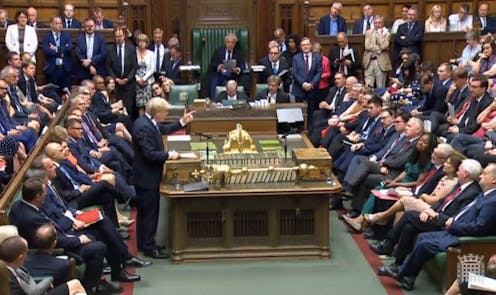
Boris Johnson has secured the prorogation of the British parliament, which means it will be prevented from sitting for much of the crucial period between now and the Brexit date of October 31.
So what options do those opposed to a no-deal Brexit now have in parliament to prevent it?
A cunningly placed and timed prorogation
If a majority of the House of Commons were opposed to a no-deal Brexit, two primary routes are open to it. One would be the enactment of legislation requiring the government to seek a further deferral of the Brexit date until after some circuit-breaking event could be held, such as a new referendum or general election. The other would be a vote of no-confidence in the government and an early general election.
Both would be extremely difficult to achieve within the now very tight parliamentary timeframes – which presumably was the point. This prorogation is cunningly timed and placed. The fact that parliament has not been prorogued for the entire period leading up to the Brexit date makes it harder to argue in the courts that the prorogation is unconstitutional.
Read more: Boris Johnson, 'political Vegemite', becomes the UK prime minister. Let the games begin
The fact that Johnson gave prorogation advice to the queen before a court could decide on whether to issue an injunction to prevent the giving of such advice (with a hearing on the matter having been scheduled for September 6) also potentially stymies the use of the courts to prevent prorogation. This is because the main avenue for legal attack is in relation to the giving of the advice by ministers, rather than the action of the queen in giving effect to that advice. The latter would normally be regarded as “non-justiciable” – outside the appropriate exercise of judicial power.
In addition, slicing up the sitting period with prorogation in the middle, from September 10 to October 13, means it is now likely there is too little time to achieve all the procedural steps necessary to pass legislation or the resolutions necessary to secure a change in government.
This is exacerbated by the fact that the government largely controls the order of proceedings in the House of Commons and prorogation effectively wipes the parliamentary slate clean of any uncompleted action. Any partially completed action would have to start again once parliament resumes.
Confidence, fixed-term parliaments and an election
One alternative that has previously been raised is a vote of no confidence in the government and an early election. The UK has fixed five-year terms for its parliament. But an early election can be held if a two-thirds majority of the House of Commons votes for it, or if there is a vote of no confidence in the government and after 14 days there has been no vote of confidence in the government.
In either case, the Fixed-term Parliaments Act 2011 states that the election is to be held on a day appointed by the queen on the recommendation of the prime minister.
A senior government source reportedly told The Guardian:
We have been very clear that if there’s a no-confidence vote, [the prime minister] won’t resign. We get to set an election date. We don’t want an election, but if we have to set a date, it’s going to be after 31 October.
What could be done to avoid that outcome?
The House of Commons could instead act to force the resignation of the prime minister, secure the appointment of a caretaker prime minister, bring about an early election and authorise the new prime minister to seek to defer Brexit until after the election was held so the people could make the ultimate decision on Brexit.
The Fixed-term Parliaments Act deals solely with issues of confidence in relation to the holding of an early election. It provides that only a resolution “that this House has no confidence in Her Majesty’s Government” can cause an early election. It does not deal with other expressions of no confidence in the government.
As the then clerk of the House of Commons advised the House of Commons Public Administration and Constitutional Affairs Committee in 2018, the House could pass a “no confidence motion in other terms than those in the Act”, including no confidence in a specific minister.
This would have a “massive political effect but [would] not trigger the terms of the Act”.
So if, for example, the house expressed no confidence in Boris Johnson to hold the office of prime minister, he would be forced, by convention, to resign.
In addition to passing a vote of no confidence in a prime minister, the house may pass a “constructive motion of confidence”, which states that it has confidence in someone else to form a government.
This may be a compromise candidate who is trusted by both sides to run a caretaker government, which makes no significant policy decisions or appointments but simply undertakes necessary ordinary business until an election is held.
The formation of a caretaker government is consistent with British parliamentary practice. Winston Churchill formed one and popularised the “caretaker” term in 1945.
When a prime minister resigns, he or she might give advice to the queen as to whom to appoint as his or her successor. But the queen is not bound by this advice, as the outgoing prime minister ceases to be responsible to parliament for it.
Instead, the queen is obliged to appoint as prime minister the person most likely to hold the confidence of the House of Commons. If the House of Commons has declared, by resolution, who this person is, then the queen has clear evidence, so her appointment of that person cannot be questioned.
The next consideration is that a caretaker prime minister is by convention constrained in undertaking significant acts. If parliament wanted the prime minister to renegotiate the Brexit date so the people could decide on Brexit as a key policy in a general election, it would be prudent for a parliamentary resolution to authorise this action.
Read more: What's the deal (or no-deal) with Brexit? Here's everything explained
Finally, in the United Kingdom it has historically been the case that fundamental constitutional change has been put to the people in a general election. An example is the equally divisive debate over Home Rule for Ireland and the limitation of the powers of the House of Lords.
This means the House of Commons would need to pass a formal resolution that “this House has no confidence in Her Majesty’s Government”, referring to the government established by the new prime minister. This would allow an early election to be held.
In addition, to ensure the caretaker government was for the shortest possible time, the house could resolve that the prime minister should set a particular date for that election.
A series of resolutions could achieve this, but it would require a united front from those opposed to a no-deal Brexit and clever parliamentary tactics to achieve it within the very limited sitting time available.
It may prove that prorogation was the masterstroke to prevent this from occurring.
Authors: Anne Twomey, Professor of Constitutional Law, University of Sydney


 Daily Bulletin


