

As Australia looks to join a coalition in Iran, the risks are many
- Written by: Tony Walker, Adjunct Professor, School of Communications, La Trobe University
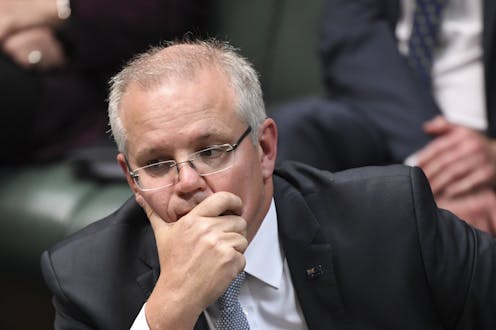
Prime Minister Scott Morrison has indicated Australia will join a multinational peacekeeping force to protect freedom of navigation in the Gulf, but at this stage he has not indicated what form Australian participation might take.
Speaking to reporters after a conversation overnight with newly-installed British Prime Minister Boris Johnson, Morrison said Australia was “looking very carefully at an international, multinational initiative” to provide a peacekeeping role.
But given recent experience of Australia too hastily joining an American-led Iraq invasion of 2003, with disastrous consequences, Morrison and his advisers need to ask some hard questions – and set clear limits on any Australian involvement.
It is not clear the extent to which the prime minister and his team have interrogated the risks involved before acceding to an American request for some form of military contribution to policing one of the world’s most strategically important waterways.
Read more: Iran and US refusing to budge as tit-for-tat ship seizures in Middle East raise the temperature
Nor is it clear what form Australian engagement might take to deter Iran’s threats to tanker traffic. This includes its seizing of a British-flagged vessel.
Options include sending a warship or warships to join peacekeeping patrols under American command, or stationing surveillance aircraft in the region to monitor ship movements through the Strait of Hormuz.
The operative words in the above paragraph are “American command”.
Any peacekeeping mission might be presented as a multinational exercise, but in effect the preponderance of American power, including an aircraft carrier battle group, means Americans would be in command.
In the Iraq invasion of 2003, Australians operated under broad American oversight, as did the British at considerable cost to Prime Minister Tony Blair’s reputation.
This is not an argument against Australian involvement in protecting a vital sea lane through which passes one-third of the world’s seaborne tradeable oil every day. Rather, it is to make the case for extreme caution.
Morrison and his team need to ask themselves whether there is a risk of being drawn into an American exercise in regime change in Iran. What might be the limits on Australia’s involvement should hostilities broke out in the Gulf?
What would be the rules of engagement? What might be an exit strategy?
What, for example, would be Australia’s response if a warship involved in a peacekeeping exercise was damaged – or sunk – in a hostile act? This includes hitting a mine bobbing in the Gulf waterway, or a limpet mine stuck on the side of a vessel.
We have seen this before in 1984, when traffic in the Gulf was brought to a standstill by Iran floating mines into busy sea lanes.
What would Australia’s response be in the case of a surveillance aircraft or drone being shot down if it strayed into Iranian airspace?
In other words, there are multiple possibilities of conflict escalating given the concentration of firepower that is planned for the Gulf.
The aim of any international mission to which Australia attaches itself should be to de-escalate tensions in the world’s most volatile region. A military presence cannot – and should not – be detached from a political imperative.
That imperative is to draw Iran back into discussions on a revitalised Joint Comprehensive Plan of Action. Under this 2015 plan, the Iranians agreed to freeze their nuclear program under International Atomic Energy Agency (IAEA) supervision.
Iran was complying with that agreement before US President Donald Trump recklessly abrogated it in 2018 and re-applied sanctions. These have brought Iran’s economy to its knees.
Read more: US-Iran conflict escalates again, raising the threat of another war in the Middle East
Trump’s abandonment of the JCPOA against the wishes of the other signatories, including the permanent members of the United Nations Security Council plus Germany, was as inexplicable as it was damaging.
Now, the world is facing a crisis in the Gulf of American making, and one that Washington is asking its allies to police.
Morrison has been equivocal about the JCPOA. He would be well advised to reiterate Australia’s backing for the agreement as a signal to the Americans that Australia stands with its allies in its support of international obligations.
These cannot – and should not – be ripped up at the whim of a president who seems to have been motivated largely by a desire to undo the useful work of his predecessor.
Not to put too fine a point on it, this has been an act of self-harm to American interests and those of its allies. It is a crisis that need not have occurred.
Viewed from the distance of Canberra, Morrison and his advisers might have difficulty fully comprehending the risks involved in a potential escalation of tensions in the Gulf.
In a useful paper, the International Crisis Group warns of the dangers of an escalation of hostilities due to a mistake or accident in a highly charged environment.
As Iran Project Director Ali Vaez puts it:
Just as in Europe in 1914 a single incident has the potential of sparking a military confrontation that could, in turn, engulf the entire region.
What should be kept in mind in all of this is that it is not simply stresses in the Gulf itself that are threatening stability, but a host of other Middle East flashpoints. These include ongoing conflicts in Syria and Yemen, and heightened tensions between Iran and a Sunni majority led by Saudi Arabia.
Then there is the drumbeat on Capitol Hill. Hawkish Republican lawmakers agitate for pre-emptive strikes against Iran in the mistaken belief such an exercise would be clinical and short-lived.
Further destabilisation of the entire region would result, and possibly all-out war.
The ICG is urging America to redouble its efforts to establish a dialogue with Iran to bring about a resumption of negotiations on a revised JCPOA. This would require Washington making a down payment in good faith by easing sanctions on Iran’s oil exports.
It is not clear the Trump administration would be willing or able to make these concessions.
Morrison could do worse than argue the case for “redo” of the JCPOA when he is in Washington next month on a state visit.
Authors: Tony Walker, Adjunct Professor, School of Communications, La Trobe University
Read more http://theconversation.com/as-australia-looks-to-join-a-coalition-in-iran-the-risks-are-many-121550


 Daily Bulletin


