

First-ever Australian study shows how yoga can improve the lives of prisoners
- Written by: Anthony Hopkins, Senior Lecturer, Australian National University
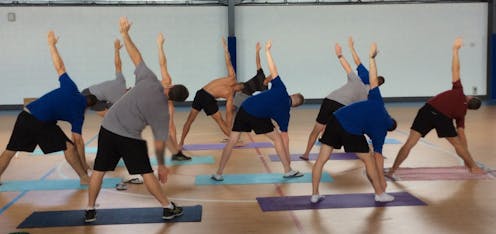
In 2017, a small group of male prisoners participated in an eight-week yoga program at the Alexander Maconochie Centre(AMC), which houses all adult prisoners in Canberra. While prison yoga programs have been evaluated in other countries, this yoga program was the first in Australia to be the subject of academic research.
In line with international research, our results published in the International Journal of Offender Therapy and Comparative Criminology showed that participants received significant mental and physical health benefits from the program.
Specifically, prisoners showed improvements in their levels of depression, anxiety and stress. They also reported an increase in self-esteem and an improved ability to accept their emotional responses and engage in goal-directed behaviour.
These are important outcomes because they are all crucial for the healthy functioning of the prison, and prisoners’ ability to build strong relationships after release.
Read more: Yoga isn't timeless: it's changing to meet contemporary needs
The ACT pilot yoga program
In addition to evaluating the results of the program for participants, another aim of the pilot was to identify the challenges involved in establishing a yoga program in a prison. The pilot was made possible through a partnership between our research team (made up of a clinical psychologist, criminal defence barrister and criminologist), ACT Corrective Services and the Yoga Foundation.
On a hot afternoon in late January 2017, ten male prisoners, with security classifications ranging from minimum to maximum, met their yoga teacher for the first time at the AMC prison.
None had any experience with yoga. In fact, they thought the program was an unconventional and “weird” offering.
For the next eight weeks, the prisoners were taught basic yoga postures (from downward dog to the triangle pose), various movement sequences and breath awareness. For participating prisoners, the challenges of learning the discipline were both physical and mental, as were the benefits.
Nine prisoners completed the program. Their efforts were acknowledged in a graduation ceremony, where they were presented with a yoga mat supplied by a local studio.
Our findings
The prisoners were assessed before the program to determine their existing levels of depression, anxiety and stress, their capacity to regulate their emotions and their self-esteem. They completed the same assessments again at the end of the program.
The results showed that the participants achieved statistically and clinically significant benefits from the program, as assessed by the Depression, Anxiety and Stress Scale (DASS-21), the Difficulties with Emotion Regulation Scale (DERS) and the Rosenberg Self Esteem Scale (RSES).
The participants reported improved flexibility, sleep and pain reduction. They also identified improvements in their mental well-being. All said the program had relaxed them.
One participant reflected that
it was something I looked forward to each week, towards feeling relaxed and calm. I would just feel really relaxed and at peace.
Another said that, after starting the yoga, he had fewer negative thoughts. Yet another reported that the program had an impact on how he approached people.
More calm. More relaxed.
The health of Australia’s prisoners
A 2018 report by the Australian Institute of Health and Welfare on the health of Australia’s prisoners presented a picture of compromised well-being.
Four out of every ten people entering prison had been diagnosed with a mental health condition, while 30% had a chronic physical health condition and 21% had a history of self-harm.
Read more: Give prisoners internet access for a safer and more humane community
Recent data presents a similarly grim picture in the ACT, with 30% of prisoners reporting depression, 32% reporting anxiety and 35% having attempted suicide.
Physically, 33% of prisoners in the ACT survey experienced chronic pain of some sort and 34% reported back problems.
What studies in other countries have found
A randomised controlled study was conducted in nine Swedish prisons in 2017 to assess the effects of yoga on prisoners. After the participants took part in a 10-week program, the researchers found significant improvements on 13 of 19 measures relating to well-being, leading them to conclude that
yoga practice can play an important part in the rehabilitation of prison inmates.
This is consistent with other studies on the rehabilitative benefits of yoga practices in countries where it has been introduced to prisons, such as India, the US and UK. The findings across various studies demonstrate statistically significant decreases in stress, depression, anxiety and aggression among prisoners who practised yoga, as well as improvements in impulse control.
The future for prison yoga in Australia
International research indicates that yoga programs can be a “cost-effective supplementary treatment” for prisoners with compromised mental and physical health, alongside professional medial care. Beyond this, yoga programs offer the potential to promote well-being even for those not experiencing any identified mental or physical health challenges.
All the participants in the Canberra program were enthusiastic about the potential for yoga programs to be offered more widely and regularly at the AMC. One, reflecting on his own experience of the benefits of participation, was adamant that priority should be given to “people who were really depressed”.
One of the challenges identified by the participants was the difficulty in maintaining their own practice without a structured class, pointing to the need for regular yoga programs.
Read more: Good mental health care in prisons must begin and end in the community
For a prison to offer ongoing classes, it would require funding for qualified yoga teachers. (We had the benefit of an experienced yoga teacher volunteering his time for our study.) In the UK and Ireland, funding for yoga and meditation enables classes to be offered in over a third of their prisons.
Ongoing classes also requires a commitment to meeting operational requirements, such as providing a space and arranging for the movement of prisoners.
We hope the ACT pilot program will lead to more yoga programs in Australian prisons that can be subject to larger-scale evaluations to test their benefits.
The last word on the potential for yoga programs to support prisoner well-being is best left to one of our participants.
You would have a negative day and then come there and after you had done it, it was nice, it was calming … the effects lasted, they were ongoing.
Authors: Anthony Hopkins, Senior Lecturer, Australian National University


 Daily Bulletin


