

With China's swift rise as naval power, Australia needs to rethink how it defends itself
- Written by: Hugh White, Emeritus Professor of Strategic Studies at the Strategic and Defence Studies Centre, Australian National University
As China grows more powerful and influential, we’re publishing a series, The New Superpower, looking at what this means for the world – how China maintains its power, how it wields its power and how its power might be threatened.
Visiting Wellington in April 1996, I fell into conversation with a very wise and experienced New Zealand government official. We talked about the still-unfolding Taiwan Straits crisis, during which Washington had deployed a formidable array of naval power, including two aircraft carrier battle groups, to the waters around Taiwan. The aim was to compel China to abandon a series of missile firings near Taiwan intended to intimidate voters in forthcoming presidential elections.
In this, the Americans had clearly been successful, but my Kiwi friend was worried.
Success has consequences, and the consequences here are plain: the Chinese will now do whatever it takes to make sure the Americans can never do that to them again.
That remark sparked one of the trains of thought which led to the arguments in my new book, How to Defend Australia.
His remark has been proved right. China has always had a formidable army, but only since 1996 has it begun to develop as a maritime power, as well. In that time, it has made massive and, it seems, very effective investments in the air and naval forces required to fight at sea.
Read more: Australia's naval upgrade may not be enough to keep pace in a fast-changing region
Today, it is quite plainly the world’s second maritime power, behind only the United States. And it now threatens America’s maritime preponderance in the western Pacific, on which US strategic primacy in the region ultimately and absolutely depends.
This is a remarkable achievement in such a short time, with immense implications for the security of countries throughout the region, so it is important to be clear about how it has happened and what it means, including for our own defence.
This is especially important because China’s achievement has been largely misunderstood by traditional naval powers like America, Britain and Australia, whose approach to maritime strategy is markedly different from China’s.
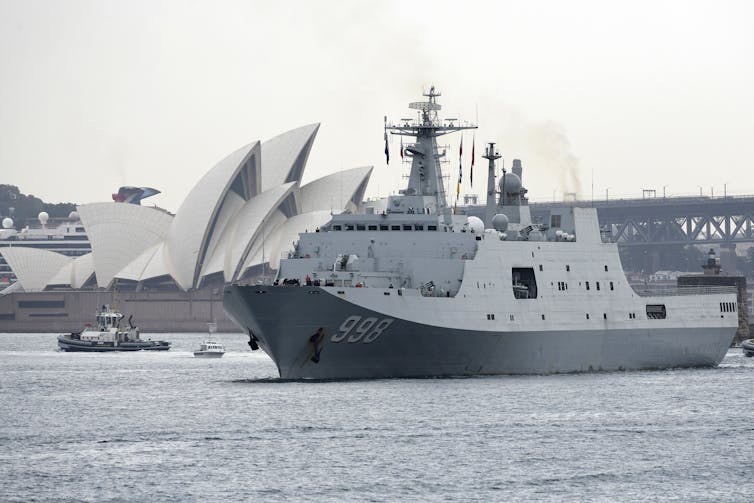 Was the visit last month by Chinese warship to Sydney Harbour a ‘reciprocal visit’, as Scott Morrison explained, or a show of force?
Bianca De Marchi/AAP
Was the visit last month by Chinese warship to Sydney Harbour a ‘reciprocal visit’, as Scott Morrison explained, or a show of force?
Bianca De Marchi/AAP
China’s ‘sea denial’ strategy
When it comes to maritime strategy, traditional naval powers emphasise “sea control” and power projection. This means their maritime forces are designed primarily to defend major platforms like aircraft carriers and amphibious assault ships, with which they aim to project power against distant adversaries.
China’s primary strategic aim has been the opposite. It has developed its naval forces to prevent adversaries – particularly the United States – from projecting power against China the way the Americans did in 1996. This is what naval strategists call “sea denial”, which boils down simply to the capacity to find and sink the other side’s ships.
In doing this, the Chinese have had three big advantages:
First, they have been able to exploit inherent advantages of “sea denial” over “sea control”. Since the late 19th century, a whole range of systems, weapons and technologies - including radio, radar, aircraft, submarines, sea mines, torpedoes, guided missiles and space-based surveillance - have made it progressively easier to find and sink an adversary’s ships, and correspondingly harder to defend them.
Second, the Chinese were able to access an array of Soviet military technologies and develop them further as their own technological base expanded and deepened.
And third, they have had a lot of money to spend, without breaking the bank, thanks to their fast-growing economy.
Read more: Xi Jinping's grip on power is absolute, but there are new threats to his 'Chinese dream'
As a result, Beijing is now well-placed to prevent America doing again what it did in 1996. A US naval carrier approaching Taiwan today would be at serious risk of attack from China’s formidable ships, aircraft and submarines, as well as from its notorious, carrier-killer, land-based ballistic missiles.
So much so, in fact, that Washington would now be very unlikely to risk such an operation.
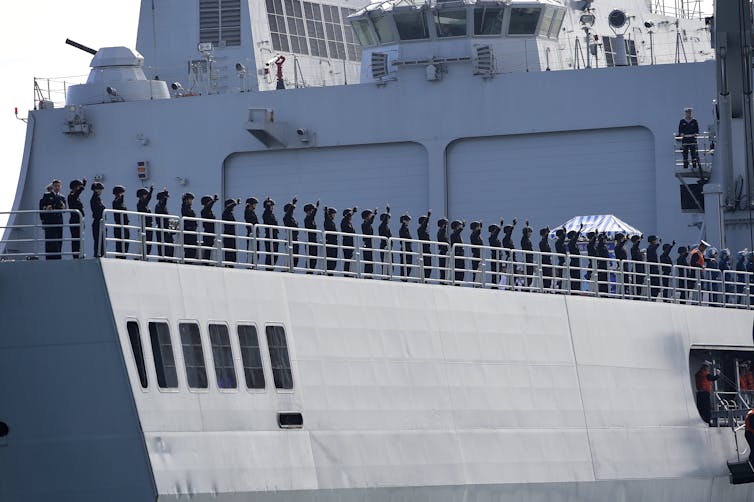 China’s navy is now only second to the US in terms of strength.
Bianca De Marchi/AAP
China’s navy is now only second to the US in terms of strength.
Bianca De Marchi/AAP
America’s loss of military might
This comes as a surprise to those who still believe that America’s military is unchallengeable.
Of course, it is still very powerful, with an unmatched capacity to deploy and sustain armed forces far from its own shores. But that doesn’t mean it can automatically defeat any adversary it faces, especially when that adversary enjoys the advantages of fighting on its home ground, as Russia would, for example, in a war over Ukraine or the Baltic states, or China would in east Asia.
And wiser heads in the US military establishment understand this all too well. The Pentagon’s recent Indo-Pacific strategy report concedes that China is “likely to enjoy a local military advantage at the onset of conflict” in east Asia.
In fact, that understates the problem. America has no credible military strategy to overcome China’s “early local advantages” to achieve the kind of swift, low-cost victory in a potential war at sea that everyone has taken for granted for so long.
The only serious attempt to develop such a strategy - the US military’s “Air Sea Battle Concept” - was abandoned soon after it was promulgated six years ago. The reality today is that America relies on the implicit threat of nuclear escalation, embodied in its refusal to rule out using nuclear weapons first, to compel China to concede victory when US conventional forces cannot.
And how credible is that threat when China can retaliate against any nuclear attack with a nuclear counter-strike?
Read more: Despite strong words, the US has few options left to reverse China's gains in the South China Sea
This swift shift in Asia’s maritime strategic balance has profound implications for the region’s strategic future. It does not just undermine America’s ability to defend Taiwan from Chinese military pressure, it undermines the credibility of US security guarantees to all its allies in the western Pacific, including Australia.
And that, in turn, undermines the foundation of America’s strategic leadership in east Asia, and paves the way for China to take its place - just as China intends.
It is this major change in the regional military balance, along with China’s relative economic weight, which makes the rapid eclipse of the old US-led order in our region now so likely.
China’s new maritime challenge
As this happens, however, China faces a new strategic challenge. Its cost-effective maritime denial strategy has been enough to undermine US regional primacy, but it will not be enough to take America’s place and establish dominance of its own in east Asia.
For that, it will need to be able to project its own military power across the vast expanse of the Asia-Pacific region. And that requires China to build its own carriers and amphibious forces – as it is now doing – and expand its capabilities to defend them from future potential adversaries.
This poses a whole new problem for China because now the boot is on the other foot. China has been able to leverage the inherent advantages of “sea denial” over “sea control” to counter US power projection in the region, but future adversaries can do the same to thwart China’s own power projection.
And that has very important implications for Australia’s future defence strategies.
Read more: With China-US tensions on the rise, does Australia need a new defence strategy?
The bad news is that we can no longer depend on America to ensure that a major power like China does not threaten us militarily in the decades ahead, or to defend us if one does. We must therefore explore – more seriously than we have ever done before – whether we can defend ourselves from a major Asian power.
It is a daunting task, but the good news, as I argue in my book, is that we can exploit the advantages of maritime denial over maritime control against China if it tries to project its power against us, or our close neighbours by sea.
By rigorously optimising our forces for a maritime denial strategy, we might be able to sustain an effective defence against a major power. That would come at a high price – much higher than we are paying for defence now – but it is a price we could afford if we decided the risks we face in Asia in the future were high enough to justify it.
Are they? That’s the big defence debate we need to have now.
Authors: Hugh White, Emeritus Professor of Strategic Studies at the Strategic and Defence Studies Centre, Australian National University


 Daily Bulletin


