

Floating cities: the future or a washed-up idea?
- Written by: Brydon T. Wang, Research Assistant and PhD Candidate, Queensland University of Technology
Humans have a long history of living on water. Our water homes span the fishing villages in Southeast Asia, Peru and Bolivia to modern floating homes in Vancouver and Amsterdam. As our cities grapple with overcrowding and undesirable living situations, the ocean remains a potential frontier for sophisticated water-based communities.
The United Nations has expressed support for further research into floating cities in response to rising sea levels and to house climate refugees. A speculative proposal, Oceanix City, was unveiled in April at the first Round Table on Sustainable Floating Cities at UN headquarters in New York.
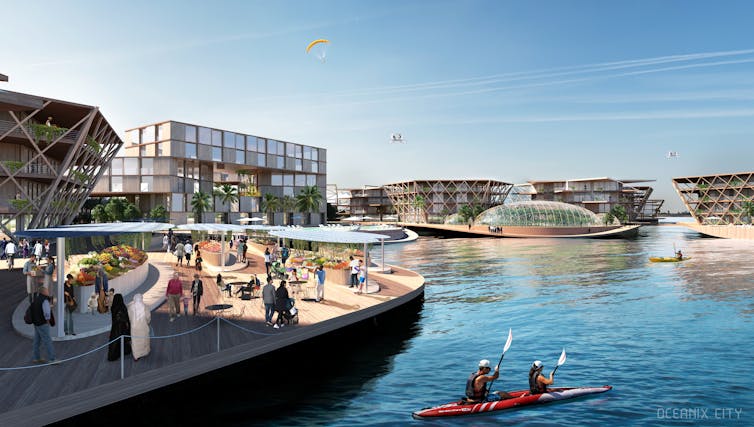 Life on a floating city, Oceanix.
OCEANIX/BIG-Bjarke Ingels Group
Life on a floating city, Oceanix.
OCEANIX/BIG-Bjarke Ingels Group
The former tourism minister of French Polynesia, Marc Collins Chen, and architecture studio BIG advanced the proposal. Chen is involved with the Seasteading Institute, which is seeking to develop autonomous city-states floating in the shallow waters of “host nations”.
While this latest proposal has gained UN attention, it is an old idea we have repeatedly returned to over the past 70 years with little success. In fact, the Oceanix City proposal has not reached the same level of technical sophistication as previous models.
Read more: The oceans are coming for us: how should we plan for dire sea level forecasts?
A brief history of floating cities
The architecture community was fascinated with marine utopias between the 1950s and ’70s. The technological optimism of this period led architects to consider whether we could build settlements in inhospitable places like the polar regions, the deserts and on the sea.
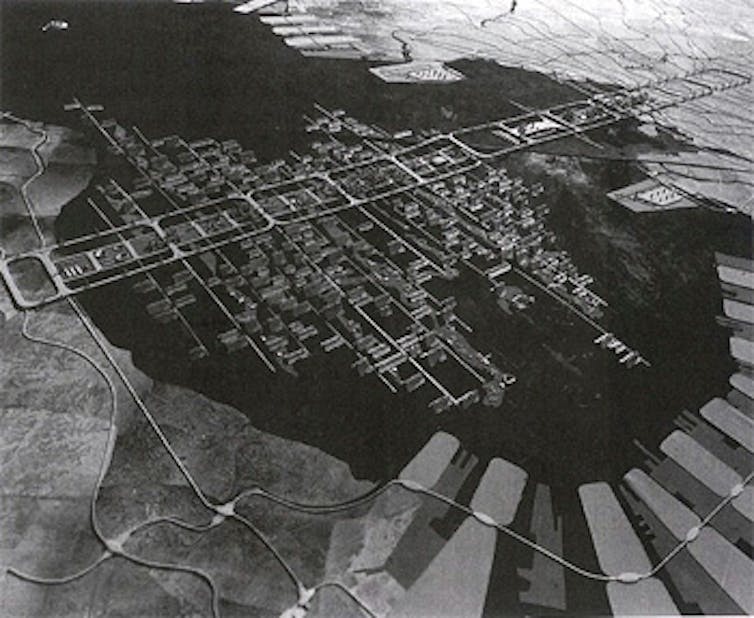 Plan for Tokyo Bay by Kenzo Tange, 1960.
Wikimedia
Plan for Tokyo Bay by Kenzo Tange, 1960.
Wikimedia
The Japanese Metabolists put forward incredible projects such as Kenzo Tange’s 1960 Tokyo Bay Plan and the marine city proposals of Kikutake and Kurokawa.
In the West, Buckminster Fuller proposed Triton City, which would be connected to the mainland via bridges. Archigram, a neofuturistic architectural group, proposed underwater sea farms.
These proposals were directed at solving the impending urban crises of overpopulation and pressures on land-based resources. Many were even sophisticated enough to be patented.
The arc of this global architectural discussion was captured during the first UN Habitat conference (“Habitat I”) in Vancouver in 1976. In many ways, the UN has returned to the Vancouver Declaration from Habitat I to “[adopt] bold, meaningful and effective human settlement policies and spatial planning strategies” and to treat “human settlements as an instrument and object of development”.
We are seeing a pivoting that began in 2008 with Vincent Callebaut’s “Lilypad” - a “floating ecopolis for ecological refugees”.
Where floating cities were once dismissed as too far-fetched, the concept has been repackaged and is re-emerging into public consciousness. This time in a more politically viable state - as a means of addressing the climate emergency.
Read more: Future 'ocean cities' need green engineering above and below the waterline
The technology and types of floating city structures
No floating settlements have ever been created on the high seas. Current offshore engineering is concerned with how cities can locate infrastructure, such as airports, nuclear power stations, bridges, oil storage facilities and stadiums, in shallow coastal environments rather than in deep international waters.
Two main types of very large floating structures (VLFS) technology can be used to carry the weight of a floating settlement.
The first, pontoon structures, are flat slabs suitable for floating in sheltered waters close to shore.
The second, semi-submersible structures (such as oil rigs), comprise platforms that are elevated on columns off the water surface. These can be located in deep waters. Potentially, oil rigs could be repurposed for such floating cities in international waters.
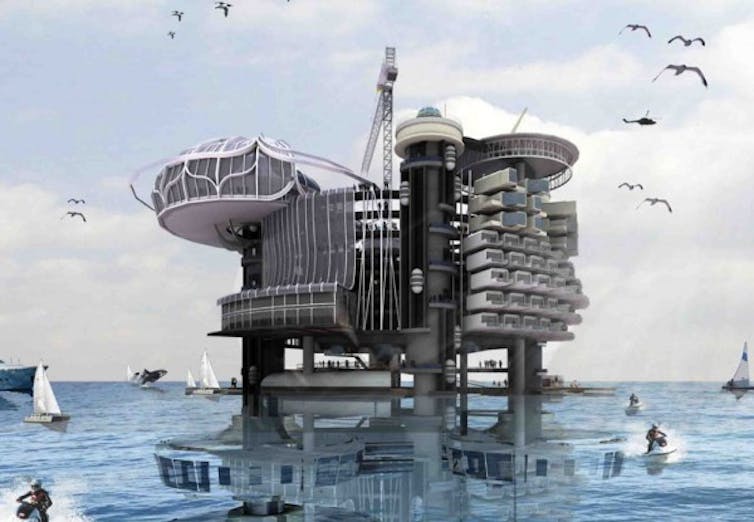 Transforming oil rigs into liveable structures. Ku Yee Kee and Hor Sue-Wern’s entry in the 2011 eVolo Skyscraper Competition.
Ku Yee Kee & Hor Sue-Wern/ eVolo, CC BY
Transforming oil rigs into liveable structures. Ku Yee Kee and Hor Sue-Wern’s entry in the 2011 eVolo Skyscraper Competition.
Ku Yee Kee & Hor Sue-Wern/ eVolo, CC BY
Oceanix City is based on the pontoon structure. This would restrict it to shallower waters with breakwaters to limit the impacts of waves. This sort of structure could serve as an extension of a coastal city, as a life raft for island communities inundated by rising waters, or to provide mobile essential services to residents of flood-prone slums.
Read more: Concrete coastlines: it's time to tackle our marine 'urban sprawl'
Sovereign floating cities and micronations
While some early marine utopian proposals were responses to emerging urban issues, many proposals conceptualised “seaborne leisure colonies”. These communities would be independent city-states allowing inhabitants to circumvent tax laws or restrictions on medical research in their own countries.
This sort of floating city was conceived of as a micronation with sovereignty and ability to provide citizenship to its occupants. The example was set by the Principality of Sealand, off the coast of Britain.
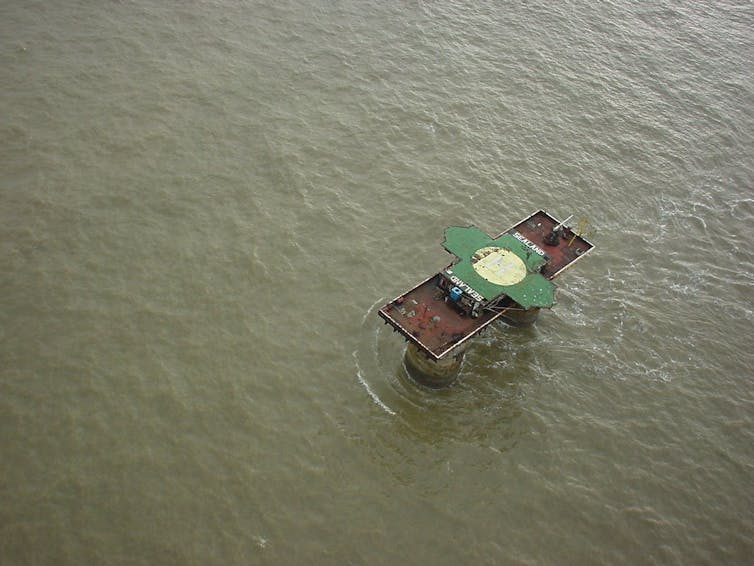 The Principality of Sealand is a micronation situated on Roughs Tower, a platform off the coast of Britain.
Ryan Lackey/Flickr, CC BY
The Principality of Sealand is a micronation situated on Roughs Tower, a platform off the coast of Britain.
Ryan Lackey/Flickr, CC BY
None of these proposals have succeeded. Even modern attempts such as the Freedom Ship and the Seasteading Institute’s plans for an autonomous floating settlement under French Polynesian jurisdiction have stalled. A recent attempt at creating a sovereign micronation (seastead) off Thailand led to its proponents becoming fugitives, potentially facing the death penalty.
Read more: New laws for the high seas: four key issues the UN talks need to tackle
A viable project?
Technology is not a barrier to floating cities in international waters. Advances in technology enable us to create structures for habitation in deep sea waters. These schemes have never really taken off because of political and commercial barriers.
While this time round proponents are packaging floating cities in a more politically viable concept as a life raft for climate refugees, commercial barriers remain. Apart from the UN, few organisation have the economic and political influence or reason to deliver a satellite floating city in the ocean.
In my view, the future of ocean cities is in technology campuses and in tourism. Given the significant risk of a community in extreme isolation in international waters, the solution to bringing people together in mid-ocean requires us to think about what connects us: technology, work and play. In these three elements we see, perhaps, the two lowest-hanging fruits (or the most buoyant of possibilities) for ocean cities.
The first is in floating tech campuses where large technology companies set up floating data centres and campuses in international waters. Situated outside national jurisdictions, these campuses could circumvent increasingly onerous privacy regimes or offer innovative technological services without having to negotiate regulatory barriers.
The second prospect is a return to the seaborne leisure colonies of the past. Companies like Disney could expand on their cruise offerings to build floating theme parks. These resorts could be sited in international waters or hosted by coastal cities.
Given our fascination with living on water, even if Oceanix City does not suceed, it won’t be long before we see another floating city proposal. And if we get the mix of social, political and commercial drivers right, we might just find ourselves living on one.
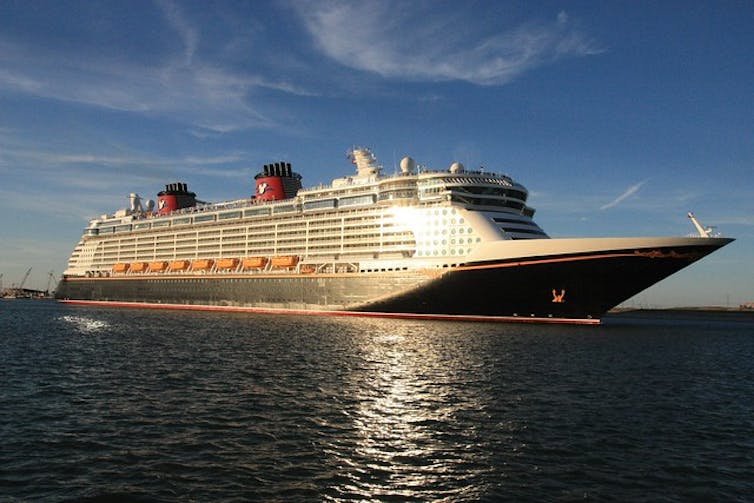 The Disney Cruise Line could potentially develop seaborne leisure colonies in future.
Diego Villuendas Pellicero/Flickr, CC BY-NC
The Disney Cruise Line could potentially develop seaborne leisure colonies in future.
Diego Villuendas Pellicero/Flickr, CC BY-NC
Authors: Brydon T. Wang, Research Assistant and PhD Candidate, Queensland University of Technology
Read more http://theconversation.com/floating-cities-the-future-or-a-washed-up-idea-116511


 Daily Bulletin


#/media/File:Tokyo_Bay_Plan_by_Tange_1960.jpg)