

The 'pulse' of a volcano can be used to help predict its next eruption
- Written by: Rebecca Carey, Senior Lecturer in Earth Sciences, University of Tasmania
Predicting when a volcano will next blow is tricky business, but lessons we learned from one of Hawaii’s recent eruptions may help.
Kīlauea, on the Big Island of Hawai'i, is probably the best understood volcano on Earth. That’s thanks to monitoring and gathered information that extends back to the formation of the Hawaiian Volcano Observatory in 1912.
The volcano is also subject to the world’s most technologically advanced geophysical monitoring network.
Read more: From Kilauea to Fuego: three things you should know about volcano risk
From the skies, satellites collect data that show the changing topography of the volcano as magma moves throughout the internal magma plumbing system. Satellites also look at the composition of volcanic gases.
From the ground, volcanologists use a number of highly sensitive chemical and physical tools to further understand the structure of that magma plumbing system. This helps to study the movement of magma within the volcano.
Earthquakes and vibrations
A lynch pin of volcano monitoring is seismicity – how often, where and when earthquakes occur. Magma movement within the volcano triggers earthquakes, and putting together the data on their location (a technique known as triangulation) tracks the path of magma underground.
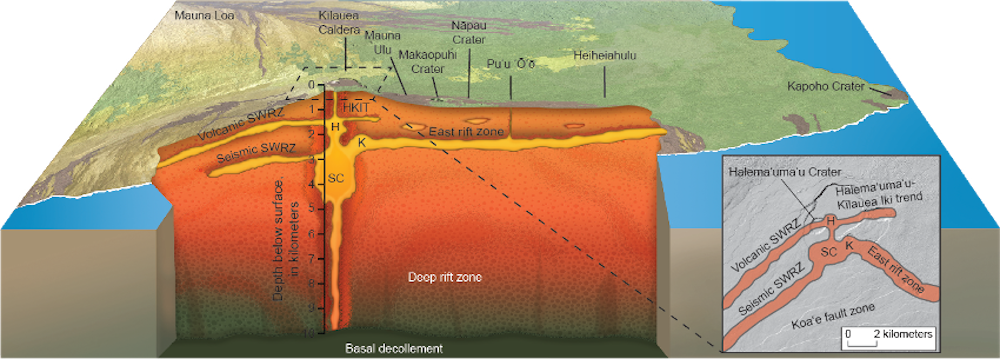 A schematic of the deep magma plumbind system of Kilauea volcano, Big Island, Hawaii. Magma is transported from deep within the Earth and arrives in a series of summit magma reservoirs.
USGS
A schematic of the deep magma plumbind system of Kilauea volcano, Big Island, Hawaii. Magma is transported from deep within the Earth and arrives in a series of summit magma reservoirs.
USGS
A newer technique, seismic interferometry, uses vibrations of energy from ocean waves hitting the distant shorelines that then travel through the volcano.
Changes in the speed of these vibrations help us map the 3D footprint of the volcano’s magma plumbing system. We can then detect when, and in some cases how, the magma plumbing system is changing.
This monitoring provides the “pulse” of the volcano during times of inactivity - a baseline from which to detect change during volcanic unrest. This proved invaluable for early warning, and the prediction of where and when, of the eruption of Kīlauea on May 3, 2018.
The “pulse” of Kīlauea includes cycles of volcano inflation (bulging) and deflation (contraction) as magma moves into and out of the storage region at the summit of the volcano.
The speeds of vibrations travelling through the volcano are predictable during observations of inflation/deflation cycles. When the volcano bulges, the vibrations travel faster through the volcano as rock and magma is compressed. When the volcano contracts these speeds decrease.
We describe this relationship between the two sets of data – the bulging/contraction and the faster/slower speed of vibrations – as coupled.
Something changed
Compared to our baseline, we saw the coupled data shift 10 days before the Kīlauea eruption on May 3. That told scientists the magma plumbing system had changed in a significant way.
The volcano was bulging due to the buildup of pressure inside the magma chamber, but the seismic waves were slowing down quite dramatically, instead of speeding up.
Our interpretation of this data was that the summit magma chamber was not able to sustain the pressure from an increasing magma supply – the bulge was too big. Rock material started to break around the summit magma chamber.
Breakage of the rocks perhaps then led to changes of the summit magmatic system so that more magma could more easily arrive at the eruption site about 40km away.
As well as Kīlauea, such coupled data sets are regularly collected, investigated and interpreted in terms of magma transport at other volcanoes globally. Sites include Piton de la Fournaise on Reunion Island, and Etna volcano, Italy.
But our modelling was the first to demonstrate these changes in the coupled data relationship could occur due to weakening of the material inside the volcano before an eruption.
The damage model that we applied can now be used for other volcanoes in a state of unrest. This adds to the toolbox volcanologists need to predict the when and where of an impending eruption.
So much data, we need help
When volcanoes are in a heightened state of unrest, the volume of information available from digital data and ground observations is extreme. Scientists tend to rely on observational monitoring first, and other data when time and extra people are available.
But the total amount of incoming data (such as from satellites) is overwhelming, and scientists simply can’t keep up. Machine learning might be able to help us here.
Artificial intelligence is the new kid on the block for eruption prediction. Neural networks and other algorithms can use high volumes of complex data and “learn” to distinguish between different signals.
Read more: How the dinosaurs went extinct: asteroid collision triggered potentially deadly volcanic eruptions
Automated early alert systems of an impending eruption using sensor arrays exist for some volcanoes today, for example at Etna volcano, Italy. It’s likely that artificial intelligence will make these systems more sophisticated in the future.
Early detection sounds wonderful for authorities charged with public safety, but many volcanologists are wary.
If they lead to multiple false alarms then that could slash trust in scientists for both managers of volcanic crises and the public alike.
Authors: Rebecca Carey, Senior Lecturer in Earth Sciences, University of Tasmania


 Daily Bulletin


