

Everyday racism fuels prejudice and hate. But we can challenge it
- Written by: Kumar Yogeeswaran, Senior Lecturer in Social Psychology, University of Canterbury
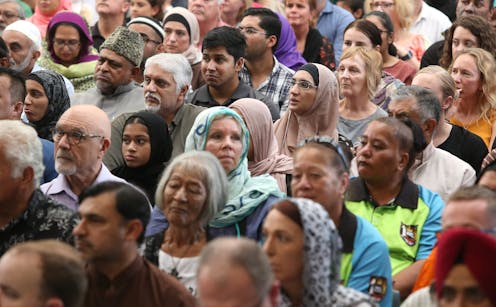
In the aftermath of the Christchurch terror attacks a month ago, New Zealanders are grappling with difficult, albeit necessary, questions about discrimination and casual racism.
The response to the horrific attack has been heartwarming. Tens of thousands of people from different backgrounds offered support to the Muslim community and paid their respects to those senselessly killed and wounded. The response of Prime Minister Jacinda Ardern has been similarly refreshing, and has become a global talking point. This gives us hope for a better future.
But lurking behind news articles and commentary proclaiming that this is “not us”, debate is growing about what this atrocity also tells us that we have been reticent to acknowledge.
Read more: How to challenge racism by listening to those who experience it
Everyday racism links to extremism
In some ways, both of these narratives ring true. On the one hand, we have bought into New Zealand’s high global ranking for tolerance and inclusion. On the other hand, New Zealand’s Human Rights Commission (HRC) and those of us who research prejudice and bigotry routinely find evidence for everyday experiences of casual racism. These experiences give extremism the space it needs to breathe.
One in three of the complaints received by the HRC in New Zealand is about racial discrimination. In 2017, the commission launched a Give Nothing to Racism campaign fronted by acclaimed film director Taika Waititi.
The New Zealand Human Rights Commission launched a campaign in 2017 to highlight everyday racism.Everyday, or “casual” racism and bigotry can appear relatively subtle or blatant. It may include comments such as complimenting someone who doesn’t fit the dominant group for being “well-spoken”, calling someone a “good” Muslim/Māori/Asian, excusing race-based jokes or comparisons as “just joking”. These seemingly benign comments are often accompanied with more blatant experiences of ethnic slurs, being told to go back to one’s country, or managers admitting they do not hire people with “foreign” sounding names (a violation of New Zealand law).
Compounded with such day-to-day experiences is research spanning decades and using a variety of tools (including neuroscience methods, reaction-time measures, and behavioural measures) to show bigotry lies on a continuum from blatant to subtle.
It’s worth mentioning, even subtle biases contribute to negative outcomes for minority groups’ health, well-being and participation in wider society. And even subconsciously perceiving minorities as “less civilised” can fuel intergroup conflict and violence towards minority groups, as shown by decades of research
While terrorism may represent the actions by a small number of extremists, they are fuelled by social norms that allow these ideologies to take root and propagate. As acclaimed French theorist Jean Baudrillard observed in The Spirit of Terrorism:
terrorism merely crystallizes all the ingredients in suspension.
Social norms shape attitudes
This does not imply that communities themselves are responsible for acts of terrorism, but rather that terrorism reflects what circulates in geopolitics, national politics, normative beliefs of those around us, the media and the influence of other ideological and social forces. Global context is, of course, important, but New Zealand now needs to reflect on how social norms within our own community can inadvertently promote hate and prejudice.
In Christchurch, and New Zealand more generally, extremist groups have been omnipresent for decades. Just last year, there was a white supremacist march down a main street in Christchurch that received numerous car horn toots of support. Students in Auckland have reported an increase in extremist group messaging on campus, even after the disbanding of a controversial European student association.
Read more: Christchurch mosque shootings must end New Zealand's innocence about right-wing terrorism
More broadly, data from the New Zealand Attitudes and Values Survey (NZAVS) show that 28% of New Zealanders are willing to express negative feelings toward Muslims. Fortunately, this is where all of us may be able to contribute to reinforcing the inclusive and tolerant society we tout in international rankings.
Where to from here
Well-intentioned and fair-minded people are often unaware of everyday experiences of members of minority groups. They often dismiss them as unrepresentative because the majority has a psychological investment in believing it “doesn’t happen here”. But such experiences do happen here as empirical research consistently finds, and these experiences cannot be undone simply through a similar number of positive experiences. People have a “negativity bias”, which means that negative events are weighed more heavily than positive ones. And if we have limited opportunities to forge meaningful close connections with people from other groups, then all it takes is a handful of negative experiences to wash away the benefits of other positive interactions and create distrust and social distancing between groups. Research shows although positive experiences are more common, negative experiences influence our attitudes more strongly.
Even as we work in increasingly diverse workplaces, our social circles tend to be fairly homogenous. Data from the NZAVS show that as recently as 2017, 64% of White New Zealanders report that they did not spend any time in the last week socialising with someone Māori. Some 83% say the same about socialising with someone Pasifika, and 77% report spending no time with someone Asian, suggesting that for many of us, our social networks are largely homogenous.
While this is similar to patterns elsewhere in the world, these homogenous networks create psychological distance between “us” and “them”. This also insulates us from hearing differing perspectives because minorities often fear that they will be seen as complainers if they share negative experiences in casual settings.
Instead, establishing relationships with people who are different from ourselves promotes positive intergroup contact, which is one of the most well-established approaches to reducing prejudice. Similarly, promoting social environments that encourage dialogue and cooperation, establishing common goals and providing opportunities for multicultural experiences offer some starting points for how to move forward.
At a time when the UN estimates more than 250 million people live outside of their country of birth, cultural diversity is an inevitable reality. It means we must learn to live and work together, and at the very least tolerate our differences. If each of us works to remove everyday bigotry within our immediate environment, we make it that much harder for extremist ideologies to take hold.
Authors: Kumar Yogeeswaran, Senior Lecturer in Social Psychology, University of Canterbury
Read more http://theconversation.com/everyday-racism-fuels-prejudice-and-hate-but-we-can-challenge-it-115118


 Daily Bulletin


