

Of bunyips and other beasts: living memories of long-extinct creatures in art and stories
- Written by: Patrick D. Nunn, Professor of Geography, School of Social Sciences, University of the Sunshine Coast
On many continents during the last ice age, typically from about 50,000 to 12,000 years ago, species of megafauna that had lived there for hundreds of thousands of years became extinct. Comparatively abruptly, it appears, in most instances.
Either climate change and/or humans caused these megafaunal extinctions. This means, of course, that people likely knew about megafauna: how they looked, how they behaved, how they might be most effectively hunted and so on. Is there a possibility that any fragments of this knowledge have reached us today? Incredibly, the suggestion seems plausible.
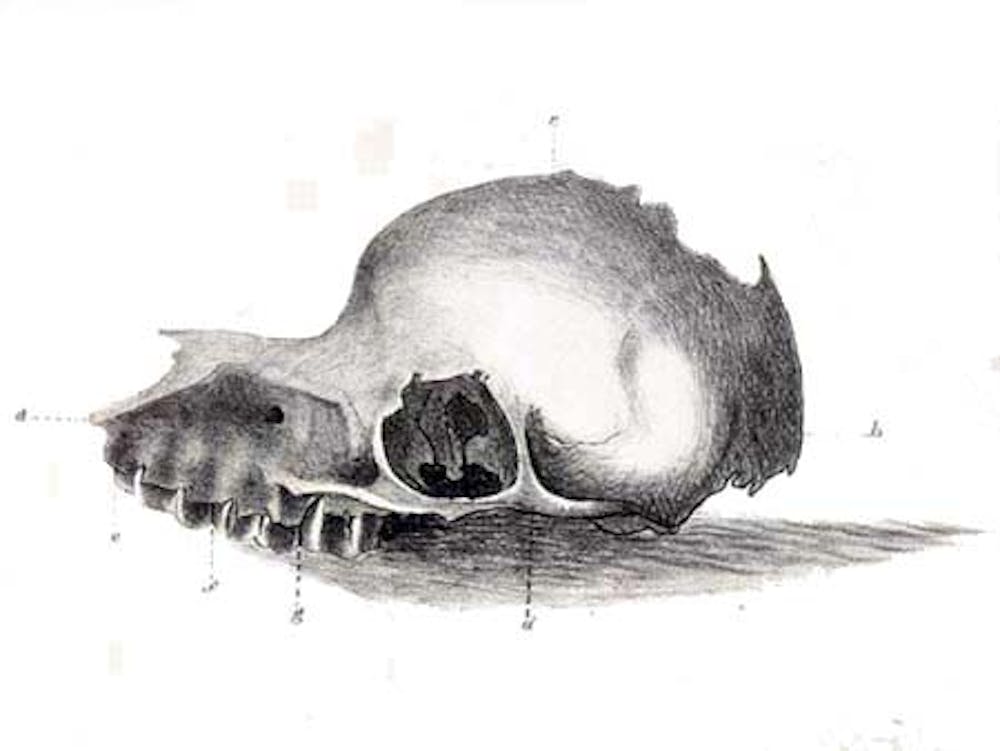 An 1847 drawing of a so-called Bunyip skull, reproduced from The Tasmanian Journal of Natural Science.
Wikimedia Commons
An 1847 drawing of a so-called Bunyip skull, reproduced from The Tasmanian Journal of Natural Science.
Wikimedia Commons
A recent collaboration between scientists in Australia and Brazil shows there are many similarities in the oral (and visual) records of now-extinct creatures.
We suggest these similarities derive from those in the nature of Australian and South American megafauna and their geological context, especially in drier parts of these continents where certain megafauna were more common owing to the lack of dense vegetation.
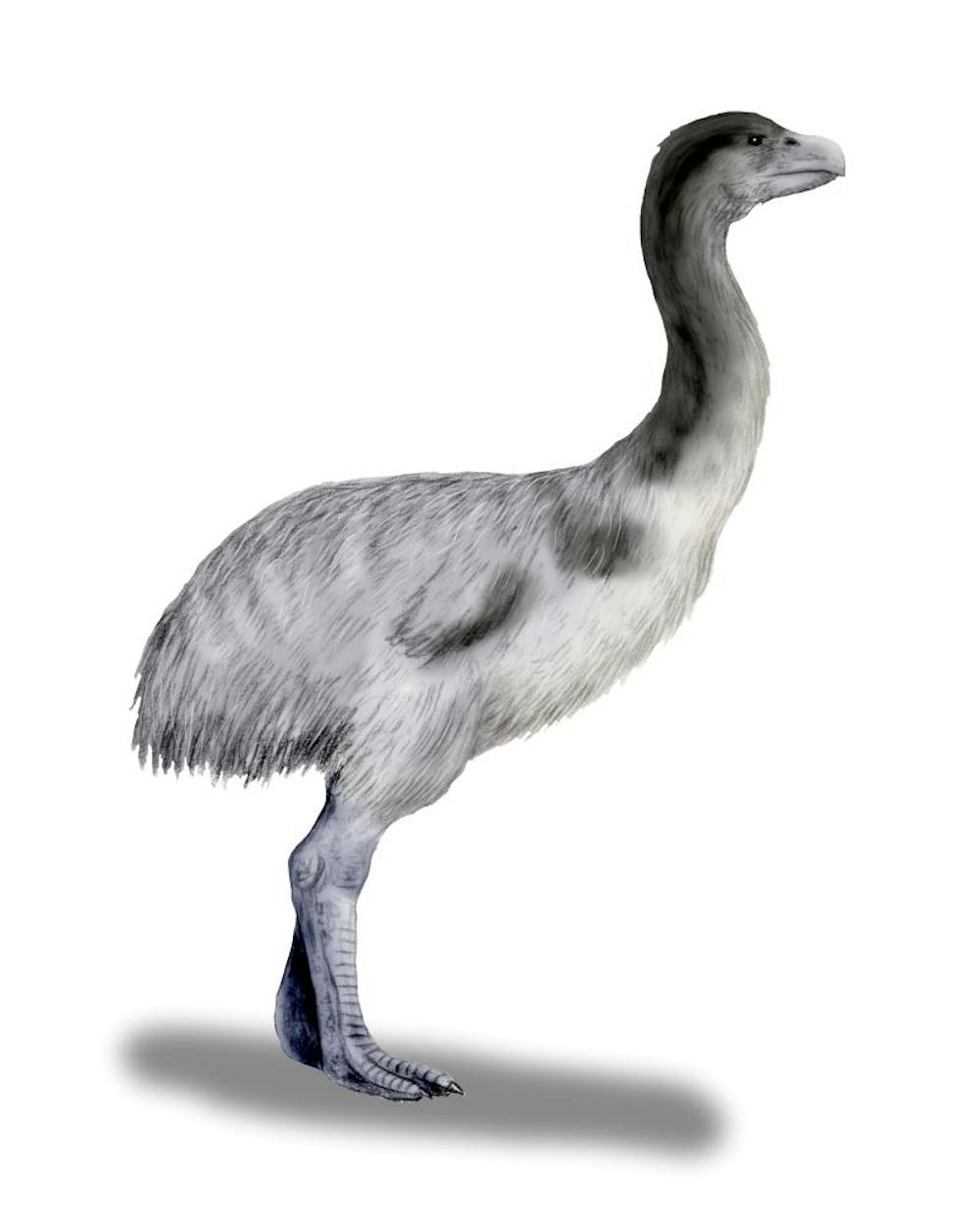 Pencil drawing of Genyornis newtoni, a thunderbird from the Pleistocene of Australia.
Nobu Tamura/Wikimedia Commons
Pencil drawing of Genyornis newtoni, a thunderbird from the Pleistocene of Australia.
Nobu Tamura/Wikimedia Commons
In most of Australia, megafauna species are considered to have become extinct by about 40,000 years ago although several exceptions are known.
For example, if the horse-sized marsupial tapir (Palorchestes azael) is indeed represented in Kimberley rock art, then it probably survived here until much more recently. A similar conclusion can be drawn about Genyornis, giant flightless birds, their heads “as high as the hills”.
The methods by which these birds were hunted by the Tjapwurung people of southern Australia have come down to us today, suggesting that Genyornis (or something like it) may have survived significantly more recently than the 41,000 years implied by most of its fossil ages.
Indigenous Australians are also known to have co-existed with the lumbering, bull-sized, wombat-like marsupial Zygomaturus trilobus for at least 17,000 years – ample time for details of their nature to have been incorporated into the extraordinarily long cultural memories of Aboriginal people.
Brazilian megafauna were dominated by placental mammals, many species of which became extinct 11,700 years ago.
Among these were the pampatheres, closely related to armadillos; several native horse species, fossil bones of which have cut marks showing humans ate them; a mastodon, Notiomastodon platensis; Xenorhinotherium, which resembled llamas with trunks; and the fearsome carnivore, Smilodon populator, the largest-known, sabre-toothed cat.
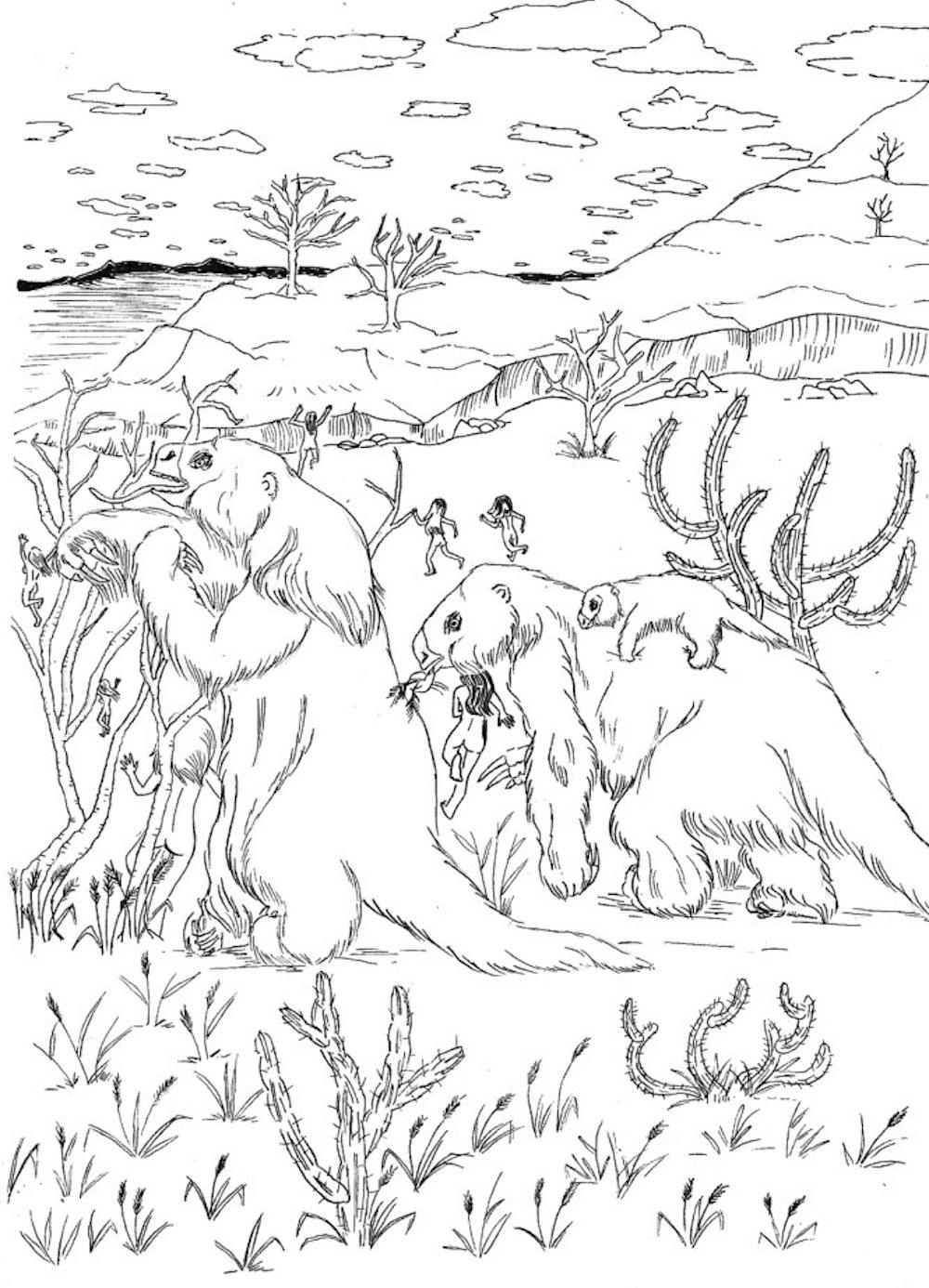 Eremotherium laurillard reconstruction from the book Conselhos Geopoéticos, written by Luiza C.M.O. Ponciano and João Marcus Caetano. Illustrated by Pâmella Oliveira (UNIRIO).
Author provided
Eremotherium laurillard reconstruction from the book Conselhos Geopoéticos, written by Luiza C.M.O. Ponciano and João Marcus Caetano. Illustrated by Pâmella Oliveira (UNIRIO).
Author provided
The similarity between palaeontology-informed reconstructions of extinct megafauna and their representations in ancient rock art leave little doubt that Aboriginal Australians and Brazilians were familiar with these creatures. But what of the stories?
From what we know about storytelling in pre-literate societies, it seems likely that the original descriptions of extinct Australian and Brazilian megafauna in Indigenous memories may have evolved through time, being successively applied to species that people feared or with which they were unfamiliar.
In Australia, it is possible that the fabulous creature Aboriginal Australians knew as kadimakara was originally Diprotodon, the largest Australian megafaunal species. Yet in places, it seems likely that kadimakara later became the name for (large) crocodiles.
Maybe the bunyip, that quintessentially Australian beast, said to groan and bellow incessantly from waterholes, was a name recently given to the large water-rat or rakali – something that could be mistaken for an otter. But the name “bunyip” had perhaps earlier been applied to a succession of apparently strange creatures.
For example, an 1846 account that reports local Indigenous groups recalling that bunyips were as tall as gum trees and tore trees out by their roots puts one in mind of Palorchestes azael, the marsupial tapir, which behaved in this way.
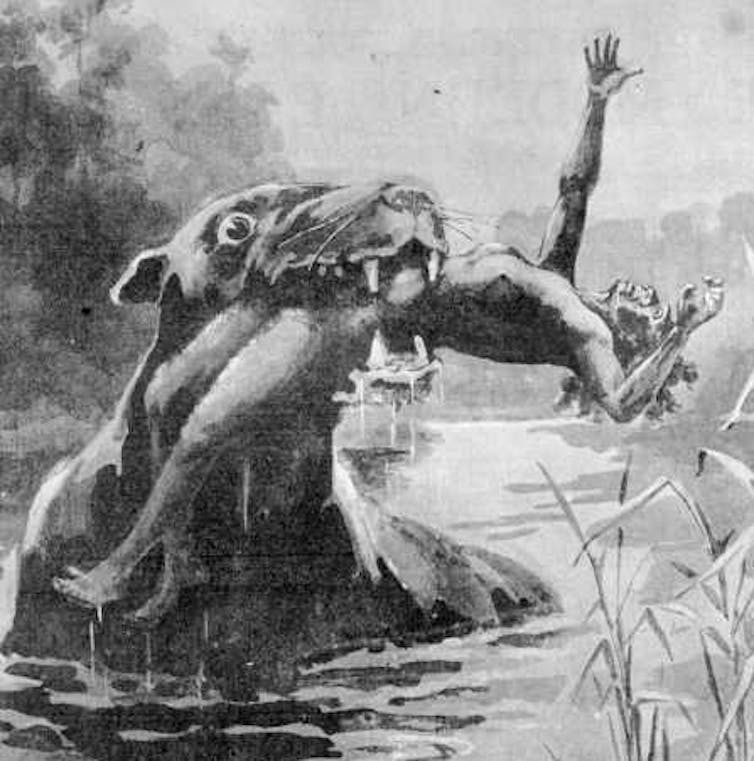 An 1890 drawing of a bunyip from the Illustrated Australian news.
Wikimedia Commons
An 1890 drawing of a bunyip from the Illustrated Australian news.
Wikimedia Commons
Similar mythical creatures are associated with Brazilian cacimbas (waterholes). One of the best-known is the mapinguari, a massive biped (walks on two legs) with long sharp claws, likely to be based on memories of a giant sloth that became extinct about 12,000 years ago.
In other parts of Brazil, there are stories about the Cobra Grande, a giant snake that slides beneath the ground surface, furrowing it as it winds its way, but then also shattering it when it turns abruptly, causing earthquakes.
So ingrained in Brazilian culture is this giant snake that an annual festival in Pará State occurs with the intention of calming the snake and protecting local people from calamity. The parallels with the behaviour of the rainbow serpent in Australian traditions are remarkable.
We shall never be able to prove conclusively that Indigenous stories about fabulous creatures like the bunyip and the mapinguari derive from observations of now-extinct megafauna, but it is reasonable to suppose this may be the case in some instances.
There is good evidence from several parts of the world that stories about observations made more than 7,000 years ago – perhaps more than 10,000 years ago – have come down to us today in intelligible form. With this in mind, it’s plausible to suppose human memories of long-extinct creatures today underpin many stories that we have generally regarded as fiction.
Authors: Patrick D. Nunn, Professor of Geography, School of Social Sciences, University of the Sunshine Coast


 Daily Bulletin


