

Seven steps Melbourne can take to regain its 'liveable city' crown
- Written by: Mark Nieuwenhuijsen, Professorial Fellow, ACU, and Research Professor ISGlobal, Instituto de Salud Global de Barcelona (ISGlobal)
For seven years, Melbourne boasted the title of “world’s most liveable city”, but recently lost the top spot to Vienna. The Economist Intelligence Unit awards the title each year when it publishes its Global Liveability Index. This ranks 140 cities for their urban quality of life based on assessments of stability, health care, culture and environment, education and infrastructure.
The rankings have their limitations, which have been criticised. To regain top spot, or indeed just to become a better place for the people who actually live in the city, perhaps Melbourne and other cities like it should go beyond the traditional indicators. This means considering other factors that affect not only liveability but also health and sustainability.
Read more: The world's 'most liveable city' title isn't a measure of the things most of us actually care about
Health and mobility are linked
Urban and transport planning has a large impact on sustainability, liveability and health. A recent study in Barcelona estimated 3,000 people die prematurely each year (20% of total mortality) because of urban and transport planning-related environmental and lifestyle factors. The largest contributor to premature death was lack of physical activity, followed by air pollution, noise, heat island effects and lack of green space.
 A city that makes walking more convenient has many benefits for health and well-being.
fritz16/Shutterstock
A city that makes walking more convenient has many benefits for health and well-being.
fritz16/Shutterstock
Melbourne is a sprawling city with not enough public and active transport. The result is a high level of car dependency (85% of trips are by car).
There are direct links between urban and transport planning, level of environmental exposures and physical activity and health and well-being. For example, infrastructure for cars results in higher car use and increases in air pollution, noise, greenhouse gas emissions, stress, mental health problems and heat island effects, and lack of physical activity, green space and social contacts.
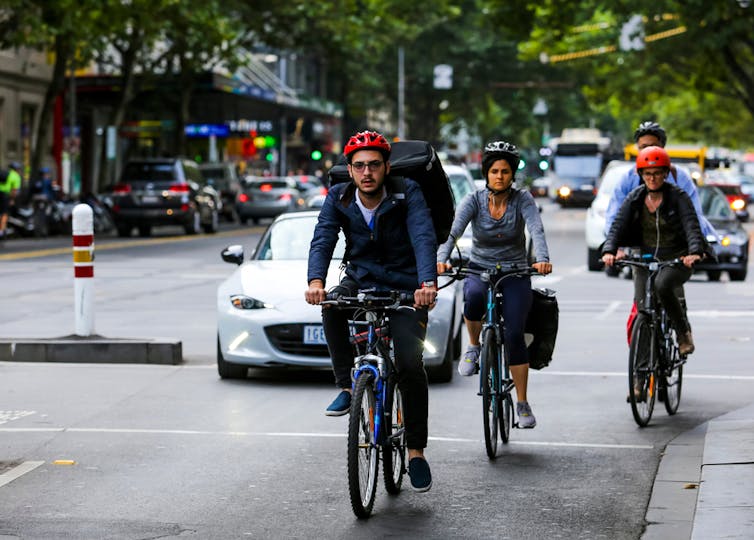
On the other hand, an investment in infrastructure for active transport such as cycling and walking leads to reductions in air pollution and CO₂ emissions, noise, stress, mental health problems and heat island effects, and increases in physical activity, social contacts and possibly green space.
Climate change is a real threat and motorised traffic is one of the large contributors to CO₂ emissions. And motorised traffic takes up a lot of public space in a city – up to 60%-70%. This space could be used in much better ways to make a more pleasant living environment.
 A shift from cars to cycling could free up a lot of road and parking space in the city.
Abdul Razak Latif/Shutterstock
A shift from cars to cycling could free up a lot of road and parking space in the city.
Abdul Razak Latif/Shutterstock
Read more: Freeing up the huge areas set aside for parking can transform our cities
Creating a sustainable, liveable and healthy city
So how do we make Melbourne not only more liveable, but also more sustainable and healthy? We urgently need to reduce urban sprawl and car dependency, increase public space for people, increase public and active transport, and increase green space.
Resulting reductions in air pollution, noise and heat island effects and increased physical activity will improve health and well-being. Furthermore, the changes in transport modes and CO₂ storage by greening will mitigate climate change effects.
There are no magic bullets to achieve these goals. It requires a package of measures, strong political leadership and large investments.
The following are seven strategies, with examples of specific measures:
1. Put people at the centre of public spaces
change the hierarchy of planning from car/motorbikes, public transport, cycling and pedestrians to pedestrians, cyclists, public transport and car/motorbikes
adopt the Barcelona superblock model for the CBD to start with, to increase public space for people
introduce a 30km/h speed limit for neighbourhoods.
2. Increase density and land-use mix
increase urban density (make the city more compact) and reduce sprawl, but do not build high-rises – limit buildings to 5-6 floors
increase the mix of housing, places of work or schooling and access to basic services and shopping, and improve walkability to reduce the need for travelling longer distances.
3. Reduce motorised traffic and move towards public and active transport
reduce the number of motorised vehicles circulating (50% reduction by 2030) with an overall aim of a car-free city, starting with making the CBD car-free
introduce levies for parking at work in the city (e.g. $500-1,000 per year) that can be used to fund public transport
introduce transport planning policies that result in the same travel time for cars and public transport from and to a given destination, by giving priority to public transport
make a shared delivery system for shops to reduce the number of vehicles
increase the cycling network with a segregated cycling lane on each road and make sure it is well connected
encourage and provide financial incentives for electric bicycles for long-distance cycling and/or cycling in hilly areas
create policies and infrastructure so all children can get to school by active and public transport.
4. Zero-emission motorised traffic by 2035
make all remaining buses, trucks, cars and motorbikes electric by 2035 – all new motorised vehicles should be electric from 2025 onward
use roof tops for a distributed solar power system (with solar panels) to provide renewable energy for electric vehicles and households.
5. Increase green space
create more green space with trees in every street, greening of vacant lots and tunnelling of roads with green space on top (target a green space of 1 hectare within 300 metres of every residence)
increase green roofs and walls on buildings
green school patios and make these areas accessible to the neighbourhood on weekends and holidays
connect existing green infrastructure by creating green corridors that are also suitable for active transport.
6. Control pollution emissions from other sources
stricter control on emissions from the port
stricter control on emissions from other sources, such as industry and rubbish
better insulation of buildings to reduce energy use for heating and cooling
aim for a low-carbon city with zero CO₂ emissions by 2035.
7. Improve governance
strong political leadership to make changes
provide administrative structure within the metropolitan area that integrates urban and transport planning, environment and public health policies to promote sustainability, health and well-being
work more closely with regional authorities and councils on integrating the transport system
create genuine participatory processes and involve citizens.
We can make our cities more sustainable, liveable and healthy, but it requires a large joint effort and can only be achieved with a strong vision and commitment. However, the results can be highly rewarding.
Most people nowadays choose cities to live. These currently have detrimental effects on the environment, health and well-being, so let’s create more liveable cities that promote health and well-being.
Read more: City-by-city analysis shows our capitals aren’t liveable for many residents
Authors: Mark Nieuwenhuijsen, Professorial Fellow, ACU, and Research Professor ISGlobal, Instituto de Salud Global de Barcelona (ISGlobal)
Read more http://theconversation.com/seven-steps-melbourne-can-take-to-regain-its-liveable-city-crown-113726


 Daily Bulletin


