

How Deep-V Hull Design Improves Ride in Rough Water
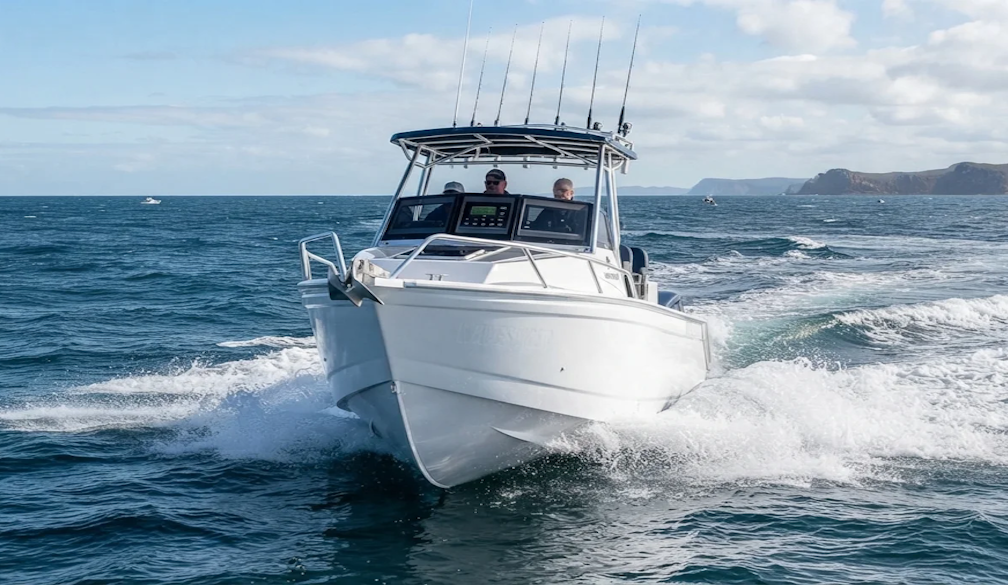
Anyone who's punched into a 20-knot sea breeze on the way home knows the difference a hull makes. One boat crashes off every wave, rattling your teeth and soaking the crew. Another carves through the same chop, landing softly and keeping everyone dry.
That difference comes down to hull shape, and for rough water nothing beats a well-designed deep V. Here's how it works, why it matters on the bar and offshore, and what to look for when you're choosing your next fishing boat.
What is a deep-V hull?
Look at a boat from the stern and you'll see the bottom form a V shape from the keel up to the chines. The angle between the hull bottom and a horizontal line is called deadrise. The steeper that angle, the deeper the V.
- Flat or shallow V (under about 12°): stable and shallow-drafted, ideal for calm rivers and lakes, but harsh in a chop.
- Modified V (roughly 12–16°): a compromise that suits bays and sheltered water.
- Deep V (around 18° and above at the transom): built for open water, with a sharp entry at the bow that gets even steeper forward.
Two other features shape how a hull handles rough water. The entry shows how sharp the bow is where it first meets the wave. The chines are where the bottom meets the sides, and their shape controls lift and spray. A good offshore hull gets all three right.
How a deep V softens the ride
It slices instead of slams. A flat bottom hits the face of a wave all at once, so the whole impact goes straight into the hull and up through your knees. A deep V meets the water with a narrow edge first, then spreads the load gradually as the hull settles. Think of a knife going into water versus a hand slapping it.
It lands softly. When the boat comes off a wave, the V re-enters the water progressively rather than belly-flopping. That cushioning is what makes a long run home in a chop bearable.
It tracks straight. The keel and steep sections bite into the water, helping the boat hold its line in a quartering or following sea instead of being pushed around. That control matters most when you're crossing a bar.
It keeps speed up safely. Because the hull isn't pounding, you can hold a sensible cruising speed in rough conditions. That means less time exposed and more time fishing.
The details that separate a good deep V from a great one
Deadrise gets the headlines, but several other design choices decide how a hull actually behaves when the sea gets up.
Deadrise in practice. Many offshore plate aluminium boats run around 18–21° at the transom, with a sharper angle at the bow. Australian builder Bar Crusher, for example, works in this range on its offshore hulls. Go much steeper and the boat needs more power and becomes less stable at rest; go much shallower and the ride starts to harden in a chop.
Strakes: help or hindrance? Lifting strakes are the thin ridges running along the bottom of many hulls. They add lift and help a boat plane, but on some designs they can cause pounding in waves and send turbulence over the propeller, which can aerate it and make the engine over-rev. Some designers leave them off for a softer ride and cleaner sounder readings, while others fine-tune their size and position. Neither approach is right for every boat, so judge the result on the water.
Chine shape and spray. Reversed or negative chines turn spray down and out instead of letting it climb the sides, which keeps the crew drier. Wider chines towards the stern add lift and help steady the boat. Some hulls also run a narrow planing plank along the keel for extra lift and directional stability.
A stiff structure. A hull is only as good as what holds it together. A well-braced sub-floor reduces flex, noise and fatigue in the hull, and sealed buoyancy compartments add a valuable safety margin.
The trade-off: stability at rest
A deep V has one well-known weakness. The same steep bottom that cuts through waves can make the boat roll more when it's stopped, drifting or at anchor. For anglers that matters, because you spend most of the day fishing, not driving.
Designers tackle this in a few ways:
- Wider chines aft give the hull more bearing surface at rest.
- Water ballast chambers flood when the boat stops, adding weight low in the hull for a steadier platform. The water drains as the boat gets onto the plane, so you don't carry the extra weight at speed.
- Sensible loading helps too. Heavy gear stowed low and central reduces roll on any hull.
The best offshore boats combine a soft ride underway with a platform that stays steady when you stop to fish.
What to look for when comparing hulls
- Ask for the numbers. Transom deadrise and how sharply the bow is shaped tell you a lot about rough-water ride.
- Look underneath. Check the chine shape, whether the hull has strakes, and whether there's a planing plank along the keel.
- Ask about stability at rest. Find out whether the boat uses water ballast or other features to reduce roll.
- Read the design details. Manufacturers that explain their deep-V hull design in plain terms make it much easier to compare like with like.
- Sea trial in real conditions. A glassed-out morning tells you nothing. Test the boat on a day with some chop.
Getting the most from a deep V in rough water
-
Trim the bow down into a head sea. Let the sharp forward sections do the work of cutting the chop.
-
Trim up a little in the following sea. This stops the bow digging into the back of the wave ahead.
-
Find the sweet spot. Adjust the throttle until the boat runs across the tops rather than falling into every trough.
-
Quarter big swells. Taking waves at a slight angle lets the V cut through with less vertical motion.
-
Load the boat evenly. Keep heavy gear low and central so the hull rides at its designed attitude.
-
Never rush to a bar. Watch the sets, wait for a lull and stay on the back of a wave.
The bottom line
If you fish offshore, cross bars or regularly head out when the breeze is up, hull design is the single biggest factor in comfort and safety. A true deep V, with a sharp entry, steep deadrise and well-shaped chines, turns a bone-jarring run into a manageable one. Pair it with a sound way of staying stable at rest and good driving technique, and you'll fish more days in more comfort.
FAQ
What deadrise counts as a deep-V hull? As a general rule, around 18° or more at the transom, with a sharper angle towards the bow.
Does a deep V use more fuel? A deeper V can need a little more power to get onto the plane. Well-designed chines and a planing plank add lift, which helps the hull plane efficiently.
Are deep-V boats less stable at rest? They can roll more when stopped. Wider chines aft and water ballast chambers that flood at rest are common ways to reduce this.
Do all deep-V hulls have strakes? No. Strakes add lift but can cause pounding and prop turbulence on some designs, so some builders leave them off. The best test is how the boat rides in real conditions.


 Daily Bulletin


