

KGI: 2025 Mid-Year Market Outlook
- Written by: Daily Bulletin
- Published in News from Asia
Navigating the New Normal
HONG KONG SAR - Media OutReach Newswire - 24 June 2025 - Today, KGI has released its 2025 Mid-Year Market Outlook.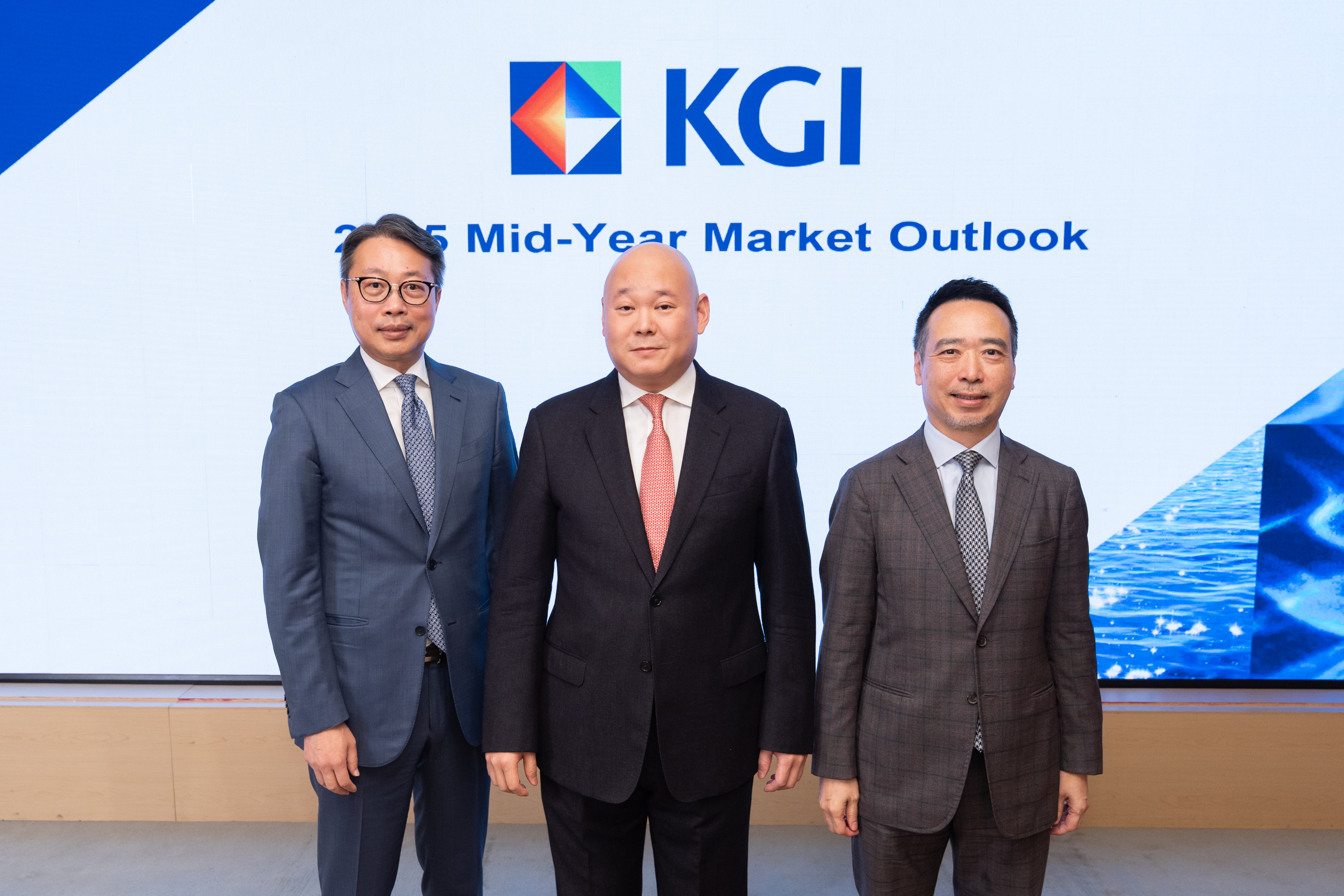
Looking back over the first half of the year, Trump officially took office as President of the United States and started a trade war.
At one point, he even threatened to levy tariffs on China of more than 100%, triggering massive market fluctuations. Since then, many countries have entered negotiations with the U.S., and positive signals have emerged. How will the ongoing tariff war affect global economic development? How will the economic uncertainty created by Trump's policies influence interest rate trends? How will China respond to the increasingly tense trade relationship? And how will China achieve economic growth targets amid external economic instability?
Under this backdrop, for the second half of the year, we maintain the "ACE" strategy:
- Alternatives: Gold and other alternative assets are expected to be inflation-resistant and have lower correlation with traditional stocks and bonds.
- Credit Selection: Maintain a preference for high-grade bonds, as the market still presents opportunities to lock in yields.
- Elite Stocks: Diversify investment in quality stocks, balancing the allocation between cyclical and defensive stocks.
Cusson Leung, Chief Investment Officer at KGI, says: "In terms of asset allocation, considering the economic and political developments in the second half of the year, investors can continue to follow the ACE strategy: A is Alternatives. The fiscal conditions of multiple governments have sparked controversy, coupled with central banks diversifying asset allocations and geopolitical instability, which will be favorable to gold prices. C is Credit Selection. We expect downside risks to the economy, thus maintaining a preference for quality bonds. Corporate bonds will provide opportunities to lock in yields. E is Elite Stock. Tariff expectations are anticipated to impact corporate earnings; cyclical stocks and defensive stocks can be balanced in the allocation. Outside the United States, focus on countries with minimal tariff impact or those that have already reached agreements."
Macro & U.S. Markets
In 2H2025, the global economy will enter a slowdown mode, particularly in emerging markets, with the slowdown being most pronounced in the United States among mature markets. In the first half of the year, U.S. companies stockpiled goods in anticipation of tariff wars, resulting in decent economic performance. However, this situation will not continue into the second half, with GDP growth rates potentially falling below 1%, averaging around 1.35% for the year. The slowdown in the Eurozone and the UK will be less pronounced than in the U.S., but the negative impacts of the trade war cannot be underestimated. The economic outlook for Japan and China is also bleak.
In the first half of the year, the U.S. economy shone due to strong demand, but this demand is expected to wane in the second half, leading to weaker economic data. The uncertainty of Trump's policies affects consumer confidence and corporate orders, with labor market data showing a downward trend, further impacting wages and consumption.
The Fed may cut interest rates by 25 basis points in the fourth quarter of 2025 and continue to lower rates by 50 to 75 basis points in 2026. As for U.S. stocks, the likelihood of entering a bear market this year is low, but a decline is possible in the third quarter, with annual profit estimates dropping from 14.1% to below 9%. Investors are advised to focus on defensive and high-quality stocks to weather the economic downturn.
In terms of bond investments, the weakening U.S. economy is expected to drive bond yields lower, with Treasury yields projected to fall to 4.0%-4.3% from the latter half of the third quarter to the fourth quarter. It is recommended to invest in higher-quality investment-grade corporate bonds and consider transitioning to non-investment-grade corporate bonds when the economy hits bottom.
James Chu, Chairman at KGI Securities Investment Advisory, says: "The easing of the trade war has reduced the risk of a U.S. economic recession, but its uncertainty has already affected economic confidence and will put pressure on hard data in the future. The recent rise in the stock market has brought valuations back to high levels. Investors need to be aware of the expiration of the tariff suspension and the subsequent economic and corporate earnings revisions that could bring volatility."
Mainland China and Hong Kong Markets
Since early 2025, China's economy has shown marginal improvement amid multiple internal and external factors. In the trade sector, after reaching a 90-day short-term tariff exemption agreement with the United States, market expectations for the full-year GDP growth rate have risen from the initially announced "Liberation Day" figure of 4.2% to 4.5% following the preliminary agreement; on the other hand, although exports to the U.S. continue to shrink, exports to ASEAN and India have increased significantly, with exporters actively expanding multilateral markets to mitigate external shocks, and the proportion of China's exports to the U.S. continues to decline. Against this backdrop of external challenges, the Chinese government's four economic priorities include: (1) maintaining liquidity in the banking system, (2) boosting consumer confidence, (3) supporting innovation and technology to drive high value-added production strategies, and (4) expanding trade alliances beyond the U.S.
China-U.S. relations will continue to play out in a "periodic tension and relaxation" new normal. Facing U.S. escalating high-tech export controls, China is accelerating the strengthening of domestic supply chains, diversified trade strategies, and independent R&D to promote core technology autonomy and control. The continued growth of gold reserves highlights the value of this safe-haven asset in uncertain environments. Regarding the Hong Kong stock market, the Hang Seng Index has performed strongly since the beginning of the year, reflecting sustained overseas capital allocation to Chinese assets and rising risk appetite. Overall, in the second half of 2025, China's economy will continue to recover driven by policy support, domestic demand rebound, and manufacturing transformation and upgrading. However, attention should remain on uncertainties such as China-U.S. friction, geopolitical issues, and international demand fluctuations.
Hang Seng Index target price in the second half of 2025 is 25,500 points
We previously set a target of 23,200 points for the first half of 2025, when the biggest downside risk was Trump's tariff policies. Considering the above factors, we believe the Hong Kong stock market will reflect more positive factors in the second half, which is also reflected in the market's upward revision of earnings per share estimates for the Hang Seng Index. We raise this year's Hang Seng Index target price to 25,500 points, corresponding to an estimated price-earnings ratio of about 11 times, with potential growth of 6.3% in the second half (as of June 17, 2025), and a total annual increase of 27.5%. In terms of sectors, we are optimistic on industry, Internet, raw materials, telecommunications, healthcare and utilities, including 13 selected stocks.
Cusson Leung, Chief Investment Officer at KGI, says: "Overall, in the second half of 2025, China's economy will continue to recover driven by policy support, domestic demand rebound, and manufacturing transformation and upgrading. However, attention should remain on uncertainties such as China-U.S. friction, geopolitical issues, and international demand fluctuations. The Hang Seng Index year end target is at 25,500 points, with a positive outlook on 6 sectors and 13 stock picks."
Taiwan Market
Trump's erratic tariff policies have caused significant volatility in the Taiwan stock market during the first half of the year. However, with the recent easing of the trade war and stable short-term AI demand, the Taiwan stock market has seen some recovery. Looking ahead, we believe the negative impact of the trade war will gradually become evident, potentially leading to downward adjustments in the Taiwan stock market before the third quarter. Nonetheless, a moderate correction could help stabilize the market in the fourth quarter. Despite the temporary agreement between the U.S. and China, high tariffs continue to affect economic growth and inflation pressures. Given the close economic ties between Taiwan and the U.S., tariff impacts could lower Taiwan stock market profits. If adverse factors can be absorbed in the third quarter, the market is likely to stabilize in the fourth quarter, with AI demand remaining a crucial support for the Taiwan stock market.
James Chu, Chairman at KGI Securities Investment Advisory, says: "The demand for AI in the short term remains stable, supporting a continued rebound in the stock market. However, the trade war and exchange rate impacts have increased the uncertainty of corporate earnings. Early stockpiling has made the normally slow season in the first half of the year less sluggish for the Taiwanese stock market, but it may lead to a less prosperous peak season in the second half of the year."
Singapore Market
In 2H25, Singapore's economy is expected to experience cautious growth due to global trade uncertainties and a challenging external environment. While sectors like wholesale trade, manufacturing, finance, and insurance provide some support, geopolitical tensions and protectionism weigh on sentiment. Inflation remains manageable, but the labor market shows signs of strain. Trade activity, boosted recently by tariff suspensions, is expected to moderate.
Looking ahead, growth is influenced by external factors such as U.S. trade policies and China's recovery. The government has revised growth expectations downward, but strengths in electronics and financial services persist. Strategic investments in AI, digitalization, and green technologies aim to future-proof the economy. Risks remain from potential trade conflicts and weakening global demand. Domestic measures to boost innovation and stabilize the property market are anticipated to support growth, though challenges for businesses and households may arise. Overall, Singapore's economy is positioned to remain steady with limited near-term upside.
Chen Guangzhi, Head of Research at KGI Singapore, says: "Amid increasing global macroeconomic uncertainties, Singapore will further underscore its strengths in political and economic stability. Therefore, we remain cautiously upbeat about the outlook in 2H25."
Hashtag: #KGI #MarketOutlook
https://www.kgi.com.hk/en/
https://www.linkedin.com/company/kgi-hongkong/
https://www.facebook.com/KGI.HongKong?mibextid=wwXIfr&rdid=3xkntTaTec9uUE6C&share_url=https%3A%2F%2Fwww.facebook.com%2Fshare%2F16VbJab3nN%2F%3Fmibextid%3DwwXIfr#
Wechat: KGI 凯基
https://www.instagram.com/kgi.hongkong?igsh=MTI5ems1ZzNlZ3YyMQ==
The issuer is solely responsible for the content of this announcement.
About KGI
KGI*has been a leading financial institution in Asia since 1997. Our scope of business encompasses wealth management, brokerage, fixed income, and asset management. We are committed to offering a comprehensive range of financial products and services to corporate, institutional, and individual clients throughout Asia. Backed by KGI Financial Group, we have a robust footprint in Asia, covering Taiwan, Hong Kong, Singapore, Indonesia, and Thailand^.
*KGI refers to KGI Asia Limited and its affiliates.
^an investee enterprise of KGI Securities, not a subsidiary.


 Daily Bulletin


