

Elevating Imaging Quality to a New Height: HKU Physicists Employ Synthetic Complex Frequency Waves to Overcome Optical Loss in Superlenses
- Written by: Daily Bulletin
- Published in News from Asia
HONG KONG SAR - Media OutReach - 21 August 2023 - A collaborative research team led by Interim Head of Physics Professor Shuang ZHANG from The University of Hong Kong (HKU), along with National Center for Nanoscience and Technology, Imperial College London and University of California, Berkeley, has proposed a new synthetic complex frequency wave (CFW) approach to address optical loss in superimaging demonstration.
The research findings were recently published in the prestigious academic journal Science. 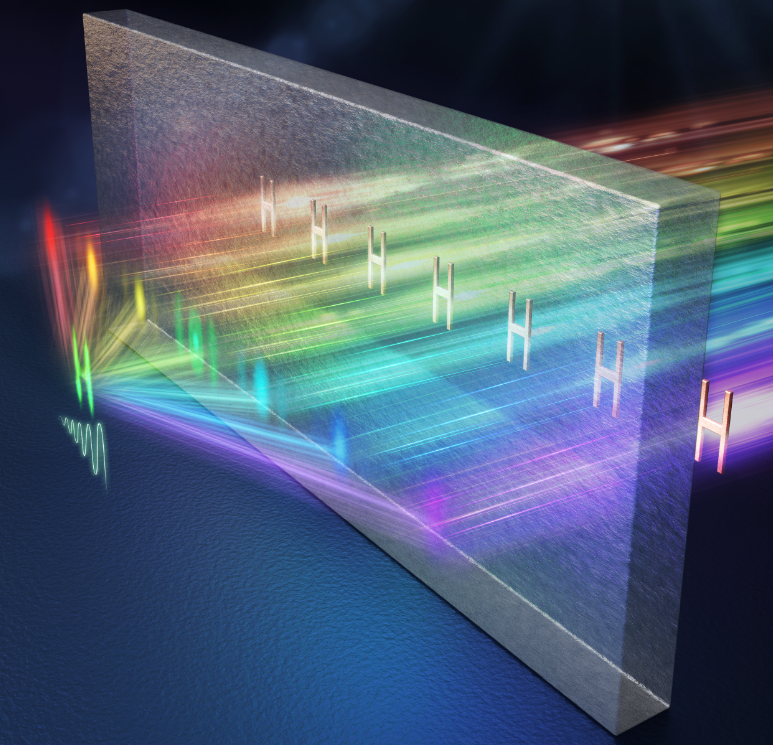
Imaging plays an important role in many fields, including biology, medicine and material science. Optical microscopes use light to obtain imaging of miniscule objects. However, conventional microscopes can only resolve feature sizes in the order of the optical wavelength at best, known as the diffraction limit.
To overcome the diffraction limit, Sir John Pendry from Imperial College London introduced the concept of superlenses, which can be constructed from negative index media or noble metals like silver. Subsequently, Professor Xiang ZHANG, the current President and Vice-Chancellor of HKU, along with his then team at the University of California, Berkeley, experimentally demonstrated superimaging using both a silver thin film and a silver/dielectric multilayer stack. These works have extensively promoted the development and application of superlens technology. Unfortunately, all superlenses suffer from inevitable optical loss, which converts optical energy into heat. This significantly affects the performance of optical devices, such as superimaging lenses, which rely on the faithful delivery of information carried by light waves.
Optical loss has been the main limiting factor that has constrained the development of nanophotonics for the past three decades. Many applications, including sensing, superimaging, and nanophotonic circuits, would greatly benefit if this problem could be solved.
Professor Shuang Zhang, corresponding author of the paper and also Interim Head of HKU Department of Physics, explained the research foci, 'To solve the optical loss problem in some important applications, we have proposed a practical solution — using a novel synthetic complex wave excitation to obtain virtual gain, and then offset the intrinsic loss of the optical system. As a verification, we applied this approach to the superlens imaging mechanism and theoretically improved imaging resolution significantly.'
'We further demonstrated our theory by conducting experiments using hyperlenses made of hyperbolic metamaterials in the microwave frequency range and polariton metamaterials in the optical frequency range. As expected, we obtained excellent imaging results consistent with our theoretical predictions,' added Dr Fuxin GUAN, the paper's first author and a Postdoctoral Fellow at HKU.
Multi-frequency approach to overcome optical loss
In this study, the researchers introduced a novel multiple-frequency approach to overcome negative impacts of loss on superimaging. Complex frequency waves can be used to provide virtual gain to compensate for the loss in an optical system. What does complex frequency mean? Frequency of a wave refers to how fast it oscillates in time. It is natural to consider frequency a real number. Interestingly, the concept of frequency can be extended into the complex domain, where the imaginary part of the frequency also has a well-defined physical meaning, i.e., how fast a wave amplifies or decays in time. Hence, for a complex frequency wave, both oscillation and amplification of the wave occurs simultaneously. For a complex frequency with negative (positive) imaginary part, the wave decays (amplifies) in time. Of course, an ideal complex wave is not physical because it would diverge when time goes to either positive or negative infinity, depending on the sign of its imaginary part. Hence, any realistic implementation of complex frequency waves needs to be truncated in time to avoid the divergence. The optical measurement directly based on complex frequency waves needs to be performed in the time domain and it would involve complicated time-gated measurements and therefore it has not been experimentally realised thus far.
The team utilised mathematical tool Fourier Transformation to break down a truncated CFW into many components of different real frequencies, greatly facilitating the implementation of CFWs for various applications, such as superimaging. By carrying out optical measurements at multiple real frequencies at a fixed interval, it is possible to construct the optical response of the system at a complex frequency by mathematically combining that of real frequencies.
As a proof of concept, the team started with superimaging at microwave frequencies using a hyperbolic metamaterial. The hyperbolic metamaterial can carry waves with very large wavevectors (or equivalently very small wavelengths), that are capable of transmitting the information of very small feature sizes. However, the larger the wavevector, the more sensitive the waves are to optical loss. Therefore, in the presence of loss, the information of those small feature sizes gets lost during the propagation inside the hyperbolic metamaterial. The researchers showed that, by appropriately combining the blurred images measured at different real frequencies, a clear image at a complex frequency was formed with a deep-subwavelength resolution.
The team further extended the principle to optical frequencies, employing an optical superlens made of a phononic crystal called silicon carbide, which operates at the far-infrared wavelength of around 10 micrometers. In a phononic crystal, the lattice vibration can couple with light to create the superimaging effect. However, the loss is still a limiting factor in the spatial resolution. Although the spatial resolutions of imaging at all the real frequencies were limited by the loss, as shown by the blurred images of the nano-scale holes, ultrahigh-resolution imaging can be obtained with synthesised CFWs that consist of multiple frequency components.
'The work has provided a solution to overcome optical loss in optical systems, a long-standing problem in nanophotonics. The synthesised complex-frequency method can be readily extended to other applications, including molecular sensing and nanophotonic integrated circuits,' said Professor Xiang ZHANG, another corresponding author of the paper, the President and Vice-Chancellor of HKU, and also Chair of Physics and Engineering. He hailed this as a remarkable and universally applicable method, 'This can be leveraged to tackle loss in other wave systems, including sound waves, elastic waves, and quantum waves, elevating imaging quality to a new height.'
This work was supported by the New Cornerstone Science Foundation, the Research Grants Council of Hong Kong.
Journal paper: 'Overcoming losses in superlenses with synthetic waves of complex frequency', Science.
The journal can be accessed here: https://www.science.org/doi/10.1126/science.adi1267
More information about Professor Shuang Zhang: https://shorturl.at/efCN1
Hashtag: #HKU
The issuer is solely responsible for the content of this announcement.


 Daily Bulletin


