How international criminal justice was born in the shadow of the atomic bomb
- Written by: The Conversation
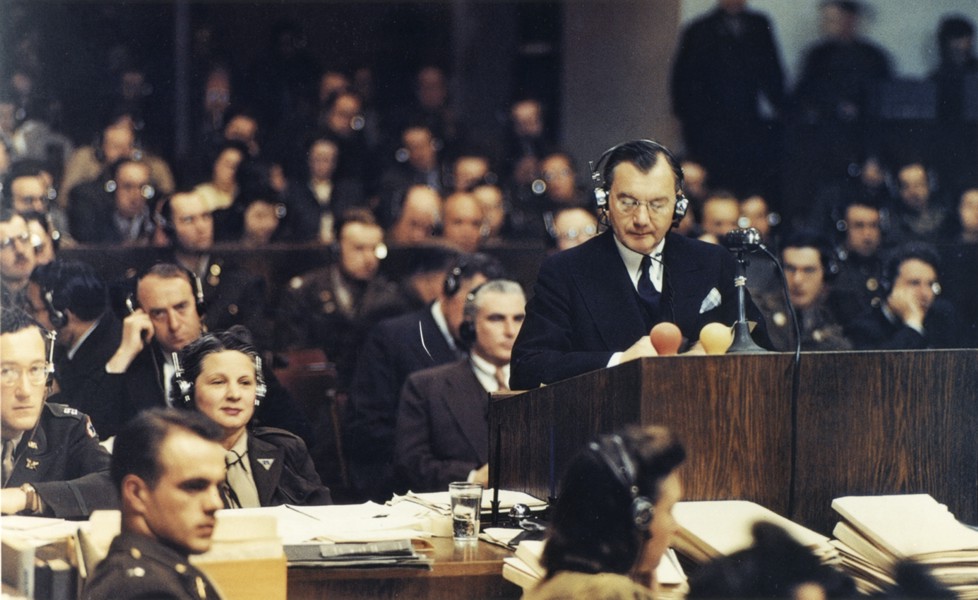
 Chief American prosecutor Robert H. Jackson addresses the Nuremberg court.Raymond D’Addario
The atomic bombings of Hiroshima and Nagasaki are now thought of as one of the darkest episodes in recent human history – but even in the brief time between them, a new hope for a legal world order was coming into view.
On August 8 1945, just before the bombing of Nagasaki, the London Agreement was signed, formally establishing the Nuremberg Trials. The charter would become the foundation for a system of individual criminal responsibility for the gravest of atrocities, irrespective of rank.
Göring, Hess and other leading Nazis were tried that November, and their trials cemented a legal and political benchmark for the design of international criminal justice.
British coverage of key Nuremberg Trial moments.
70 years on international criminal justice looks very different. After decades of geo-political indifference, its rate of growth over the past 30 years has been unrelenting. In the aftermath of the lawless horrors of genocide in Bosnia and Rwanda, a guilt-ridden UN Security Council re-launched the precedent in the early 1990s.
The birth of the ICC
This triggered a demand for a permanent International Criminal Court (ICC) which was realised at the Rome Conference in 1998, and other hybrid tribunals have been established since.
With 123 state parties the ICC is now at the epicentre and acts as a last resort, intending to catalyse national prosecutions. With such an expansive network, you would be forgiven for thinking that the cause of justice had never been better.
However, since the heady optimism of the late 1990s, there is little doubt that faith in the entire project is at an all-time low. Expectation and scrutiny have grown. Typically wins are ignored and losses amplified. There is no greater example than the ICC’s own catalogue of public relations defeats, including the recent escape of indicted President Bashir from South Africa, the collapse of the President Kenyatta trial and continued protest of an anti-African bias.
Other criticisms of compromising on fragile peace agreements, poor timing of arrest warrants, inconsistencies and case mismanagement have also plagued the ICC and the Office of the Prosecutor more specifically.
Dwindling faith
For an international court allegations of prejudice are one of the worst criticisms it can receive. They have a tendency to stick, irrespective of attempts made to expose why they may be misplaced. But these allegations should have been expected. Nuremberg’s historical legacy is synonymous with the common refrain of “victor’s justice” and the system has not been able to shake this label off.
 The seal of the International Criminal CourtICC
Attacks of partiality have been juxtaposed to all tribunals. The leadership in Belgrade has had an acrimonious relationship with the International Criminal Tribunal for the Former Yugoslavia (ICTY), because of the perception that there is an exclusive pursuit of Serbian indictments. The absence of cases addressing alleged crimes carried out by the “victorious” Rwandan Patriotic Front at the Rwanda Tribunal have also been well documented.
If this was not enough, then the irremovable presence of the UN Security Council embeds realpolitik in the judicial process. International justice has often been marginalised and reduced to arms of political power. In the ICC era this has encouraged the tactics of “lawfare” – states' use of international criminal law to discredit another, through requests for criminal investigation. ICC interventions in Libya, Sudan, Uganda, and the current preliminary examination of alleged crimes committed in occupied Palestinian territories all bear those hallmarks. Even where investigations bear legal justification, the very process leads to a cynicism about the court’s capacity to be independent.
It is easy to paint an overly negative picture. In spite of their notoriously slow pace, many people have been indicted before international tribunals; 80 have been served a sentence by the ICTY alone. International lawyers point to progress in landmark cases, many advancing the protection of women from sexual violence within the laws of war. The ad-hoc tribunals have also established clear and leading precedents such as in Tadic, Krstić and Akayesu.
However, success is judged on more than just the increasing weight of legal dictionaries. Media coverage dilutes legal victories, when broad public opinion is ailing. In the words of Professor William Schabas, international justice risks becoming banal and mediocre.
Regaining international support
The challenge is how to restore law from realpolitik shackles. The law might then unite with the legitimacy it needs. For the sheer demonstration power it offers, justice must be applied even-handedly. For some, in spite of the jurisdiction and enforcement limits, only an arrest warrant for a Western leader could achieve this.
Regardless, an important first step would be greater political transparency in the prosecution decision-making process. Ultimately shaped and spearheaded by facts and evidence, greater openness could empower the court to make a political, economic and social case to support its assessments and judgements.
Nuremberg is remembered because of a romantic symbolism. Military retribution tempered by reason was always going to bear a legitimacy that only comes with the first of a kind. The ICC has been operating for 13 years, largely without distinction, and symbolic confidence has long since waned. Many of its own member states display frugality to its funding, compounded by indifference to co-operate. Clearly, the Court cannot simply rely on their membership as an endorsement of its mandate.
The ICC might be wise to use the 70th anniversary of Nuremberg to remind people of the justification of its existence. Capturing public imagination and political faith in its mission is critical, not least in those situations where the court is prosecuting cases. Born with fledgling health, the ICC is stable, but in intensive care on a life-support machine. The Court must work to come off it and survive, or it might have to fight against a decision to switch it off.
Birju Kotecha does not work for, consult, own shares in or receive funding from any company or organization that would benefit from this article, and has disclosed no relevant affiliations beyond the academic appointment above.
Authors: The Conversation


 Daily Bulletin