

How to help young children regulate their emotions and behaviours during the pandemic
- Written by: Steven Howard, Associate Professor, Child Development, University of Wollongong
With governments around the world asking their citizens to avoid places, activities and gatherings to save lives, this just might be the largest ever international effort to self-regulate our actions against competing desires and impulses.
To achieve this, we must overcome our desire to enjoy the sun and sand, go shopping or to the pub, and even embrace family and friends.
Of course, it’s not so easy for young children, who must forego activities they previously enjoyed and may be confused by contradictions – like being able to see friends at, but not after, school.
But there are ways parents can help children learn to regulate their emotions and behaviours, and to practise these skills.
Read more: 8 tips on what to tell your kids about coronavirus
Why do kids need to learn to self-regulate?
Self-regulation has always played an important role in our lives. It’s what underpins our ability to control our behaviours, emotions and interactions, while at the same time avoiding distractions and enticing alternatives.
With lower levels of self-regulation, our decisions and behaviours would more frequently be poorly conceived, unnecessarily risky or inappropriate to the situation – often with undesirable results.
Even in the early years of life, the ability to self-regulate is important. Pre-school-aged children who have better self-regulation are often better prepared for school and life.
They then tend to:
- have higher levels of academic success
- make fewer risky decisions as adolescents
- and have better health, wealth and productivity as adults.
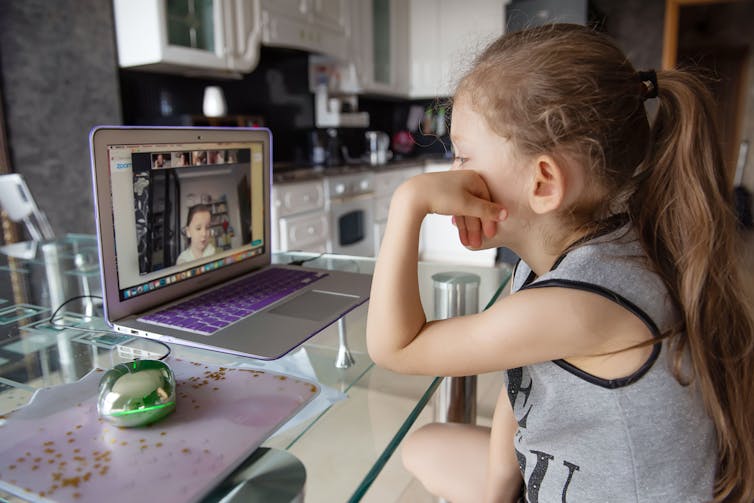 So many things have changed for children recently.
Shutterstock
So many things have changed for children recently.
Shutterstock
So, what can we do to support children’s self-regulation, especially during this pandemic, when their capacity for self-control already appears to be under strain?
Self-regulation requires at least three things: selecting a goal, problem-solving and working on motivation, and overcoming distraction and impulses.
1. Selecting a goal
Self-regulatory behaviour is goal-directed. That means children must first decide to behave in a particular way.
If a child is unaware of (or forgets) a family convention to wait for everyone to be seated before starting to eat, a child starting to eat before others may appear like a consequence of poor self-regulation. Yet the child never decided to pursue that goal in the first place.
Read more: A parent's guide to why teens make bad decisions
We need to support children’s thinking and decision-making around goals, while acknowledging that plans can change and often need to be adjusted.
Adults can support children to be more goal-oriented by giving them opportunities to lead and make decisions, as well as encouraging them to devise simple plans, strategies and procedures to achieve goals.
This may be as simple as asking children to decide what they would like to play (building a cubby house), and plan where they would play it (bedroom), with whom (mum, dad, sibling), and what resources they will need (cardboard box, cushions).
2. Problem-solving and motivation
Even when a goal has been decided, the path to its achievement is often not immediate. Children will encounter numerous distractions and competing opportunities along the way. So they need effective problem-solving and motivation strategies.
To be an effective problem-solver, children must understand there is more than one way to achieve something. This requires creative and critical-thinking, flexibility and persistence.
As adults we can encourage these by:
engaging children in brainstorming activities, like finding an alternate ending to a familiar story, such as Peter Pan losing his shadow
using open-ended questioning and posing small problems – as in “How might we capture our shadow? What will we need?”
encouraging reflective thinking, such as “I wonder, why don’t we see shadows on the ground at night?”
Supporting young children to persist in the face of challenge means taking cues from your child, validating their efforts, reinforcing their solutions and encouraging creative alternatives.
3. Overcome distractions and impulses
Children need to be able to overcome distractions and impulses that are contrary to their goals.
As with most things, this self-regulatory capacity can benefit from practice. This can be achieved in simple, playful ways.
One game, played all around the world, is musical statues. Children dance while the music plays and freeze when the music stops.
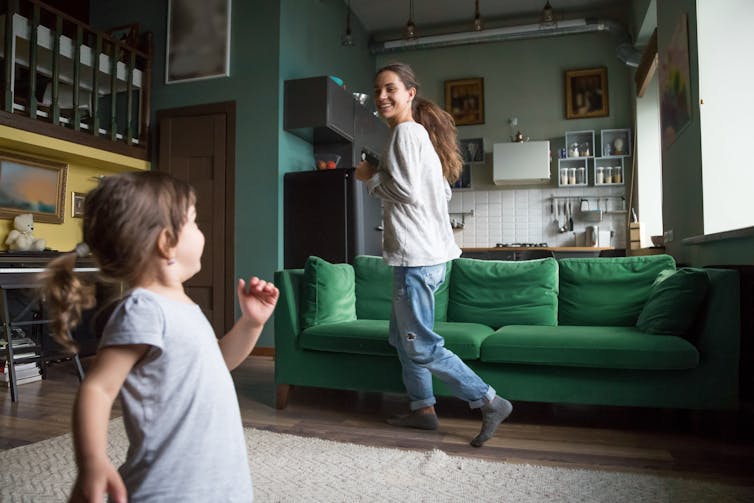 Musical statues allows children to practise controlling their impulse to keep dancing.
Shutterstock
Musical statues allows children to practise controlling their impulse to keep dancing.
Shutterstock
What often happens in this game, though, is children who can’t or don’t freeze are either left to continue dancing or they are “out”. Those who perhaps could benefit most from the practise get the least opportunity to practise.
Instead, if a child doesn’t freeze in time, have them try the next round sitting on their bottom, removing their legs from the equation. As they succeed, they can return to standing.
Where children can already do this well, why not reverse things so you dance when the music is off and remain still while the music plays?
This gives children practice controlling impulses – in this case, to keep dancing when the rule requires them to stop – at an achievable level of challenge.
For parents, it gives them unique insight into children’s capacities to control their behaviours, and where they may require additional support.
Read more: 'Stupid coronavirus!' In uncertain times, we can help children through mindfulness and play
What else do you need to take into account?
Things like stress, tiredness, hunger, fear, sadness and loneliness can deplete children’s limited self-regulation resources. Parents should seek to minimise these factors before trying to extend children’s self-regulation further.
In the current climate, we can ensure children are operating at their self-regulatory best when we reduce unnecessary demands, ensure routines are not overloaded, are patient and realistic when setting responsibilities.
Lastly, whether we are aware of it or not, children often model themselves on the ways we act and respond. As adults, it’s important to reflect on our own behaviours too: do we give up when challenged, yell when frustrated, fight for resources, or preference others in need over our own wants?
How we respond to this “new normal” will set an example for our youngest generation – and they will undoubtedly learn from our responses.
Read more: Coronavirus: 5 tips for navigating children’s screen time during social distancing
Authors: Steven Howard, Associate Professor, Child Development, University of Wollongong


 Daily Bulletin


