

US private schools often inflate student grades. This could happen in Australia if we cancel year 12 exams
- Written by: Ilana Finefter-Rosenbluh, Lecturer, Faculty of Education, Monash University
The unfolding COVID-19 situation has brought many changes to school education. NAPLAN tests have been cancelled for 2020 and most children are learning online.
Education minister Dan Tehan is meeting with the states on what to do with year 12 exams and criteria for university entry. One option flagged is for universities to look at a mixture of students’ year 11 and year 12 assessments to date.
With regards to the end of school qualification in New South Wales, the Higher School Certificate (HSC), the state’s education board has already given
principals or system authorities the power to make decisions about the number and weighting of HSC formal assessment tasks for their school in 2020.
The board went on to say it “affirms its complete trust in principals and teachers”.
This is similar to what was done in the UK. Their GCSE and A-level exams have been cancelled and replaced with teacher assessment, based on low-stakes testing, coursework and class performance.
While Australia should be looking at creative solutions for assessing students’ end of school results and criteria for university entry, a focus on teacher assessments may be problematic.
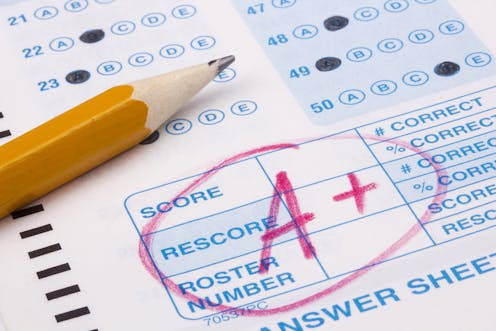
Teachers can be prone to a phenomenon known as grade inflation. This is essentially where students are awarded higher marks without demonstrating higher levels of mastery.
Our research showed teachers in private schools are more likely to inflate grades due to pressure from students and parents.
Read more: COVID-19 has thrown year 12 students' lives into chaos. So what can we do?
External exams and internal assessments
Grade inflation is a worldwide problem, both in schools and universities. As the Atlantic reports, a US study of the history of college grading found, in the early 1960s, an A grade was awarded in colleges nationwide 15% of the time. But today, an A is the most common grade given in college – the percentage of A grades has tripled, to 45% nationwide.
The United States has borne the brunt of the criticism towards grade inflation in schools, due to its grading system.
In Australia, year 12 exams – which are weighted heavily in the total score for a student’s school certificate – are marked externally. But in the US, all grades are given to students by their teachers. For extra credit, students may take external Advanced Placement (AP) exams.
Read more: Educators must commit now to tackle grade inflation
At the end of their final school year, or year 12 equivalent, US students’ grades are averaged out to provide a Grade Point Average (GPA).
Students who wish to apply to a college or university will most likely have to take an external Scholastic Aptitude Test (SAT) or an American College Test (ACT) – general tests to evaluate their written, verbal and mathematical and/or scientific reasoning skills. While these tests are used as criteria for admission to most US colleges or universities, many institutions are now test-optional, meaning they don’t require such tests at all.
While every institution balances and counts the “absolute merit” of GPA and test scores in its own way, admissions offices seem to question the grading system and search for other metrics. They acknowledge the average US teacher experiences a great deal of pressure from students and parents anxious about college admissions.
Such pressures are more prevalent in wealthier, white and private schools.
Teachers facing pressure
Our research showed how inflated expectations of students and parents led to teachers’ ethical grading dilemmas in one private prestigious school in the US. We found teachers engaged in “grade massaging” due to either an “ethic of care” toward their students (due to concern about their students’ motivation, psychology or life prospects) or due to extensive school or parent pressures.
One science teacher told us parents feel “they are paying and they deserve for their kids to get As”. As a result, she noted, there is substantial
pressure on teachers to inflate grades, to give do-overs and all that kind of thing.
Another math teacher admitted to “overlooking” a struggling student’s missing work and shoddy study habits, giving her a B+ so she “could just finish the year”.
And another English teacher lamented
there is a moral thing that I need to figure out with myself […] We just take part in this thing […] I am a partner in crime […]
These cases are not unique. Another study showed highly-ranked US public schools, which served mainly middle and upper-middle class students, advanced those they initially identified as having the most privileged background by marking others’ work harsher.
The latter students had a disadvantage when trying to enter elite universities, compared to equivalent students in less prestigious schools.
What could happen in Australia?
Educational inequality is alive and kicking in Australia. Inequitable funding settlements continue to entrench privilege in private elite schools that advance their students to accrue further advantage.
Research shows Australian low socioeconomic schools offer students less access to the core academic curriculum subjects that are important for university entry. Students from disadvantaged backgrounds are less likely to complete year 12, and are increasingly locked out of competitive education and job markets.
Read more: Aussie parents are under pressure to buy their kids academic advantage too
Unethical practices can also be found in our schools. A study that explored Australian private schools’ strategies of self promotion revealed how they have taken certain statistics or results out of a larger context (“partial reporting”) to give themselves a successful image. Another study discussed how schools manipulating NAPLAN data to secure a good image.
A petition to cancel year 12 exams this year has received thousands of signatures. While weighing up the prospects of this, governments must consider the implications to society, and particularly how this might affect more disadvantaged students.
Although pressing times are calling, teachers should not be left to their own devices to deal with parents, community and other school pressures. Social inequality is already here. Do we really want to take the risk of increasing it?
Authors: Ilana Finefter-Rosenbluh, Lecturer, Faculty of Education, Monash University


 Daily Bulletin


