

Coronavirus might cause loss of smell, or anosmia. But it probably won't be permanent
- Written by: Jenny Ekberg, Associate Professor, Menzies Health Institute Queensland, Griffith University
Reports from South Korea, China and Italy say losing the sense of smell and taste may be a symptom of COVID-19, the disease caused by the coronavirus SARS-CoV-2. Specialists in the UK have suggested the loss of smell, also called anosmia, could even be an early indication of infection.
While the exact details of what happens with this coronavirus are unclear, evidence from other infections suggests that while damage to the sense of smell is possible, it’s unlikely to be permanent.
Read more: Curious Kids: How do we smell?
Can viruses get into your nerves?
Viruses and bacteria are constantly bombarding the lining of the nose. Luckily our defence mechanisms prevent most pathogens penetrating into the deeper layers of tissue.
Yet some pathogens can penetrate the nasal lining and are known to enter the olfactory nerve, which is responsible for the sense of smell. Pathogens can also enter the trigeminal nerve, which is responsible for controlling biting and chewing, and for sensation in the face.
If viruses or bacteria do enter the nerves, the consequences can be serious. Perhaps the most striking example is Bell’s palsy, where part of the face is temporarily paralysed, and which may sometimes be caused by viral infection of the facial nerve.
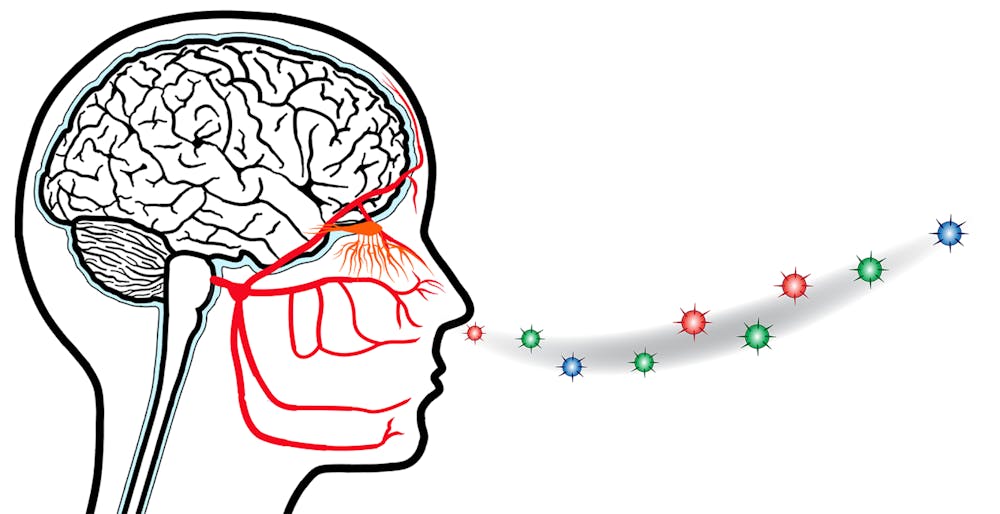 The nerves can provide
James St John, Author provided
The nerves can provide
James St John, Author provided
Do other viruses affect the sense of smell?
Other viruses, including influenza and herpes, are known to infect the olfactory nerve. From animal studies using other types of coronaviruses (not SARS-CoV-2, the virus that causes COVID-19) we also know that a nasal inoculation with mouse hepatitis virus, which is a type of coronavirus, can rapidly penetrate the olfactory nerve and then continue up into the brain.
In humans, it has been shown that some types of human coronaviruses can enter the brain from the olfactory bulb at the end of the olfactory nerve. To date, it remains unknown whether SARS-CoV-2 can damage the olfactory nerve.
Bacteria also penetrate the olfactory nerve. Our research team has shown that Burkholderia pseudomallei, which causes the tropical disease melioidosis, can kill the olfactory nerve cells and then enter the remnants of the olfactory nerve to move up into the brain.
Once pathogens are inside the olfactory nerve, it is like a highway from the nose to the brain. If the infection kills off nerve cells, it’s even easier for the pathogens to move along the nerve.
How does an infection affect the sense of smell?
This killing of the olfactory nerve cells is likely to be the main reason people lose their sense of smell after an infection. Once 20-30% of the olfactory nerve cells have died, people will report they have lost their sense of smell.
If a person has lost 30% of their olfactory nerve cells, they won’t be able to detect enough odour molecules to activate the threshold level for smelling when they breathe normally. However, if they sniff harder they will probably be able to smell enough to recognise an odour.
Our research with bacteria has shown that olfactory nerve damage can occur within 24 hours of initial exposure, and (unpublished) results with other viruses show they can act even more quickly. In this way, loss of sense of smell can indeed be an early indicator of a potential pathogen onslaught within the nasal system.
Why is taste affected as well?
What we usually think of as “taste” when we enjoy a delicious meal is actually the combination of smell and taste. When people lose their sense of smell, the major contribution to the enjoyment of food is lost.
This is why people may report they have also lost their sense of taste – which strictly speaking depends on the tongue and tastebuds – when they have lost only their sense of smell.
Why do only some people with COVID-19 lose their smell?
Our bodies and immune systems are very diverse, due to genetics and circumstances. Not all people will be susceptible to particular pathogens or affected in the same way.
Our research in mice has clearly demonstrated not only that different strains of mice are susceptible to different bacteria but also that different nerve routes can be affected.
While we do not yet know if SARS-CoV-2 does harm the olfactory nerve, a similar process could explain why some people report a loss of smell and some don’t.
Will it be permanent?
Luckily, the olfactory system is designed to survive the constant bombardment of pathogens so if you do lose your sense of smell it will only be temporary. While the olfactory nerve cells that are present within the nasal lining can be infected and die off, stem cells that lie beneath the nerve cells rapidly generate new nerve cells to replace the lost ones.
The new nerve cells grow their long connections back up into the brain to restore the pathway. Depending on the severity of the initial infection, the sense of smell can return within a few days or weeks.
Read more: An impaired sense of smell can signal cognitive decline, but 'smell training' could help
Authors: Jenny Ekberg, Associate Professor, Menzies Health Institute Queensland, Griffith University


 Daily Bulletin


