

Coronavirus is a huge story, so journalists must apply the highest ethical standards in how they tell it
- Written by: Denis Muller, Senior Research Fellow, Centre for Advancing Journalism, University of Melbourne
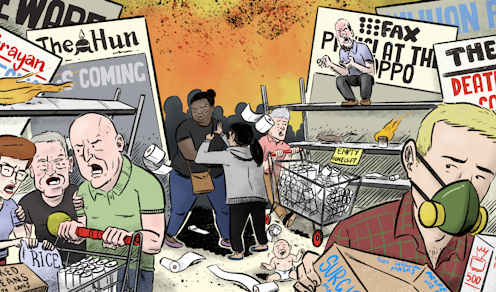
From an ethical perspective, covering the coronavirus story is really hard to do well.
The reason for this lies in an inherent conflict between two ethical obligations: the obligation to truth-telling and the obligation not to add unjustifiably to public anxiety.
From the earliest days, when the virus spread rapidly in China and began to cause deaths, a degree of anxiety enveloped the world. This swiftly accelerated into panic as it became clear that, in an age of global connectedness, no country was going to be immune.
In Australia, as elsewhere, this public panic was exemplified by the run on toilet paper.
Read more: Why are people stockpiling toilet paper? We asked four experts
By its nature, the spread of COVID-19 (the disease caused by coronavirus) is the cause of high public anxiety and is not of itself the product of media reporting.
However, some of the coverage is unquestionably adding to that anxiety in a way that is ethically unjustifiable.
The media’s job is to tell the story in the detail necessary for a good public understanding of what is going on. They do this by giving it the prominence justified by its impact on people’s lives and by couching it in language proportional to the risks facing the community.
If that adds to public anxiety, then that is an unavoidable consequence of keeping the public informed. We have already seen what happens if the alternative prevails. When China tried to cover up the seriousness of the first outbreak, precious days were lost in developing a response, and people were denied information they were entitled to have.
All this is easy to say in abstract terms, but what does it mean for the way journalists do their job?
In short, it means the adoption of a triage system to guide editorial decision-making.
The stories we have seen so far fall into three broad categories.
The first and most important are stories containing health advice, information about the spread of the illness, who is at risk, what governments and other authorities are doing in response, what is happening to the economy, and how ordinary life is being disrupted.
The second are less important, though perhaps more entertaining: a fight in a supermarket over toilet paper; people hoarding tinned food.
And the third are rubbish: rank beat-ups and crazy conspiracy theories.
For example, there was a beat-up last week about Qantas passengers being stranded in Singapore because of the virus. Just nonsense. Their plane had a mechanical fault. The story should have been spiked.
And there was Bronwyn Bishop’s unhinged contribution on Sky at night that the Chinese government had unleashed the virus to kill off the weak in their community.
More generally, it is the secondary stories that are likely to add to the panic and tell the least important information. The reason is that they tend to be entertaining rather than informative and therefore likely to be replicated online in contexts where the ethical norms of journalism do not apply.
Newsrooms need to think hard about the play they give these stories – whether to run them at all and, if they do, how much prominence to give them.
The news values known as “consequence” and “significance” need to be prioritised over those of “novelty” and “entertainment”.
Language also matters. It needs to be proportional to the telling of a truthful account.
If there is confusion, journalists should say so. But is the situation “chaotic”? The further up the rhetorical scale a journalist goes, the likelier it is that they will add unjustifiably to public anxiety.
All this gets harder still when people in public life spread misinformation, as Victorian Health Minister Jenny Mikakos did by making a baseless accusation against Toorak GP Dr Chris Higgins.
The media had to cover this, even though doing so obviously caused Higgins harm. They had to report she said she was “flabbergasted” by Higgins turning up to work “with flu-like symptoms” .
Mikakos is the health minister. What she says carries authority. And she needs to be held to account.
Equally, journalists also had to report Higgins’s response: the fact that he followed all the rules and did not knowingly treat patients while he had COVID-19, as Mikakos implied he did.
And journalists had to report that Higgins received strong backing from his medical colleagues, including the Australian Medical Association (AMA), and that they called on Mikakos to apologise.
It is also legitimate for journalists to be asking who told the minister what and when, and how she arrived at the conclusion she did. It is part of the media’s watchdog function. In an atmosphere of high public anxiety, people in authority are rightly held to a high standard of accountability.
No one is saying Mikakos acted in bad faith, but she spread misinformation at a time when she herself is saying the community needs reliable information.
One wit has labelled her handling of the Higgins case #flabbergaslighting.
COVID-19 is a huge story. It directly concerns the health and welfare of the public at large, puts great pressure on public resources, stretches the capacity of governments to respond, disrupts the economy and brings risks that so far are not fully understood. People everywhere are understandably worried.
For exactly those reasons, it imposes a heavy obligation on journalists to apply the highest ethical standards in how they tell it.
Authors: Denis Muller, Senior Research Fellow, Centre for Advancing Journalism, University of Melbourne


 Daily Bulletin


