

Friday essay: Beethoven - an icon at risk of overexposure?
- Written by: David Larkin, Senior Lecturer in Musicology, University of Sydney
In a series marking the 250th year of his birth, we analyse the significance of Ludwig van Beethoven.
In the centre of Bonn, a bronze statue stands on a pedestal in the Münsterplatz.
The figure is dressed in typical early 19th-century garb, cravat and jacket visible beneath a heavy outer cloak. Protruding from the rough folds, the left hand clutches an open notebook. The right hand holds a pen at arm’s length, the gesture suggesting action momentarily suspended by thought. Above the collar, a face framed by a shock of hair frowns into the middle distance.
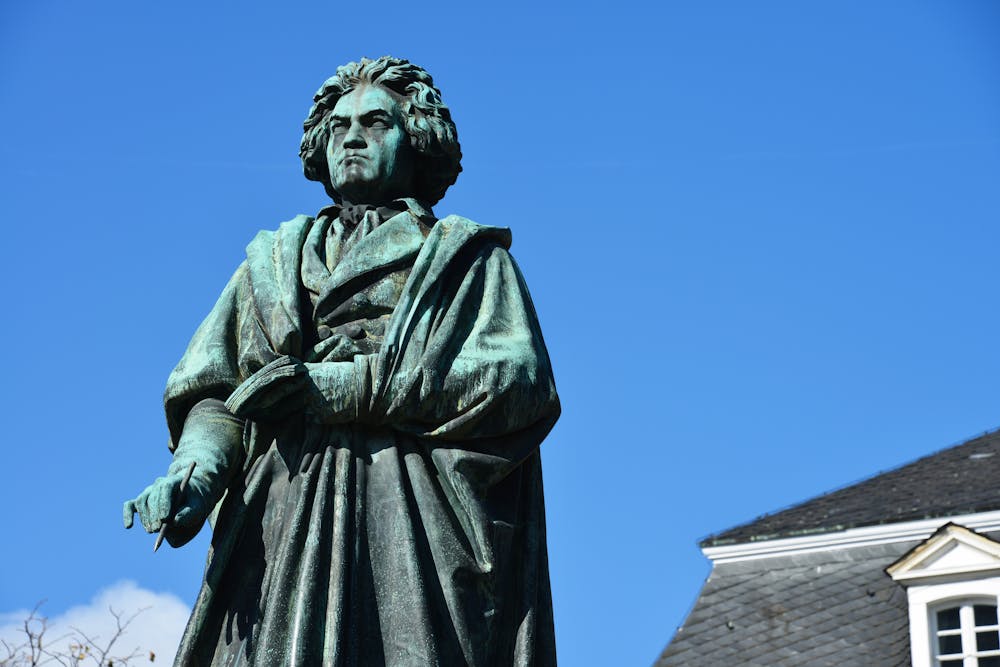 Beethoven Monument in Bonn, Germany.
Shutterstock
Beethoven Monument in Bonn, Germany.
Shutterstock
This memorial to Bonn’s greatest musical son has been in place since 1845, a reminder that paying tribute to Ludwig van Beethoven (1770-1827), whose 250th birthday is celebrated this year, is a practice with its own lengthy history.
The Bonn statue, the first erected to any musician in Germany, was unveiled on the 75th anniversary of Beethoven’s birth. It would not be the last statuary tribute to the composer, whose reputation grew ever greater as the 19th century advanced. Thirty-five years later, his adoptive city of Vienna unveiled an even more substantial Beethoven monument.
This was followed by Max Klinger’s 1902 sculpture for the Viennese Secession, in which the bare-torso composer is literally enthroned. Today, 3D representations in the form of busts and even action figures are widely available.
The ubiquity of Beethoven imagery reflects his status as a true icon, one of a handful of creative personalities whose achievements have become bywords for the supreme capacities of the human spirit. As he turns 250, Beethoven has been lauded as “not just […] history’s greatest composer, but also one of its greatest human beings”.
Overcoming tragedy
Even before we try to grasp what makes Beethoven’s musical creations so special, the fact that he continued to write music in spite of his worsening hearing has enshrined him in the broader cultural imaginary as a martyr-magician.
Beethoven’s deafness may have contributed to his legend, but several of works have achieved iconic status in their own right, often spawning complex reception traditions of their own. Some of the most popular, including the Fifth and Ninth Symphonies, trace a struggle-to-victory trajectory, on one level a musical metaphor for the way the composer triumphed over his disability.
The Ninth Symphony begins in a dark D minor, and concludes with a D-major setting of Schiller’s Ode to Joy, usually seen as a paean to universal brotherhood. As such, it was a fitting choice for a historic December 1989 concert to celebrate the dismantling of the Berlin Wall. Yet this work has also been interpreted as a celebration of violence, as was brilliantly but subversively brought out in Stanley Kubrick’s 1971 film of A Clockwork Orange (based on Anthony Powell’s novel).
For Christmas 1989, Leonard Bernstein led a performance of Beethoven’s Ninth Symphony, with choir and musicians from East and West Germany.Equally ubiquitous is the Fifth Symphony, famous for its opening da-da-da-DAH, which is obsessively pursued throughout the first movement.
The coincidental relationship of this motif to the morse-code pattern for the letter “V” — dot, dot, dot, dash — linked it to Churchill’s two-fingered “V for Victory” salute. This led the BBC to use a version of Beethoven’s motif for timpani at the start of their broadcasts to Europe during the second world war, a blatant challenge to the Germans who otherwise might have seen Beethoven as their property.
In less fraught times, this four-note motif acquired the text le-che con PAN (milk with bread) in the Spanish-speaking world. Whether intended or not, this serves as fitting commentary on how Beethoven has become the staple diet of orchestras throughout the world.
Stanley Kubrick’s A Clockwork Orange makes use of the mythical status that Beethoven’s Ninth Symphony.Straddling the romantic-classical divide
While Beethoven’s position in the musical pantheon is well-entrenched today (in 2019, he was once again voted Australia’s favourite composer in an ABC Classic poll), matters were more equivocal during his lifetime.
The premiere of the breakthrough Eroica Symphony in 1805 left audiences divided: according to a contemporaneous report, some believed this was Beethoven’s “masterpiece, […] the true style for high-class music”, while others felt that it illustrated “a completely unbounded striving for distinction and oddity, which, however, has produced neither beauty nor true sublimity and power”.
The idea that Beethoven was “difficult” was only strengthened by the works he produced in the last decade of his life, which (with the exception of the Ninth Symphony) have lagged in popularity behind earlier masterpieces such as the Third to Eighth Symphonies, the Waldstein and Appassionata Sonatas for piano, the Violin Concerto and so forth.
However, for cognoscenti and many performers, late works such as the last five piano sonatas and the last five string quartets have a special place as rarefied exhalations of the human spirit.
In his celebrated 1810 review of the Fifth Symphony, E.T.A. Hoffmann wrote that “Beethoven’s instrumental music unveils before us the realm of the mighty and the immeasurable”. This becomes even more true when we consider the titanic fugue that concludes the ‘Hammerklavier’ Piano Sonata, Op. 106 (1818), or the Heiliger Dankgesang movement from the String Quartet in A minor No. 15, Op. 132 (1825).
Hoffmann’s essay also made the important claim that Beethoven was
fully the equal of Haydn and Mozart in rational awareness, his controlling self detached from the inner realm of sounds and ruling it in absolute authority.
This was a notable departure from the critical consensus of the day, which viewed Beethoven’s music as a byword for quasi-improvisatory freedom. Hoffmann’s analysis demonstrated that the apparently unbridled emotionalism of the Fifth Symphony was actually underpinned by a rigorous logic of construction. In the intervening two centuries, Beethoven has become a textbook exemplar of formal mastery. Glenn Gould, no uncritical admirer of the composer, neatly summarised these two sides of his art in a 1967 pre-performance talk:
Beethoven is a kind of living metaphor for the creative condition. In part he is the man who respects the past, who honours the traditions [from] which art develops, and while never other than intense and constantly gesticulating with those rather violent gestures which are so peculiarly his own, this side of his character leads him to smooth off the edges of his structure sometimes, to be watchful and even painstaking on occasion about the grammar of his musical syntax.
And then there’s this other side, the fantastical romantic side of Beethoven, which draws from him those unapologetically wrongheaded gestures, those proud, nose-thumbing anti-grammatical moments which, in the context of tradition [and] against the smooth and polished edges of classical architecture, make him unique among composers for the sheer devil-may-careness of his manner. But in the end this sort of amalgam exists for every artist, really; within every creative person there is an inventor at odds with a museum-curator.
This captures the productive tension that existed between Beethoven the classicist and Beethoven the romantic. Without his tendency to strain against the norms of his day, his music would lack that transgressive thrill and the feeling that he was taking the art forward. But without his mastery of structural control, his muse would have risked incomprehensibility. The two are crucial to Beethoven’s achievement, the synthesis he achieved between expressive individuality and formal balance.
An (overly?) dominant presence
Significant anniversaries of major composers are typically marked by an uptick in the number of performances of their music. However, the Beethoven market is already close to saturation point.
An Australian composer, Ian Whitney, noted back in 2016 that Beethoven made up 11% of the repertoire put on by the seven major Australian orchestras in that year, where the entire sum of Australian works heard amounted to only 6%. His witty analysis of 2020 shows that the disproportion is even more marked in this anniversary year.
The total eclipse of all things by Beethoven is not uniquely an Australian problem. Back in 2014-15, in cosmopolitan San Francisco, Beethoven outmatched the combined totals of the second- and third-most played composers (Stravinsky and Mozart respectively) in the local Symphony’s programs. The vain wish to avoid such saturation led Andrea Moore in the Chicago Tribune to call for a year-long moratorium on Beethoven performances, to be replaced with new music.
While one might have sympathy for the living, squeezed out of the picture by the long dead, a ban on Beethoven is never going to be the answer. Much better is the solution followed by the Opus Now collective, which in recent years put on a series of 16 concerts pairing a Beethoven string quartet with avant garde compositions.
A series of this sort accomplishes much: it resists the ghettoisation of contemporary music into cliquish events and serves to remind both Beethovenians and devotees of new music how radical Beethoven’s works were — and indeed, still are. More than a century after it was written, the Grosse Fuge Op. 133 was described by Igor Stravinsky as “an absolutely contemporary piece of music that will be contemporary forever”.
The lesser-known Beethoven
Moreover, when we dig down into the matter, can we really say we know Beethoven all that well? Some of his works have been played to the point of overexposure, but there are plenty of other discoveries to be made. Thankfully the ABC is running a year-long series of weekly broadcasts with the aim of covering the entirety of Beethoven’s output, pairing major masterpieces with curiosities like his music for mandolin, or for mechanical clock.
One underrated gem that deserves to be better known is the Fantasie Op. 77 (1809). Scholars think this captures something of Beethoven’s legendary improvisations at the keyboard. Beginning with a precipitate descending scale, answered by a soulful melody, the music continually changes style, tempo and key in the first half: now jaunty, now stormy, with busy passage-work alternating with melancholy Adagio moments and occasional hints of imitation between the hands. Eventually, order emerges from the chaos in the form of a set of variations on a theme in B major.
Just playing around. Scholars believe Fantasie Op. 77 captures Beethoven’s virtuoso improvisation.Beethoven’s instrumental music tends to dominate our perceptions, meaning that his vocal music is comparatively less well known (with the arguable exception of his single opera, Fidelio). One piece that is underperformed in the anglophone world is the 1816 song cycle [An die ferne Geliebte [To the distant beloved], Op. 98] A compact set of six Lieder lasting only a quarter of an hour, Beethoven’s sole song cycle is very different in both size and organisation from the famous later cycles by Schubert (Die schöne Müllerin, Winterreise), Schumann (Frauenliebe und -leben, Dichterliebe) or Wolf (Italienisches Liederbuch).
In the first poem by Alois Isodor Jeitteles, the protagonist expresses his yearning for his beloved. Poems 2 through 5 address the clouds, woods and hills separating the two, while poem 6 bids her “accept these songs, beloved, which I sang to you”.
This final song returns to the key and, from halfway through, the music of the first song, giving it a satisfying feeling of coming home. Moreover, unlike his successors, Beethoven binds his cycle into an unbroken whole by writing brief transitional passages between songs. Thus, while the individual songs have a folk-like simplicity to them, the collection as a whole is satisfyingly subtle in its organisation.
A series of six songs expressing yearning for a lover who is far away, the song cycle An die ferne Geliebte resonates with Beethoven’s own frustrated passion for a series of women, including the mysterious Immortal Beloved.When it comes to Beethoven’s orchestral works, if one were looking for alternatives or supplements to the great series of symphonies, overtures and solo concertos that are concert-hall fixtures, one might reexamine the so-called Choral Fantasy, Op. 80 (1808), a piece that begins as a solo piano fantasy, turns into a concerto proper and ends as a dry run for the choral finale of the Ninth Symphony.
Another curiosity (whose existence many would prefer to forget) is Wellington’s Victory (The Battle of Vittoria), Op. 91 (1813). Sometimes called Beethoven’s Battle Symphony, it has rightly been kept apart from the canonic nine numbered symphonies. This is not just a matter of puritan distaste for the very vivid musical pictorialisms (there is, for instance, more cannon fire here than is found in Tchaikovsky’s 1812 Overture), but also because Beethoven deliberately chose not to follow the layout proper to a multi-movement symphony of the era.
Beethoven took some well-known themes as his material: Wellington’s forces are represented at the outset by Rule Britannia, and in victory by God save the King, while the French are identified by “Marlbrough s’en va-t-en guerre” (a French folk tune generally sung in English to the words “the bear came over the mountain”).
While the piece as a whole falls short of the level of compositional craft one finds in the numbered symphonies, the “victory” section has plenty of moments of interest (including a fugue on a hyper-accelerated version of the British anthem), and the unprejudiced ear will recognise its rhetorical kinship with the finale of the Fifth Symphony.
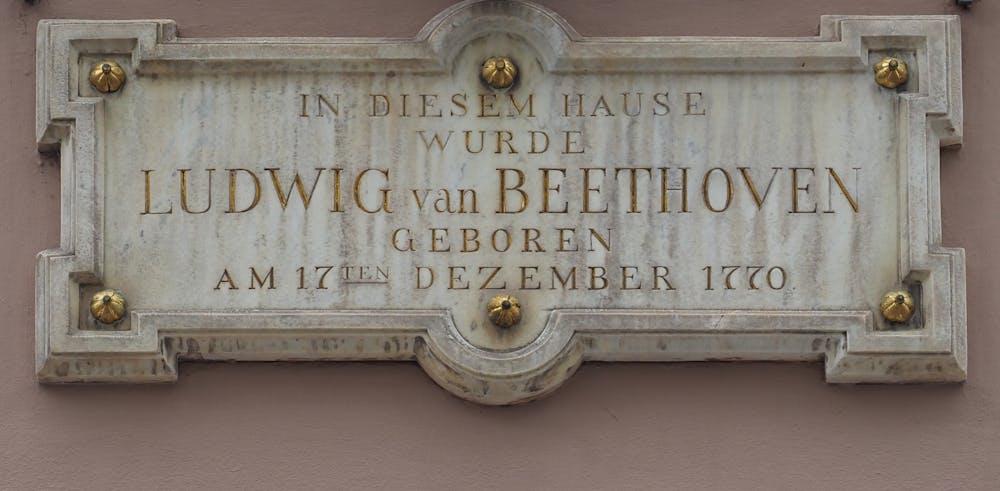 A plaque at the house where the composer was born 250 years ago.
Shutterstock
A plaque at the house where the composer was born 250 years ago.
Shutterstock
Happy birthday
And so, 250 years after his birth, Beethoven remains important, and not just for the listening public. The past two centuries are unthinkable without the stimulus his music gave to other musicians: not only was his oeuvre the touchstone for virtually every symphonic and instrumental composer who followed in the 19th century, even today he continues to inspire the creation of new music.
Kronos Quartet artistic director David Harrington has said that when he heard the Budapest Quartet recording of this piece in 1961, “It awakened something for me that no other sound had ever done up to that point, and I had to try to make that sound.”There should be no begrudging him his place in our concert halls, where an imaginative live performance can render even works as beloved as the Moonlight Sonata, the Seventh Symphony or the “Emperor” Piano Concerto fresh and interesting.
Whether we stick with old favourites, or try to make new discoveries, let 2020 be a year in which we unashamedly indulge in the output of a composer who more than any other has shaped the classical musical landscape we know today. For, as Austrian writer Franz Grillparzer first asked in his funeral oration for Beethoven: “He was an artist, and who shall stand beside him?”
Authors: David Larkin, Senior Lecturer in Musicology, University of Sydney
Read more https://theconversation.com/friday-essay-beethoven-an-icon-at-risk-of-overexposure-128628


 Daily Bulletin


