

Bees learn better when they can explore. Humans might work the same way
- Written by: Adrian Dyer, Associate Professor, RMIT University
Understanding how humans learn is one key to improving teaching practices and advancing education. Does everybody learn in the same way, or do different people need different teaching styles?
The question may sound straightforward, but assessing and interpreting learning performance remains elusive. It is one of the most widely debated educational topics of today, especially for learners who have unique ways of demonstrating their understanding.
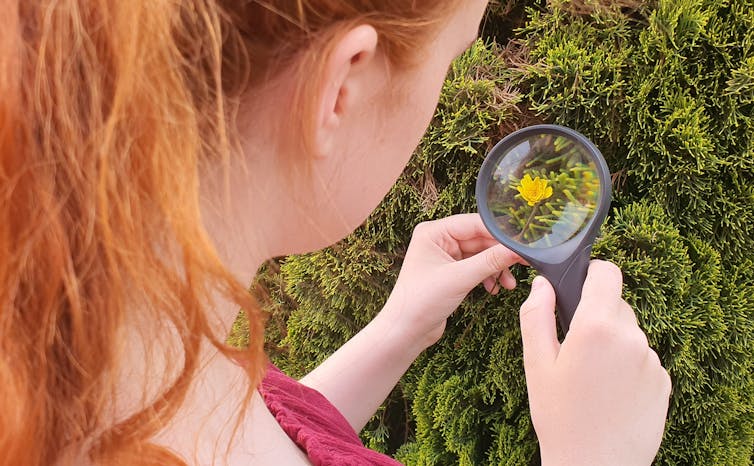 Self-based exploratory behaviour can enhance learning outcomes.
Author supplied.
Self-based exploratory behaviour can enhance learning outcomes.
Author supplied.
Bees learn
We looked for answers in what might be an unexpected place: among honeybees. In a new study published in the Video Journal of Education and Pedagogy, we use the bees as a model to understand how different individuals acquire information.
Using animal models to understand learning has a long and proud history. The Nobel Prize winner Ivan Pavlov famously trained dogs to associate a sound with a food reward. Eventually Pavlov demonstrated that the dogs began to salivate at the sound.
Pavlov’s experiment revealed the core theory behind how we understand associative learning in education, society and popular culture. (Think of how Gringott’s dragon was conditioned in Harry Potter And the Deathly Hallows.)
Much of what we know about the physiology of memory formation comes from the seminal work of the Nobel laureate Eric Kandel. Kandel used the simple sea slug (Aplysia californica) to investigate how connections between neurons in the brain enable learning.
Bees are surprisingly good learners and recent research shows individuals can learn faces, add and subtract and even process the concept of zero. Bees learn complex tasks through trial and error, where a reward of sugar water is provided for correctly solving a problem.
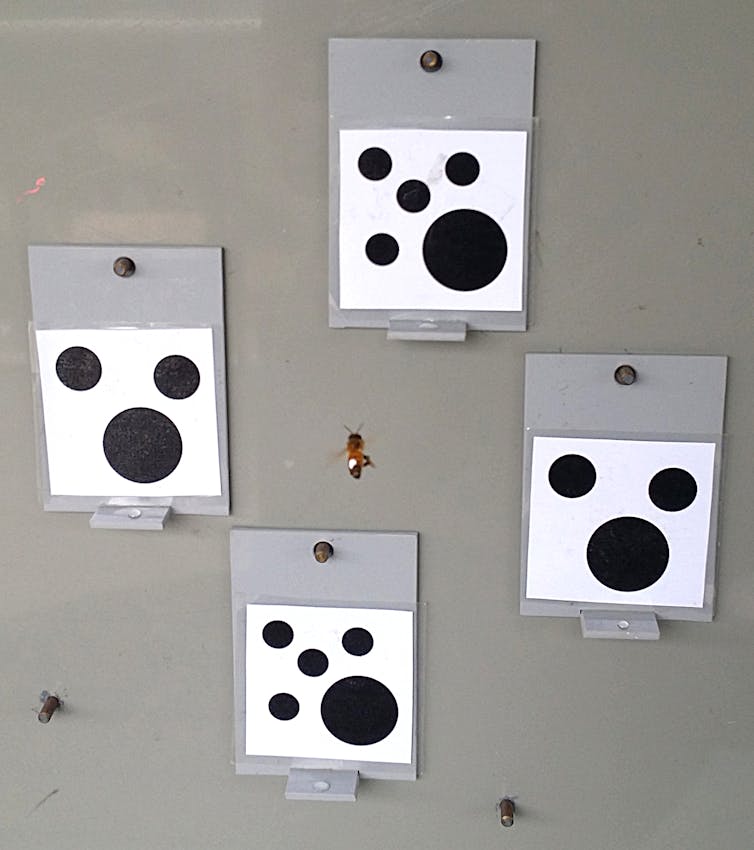 A honeybee with a white identification mark learns to discriminate between 3 and 5 item displays that each present the same overall surface area.
Author supplied.
A honeybee with a white identification mark learns to discriminate between 3 and 5 item displays that each present the same overall surface area.
Author supplied.
Teaching bees arithmetic
We were very interested to discover whether all individual bees would learn complex tasks in a similar way. Would each individual show similar learning performance throughout training, or would individuals demonstrate different learning strategies?
Read more: We taught bees a simple number language – and they got it
One foundation math skill we all learn at about preschool age is how to add and subtract numbers. Arithmetic is not a trivial task. It requires long-term memory of rules associated with particular symbols like plus (+) or minus (–), as well as short-term memory of what particular numbers to manipulate in a given instance.
When we trained bees to add and subtract, we evaluated how many trials it took each bee to acquire the task, and summarised the data examining how individuals learn in a video.
We were surprised to see that all bees did not learn the task at the same stage of training. Instead, different individuals acquired the capacity to solve the problem after a different number of trials.
There was no common learning stage throughout the trials where bees achieved success. Rather the task required bees to try different strategies to see what worked. In particular, the opportunity to learn from mistakes was critical to enabling the bees to learn maths-based problems.
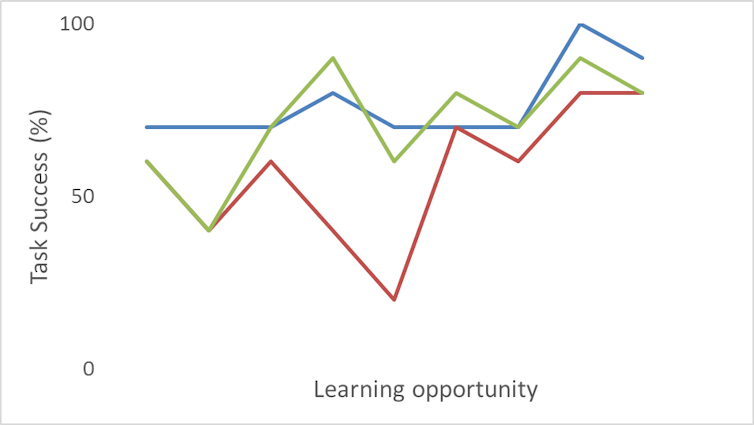 Different paths of learning: Performances of three different bees in an arithmetic task. While all three reach success, the path to learning the task is very different.
Author supplied.
Different paths of learning: Performances of three different bees in an arithmetic task. While all three reach success, the path to learning the task is very different.
Author supplied.
This finding suggests that when brains have to learn multi-stage problems involving different types of memory, an opportunity for exploratory behaviour is what nature prefers.
What does this mean for education?
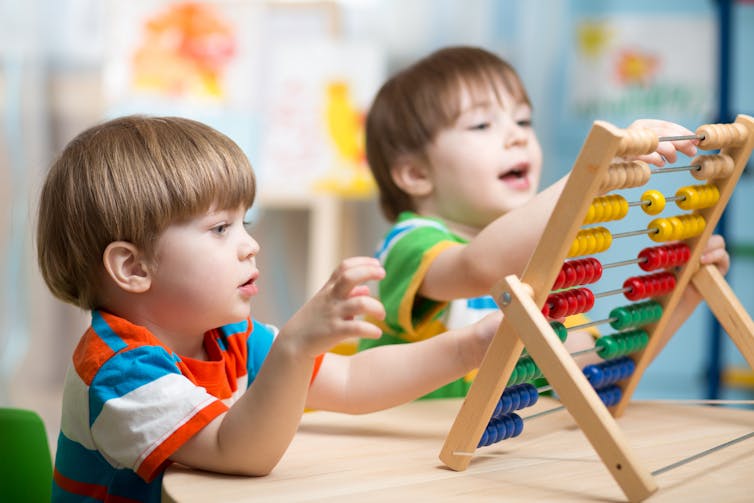 Learning through experience.
Shutterstock
Learning through experience.
Shutterstock
Humans and bees last shared a common ancestor about 600 million years ago. However, we share a large number of genes and it is likely we have some similarities in how we process information.
We know that bees and humans have a common way of processing numbers from one to four, for instance, suggesting that learning processes may be linked to evolutionary conserved mechanisms. So bees’ improved results when learning maths problems in an individual exploratory fashion suggests this may be how humans too are wired to acquire new skills.
Indeed, some recent research in learning and learning difficulties in children has found evidence that individuals frequently see and learn in different ways depending on environmental context.
Our biology may be programmed to encourage exploratory learning, rather than trying to acquire information in a set prescribed way. If so, our education systems should take this into consideration.
This idea may not be new, but may face challenges if computer-based learning is increasingly adopted as there is a risk that limited programming could limit learning styles.
On the other hand, the clever use of exploratory learning environments – digital or physical – may enhance learning outcomes.
We should not shy away from examining how our evolutionary history impacts learning and using this to our advantage. Understanding evolutionary principles could help in designing learning environments best suited to encouraging exploration for optimal learning, for example.
Authors: Adrian Dyer, Associate Professor, RMIT University


 Daily Bulletin


