

To save koalas from fire, we need to start putting their genetic material on ice
- Written by: Ryan R. Witt, Conjoint Lecturer | Conservation Biology Research Group, University of Newcastle
Thousands of koalas may have died in fires burning through New South Wales but expert evidence to a state parliamentary inquiry on Monday said we are unlikely to ever know the real numbers.
Unprecedented fires have burned through millions of hectares of forest, including koala habitat and rainforests untouched by fire for thousands of years.
Read more: It's only October, so what's with all these bushfires? New research explains it
The devastation won’t stop once the fires are out. Koala populations that survive the fires could be cut off from each other, lowering their genetic diversity and threatening their long-term survival.
To protect Australia’s iconic koalas we need to start freezing their genetic material. With more investment in the fast-developing field of cryogenics, koala hospitals could start taking samples from their patients, creating a vital lifeline for the species as a whole.
Koala-threatening fires are getting worse
Fire seasons are starting earlier, lasting longer and becoming more intense, made worse by climate change.
This season, there is an above-average risk of serious fires across an extensive range of koala habitat on Australia’s east coast.
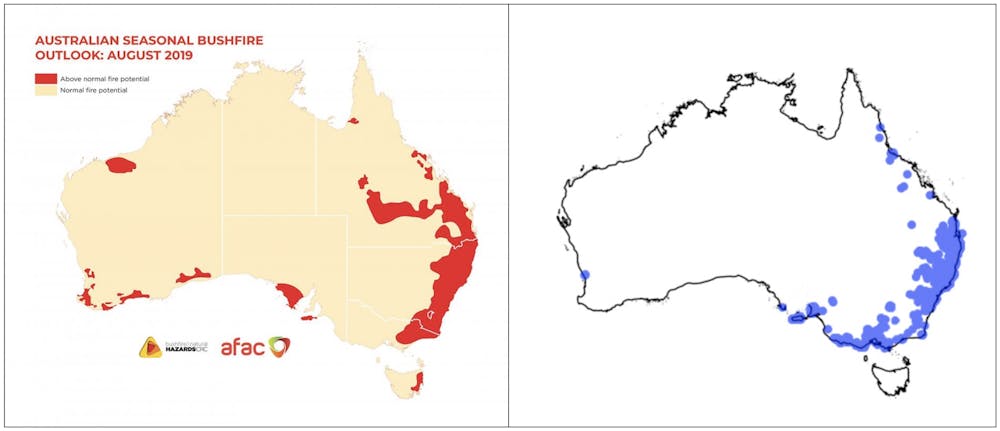 Left, Australian seasonal bushfire outlook for the upcoming bushfire season. Right, the comparative koala distribution from January 2017 to 2019.
Bushfire and Natural Hazard CRC/Atlas of Living Australia
Left, Australian seasonal bushfire outlook for the upcoming bushfire season. Right, the comparative koala distribution from January 2017 to 2019.
Bushfire and Natural Hazard CRC/Atlas of Living Australia
Experts at the NSW inquiry estimated about 2,000 koalas may have died in fires already this year, and the destruction of habitat means further population declines are inevitable. With areas not usually threatened by fires now at risk, we need new plans for future conservation.
Koalas are highly vulnerable to fire. The heat burns their paws and fur, and the superheated air can cause internal damage to their lungs. The canopy of eucalypt forests is their only refuge, but offers no protection during high-intensity bushfires.
Beyond this direct threat, when large numbers of koalas are killed or badly injured, the genetic diversity of their local populations shrinks.
Over the coming months, koalas will depend heavily on wildlife hospitals for rehabilitation and recovery after fires.
Small, fragmented groups of koalas living in habitat on the edge of urban areas, such as the coastal areas of Port Macquarie and Port Stephens, are particularly at risk.
Port Stephens experienced several fires in 2018 that burned thousands of hectares of koala habitat. This followed a similarly catastrophic fire season five years earlier.
If these events continue at the same rate – or, as predicted by climate modelling, become more intense and more frequent – we may lose sources of koala genetic diversity that cannot be replaced.
Read more: Koalas sniff out juicy leaves and break down eucalypt toxins – it's in their genome
Sudden reductions in population size can cause genetic bottlenecks that lead to inbreeding. Eventually this reduces reproductive fitness and makes extinction more probable.
Take, for example, a koala population like that of Port Macquarie, between 1,000 and 2,000 individuals. We estimate that losing 350 koalas from this group would increase inbreeding by 20-50%. It would take five to ten years for the population to recover, assuming no further fires in that time.
While many volunteers and professionals do fantastic work to help koalas survive fire, we have no strategy for safeguarding genetic diversity and reducing the risk of inbreeding.
But we can take a lesson from botanical gardens, which routinely freeze genetic material for seed banks. Freezing koala sperm, eggs and embryos could offer a way to preserve genetic diversity ahead of further population crashes.
Read more: It's fish on ice, as frozen zoos make a last-ditch attempt to prevent extinction
Artificial reproduction is in its infancy
Artificial reproduction for koalas – and marsupials generally – is developing quickly. Scientists have used freshly collected sperm to artificially inseminate zoo koalas, which resulted in the birth of live young.
However, the technology does not yet exist to freeze, store and then use koala sex cells. Components of this process do exist, but there is no complete system for marsupials.
If that capacity existed, koala hospitals could easily and inexpensively begin collecting genetic samples from their patients.
Although NSW has invested significantly in koala conservation in recent years, we argue that future funding should also support applied research to make this technology a reality for not only koalas but other marsupials.
Koalas and many other native species are exceptionally unprotected in this new era of record-breaking fires. We need to start planning and investing in long-term conservation solutions and new research-based technologies that provide a last line of defence against the possibility of permanent extinction.
Authors: Ryan R. Witt, Conjoint Lecturer | Conservation Biology Research Group, University of Newcastle


 Daily Bulletin


