

To feed the world in 2050 we need to build the plants that evolution didn't
- Written by: Claudia Vickers, Director, Synthetic Biology Future Science Platform, CSIRO
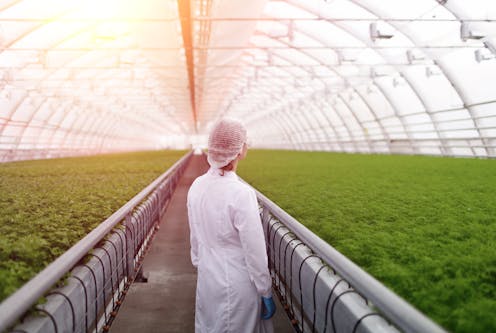
We need to revolutionise agriculture in the next 30 years. In 2050 we may have almost 10 billion people to feed. Farmland is already degraded by existing agriculture, and climate change is putting new pressure on crops and livestock.
With the tools we have now we can’t create new breeds and cultivars fast enough to cope with the rapidly changing conditions. How will we get strong yields in uncertain environments and make more food without using more land?
Part of the answer is synthetic biology: using cutting-edge genetic technology to build organisms that evolution never did. Synthetic biology has already had some successes, such as turning yeasts into tiny chemical factories and giving cotton the qualities of synthetic fibres.
At CSIRO, we have already used synthetic biology to produce energy-rich feed for livestock. Our scientists have “switched on” high oil production in the stems and leaves of plants, which could potentially triple the amount of oil they produce.
But these examples are just the beginning.
What is synthetic biology?
Synthetic biology applies engineering theory to biological systems. It relies on a standard kit of biological “parts” such as genes that can be combined to generate complex subcellular machines, circuitry, devices and even whole cells and complex engineered organisms.
This means cells and other biological systems can be designed like electrical circuit boards. Methods that have been successful in other areas of engineering – such as design-build-test-learn cycles, robotic assembly systems and using artificial intelligence algorithms to extract meaning from large data sets – can now be used on life itself to rapidly improve engineered organisms.
Read more: The synthetic biology revolution is now – here's what that means
Beyond evolution
Evolution allows plants and animals to explore various different solutions to problems they encounter via random mutations and natural selection.
For example, breathing can work in several different ways, and some of these are much more efficient than our lungs. Evolution doesn’t necessarily deliver the best solution to a problem – it just delivers one that lets an organism survive in a given niche.
So, for any given problem, better solutions may exist than the ones already available in biology. Synthetic biology lets us explore this untested “solution space” much more quickly than evolution – on a timescale of weeks or months, rather than years or millennia.
Synthetic biology therefore allows us to explore places where evolution has never gone – and in some cases, probably never would go. It means we can reach outcomes chosen to meet human needs, instead of evolutionary pressures.
Changing the system
To make the most of synthetic biology, there are several systemic challenges that need to be addressed.
I recently met with colleagues from around the world to explore these challenges for agricultural synthetic biology and we have just published our conclusions in Nature Plants.
We agreed that synthetic biology is changing not just what we deliver but how we do this kind of science.
Designing high-throughput bioengineering experiments is quite different from the bespoke, master-craftsperson approach we have used previously. It requires a conceptual and cultural shift that has to happen in a relatively short time frame. Universities will need to modernise their teaching programs to keep pace.
Read more: A fresh opportunity to get regulation and engagement right – the case of synthetic biology
We also need to build robotic infrastructure (known as “biofoundries”), create faster analytical systems to handle testing, and develop new data-analysis methods and machine-learning algorithms. A global alliance of biofoundries was recently established to help push this science forward rapidly.
Basic research into the fundamental principles of the systems that we aim to engineer must also be supported. We cannot engineer effectively unless we understand the system we are modifying. Engineering a system effectively in turn aids our understanding of that system.
Finally, we must ensure the social, legal, ethical, regulatory and institutional issues surrounding synthetic biology are addressed in parallel with development and deployment of these technologies.
An opportunity for Australia
Australia has recognised the importance of synthetic biology. CSIRO, Australia’s national science agency, established the Synthetic Biology Future Science Platform in 2016 to build our synthetic biology capability. This is now a A$60 million research and development program with 45 partners nationally and internationally.
It includes a strong investment in social sciences and responsible innovation. The Australian Council of Learned Academies published a roadmapping report for synthetic biology in 2018, and the Australian Research Council has just invested A$35 million into an ARC Centre of Excellence in Synthetic Biology.
At CSIRO, synthetic biology is being used to create cotton with the properties of synthetic fibres, such as being stretchy, non-creasing and even waterproof. This avoids the use of petrochemicals, and the cotton remains biodegradable.
And at The University of Queensland we are engineering yeast – the same yeast used to make beer, wine and bread – to make sustainable agricultural chemicals. The chemicals can alter crops and their associations with microbes in the roots so they take up nutrients more efficiently. The aim is to increase the yield of crop plants.
We have much to do and a relatively short time to do it in. We need to explore uncharted territory beyond evolution to solve the existential problems that agriculture faces. The synthetic biology tools and techniques we are developing will be critical to deliver the agriculture we need in a challenging future.
Authors: Claudia Vickers, Director, Synthetic Biology Future Science Platform, CSIRO


 Daily Bulletin


