

A national drought policy should be an easy, bipartisan fix. So why has it taken so long to enact a new one?
- Written by: Linda Botterill, Professor in Australian Politics, University of Canberra
In a country as dry as Australia, surely it is a no-brainer that we have in place a coordinated, national drought response that can be rolled out the same way that the Natural Disaster Relief and Recovery Arrangements are triggered when the country experiences cyclones, floods or bushfires.
Drought used to be part of these arrangements but, for good policy reasons, was removed in 1989.
Our last attempt at national drought policy
Once upon a time, Australia had a national drought policy. It was enacted in 1992 following a comprehensive review and report by an independent panel, the National Drought Policy Review Task Force, and detailed negotiations between Commonwealth and state ministers and their officials.
The policy included commitments by both state and Commonwealth governments to implement a coordinated and comprehensive package of programs covering drought preparation and response.
At the Commonwealth level, these measures were centred around:
the controversial “exceptional circumstances” provisions of its revised Rural Adjustment Scheme, which were aimed at supporting farm businesses by subsidising up to 100% of the interest paid on commercial loans.
a farm household support scheme that provided short-term income support to farmers and also offered grants for those who decided to leave the land.
farm management bonds, later known as farm management deposits, that allowed farmers to set aside pre-tax income they could later draw on in times of need.
a drought relief payment (added to the policy in 1994) that provided income support for farmers in areas declared to be experiencing “exceptional circumstances” drought. By May 1995, over 10,000 families were accessing this payment every month.
Flaws in the policy
As anyone familiar with these programs will know, the exceptional circumstances program was plagued by problems.
The first was the lack of clarity around defining when a drought moved from a “normal” situation that was expected to be managed by farmers, to an “exceptional” situation with which even the best manager could not be expected to cope.
The definition of an “exceptional circumstances” drought became the subject of ongoing debate, along with concerns that drought assistance was based on administrative boundaries, leading to inequities that became known as the “lines on maps” problem.
Read more: Just because both sides support drought relief, doesn’t mean it's right
The second issue was the amount of information farmers were required to provide in order to demonstrate eligibility for “exceptional circumstances” assistance. The process was considered onerous and time-consuming.
Amid these concerns, a comprehensive review of drought policy was conducted in 2008 by the Productivity Commission. This was accompanied by a report by the Bureau of Meteorology and CSIRO on the likely impact of climate change on the frequency and severity of droughts in Australia, and an independent report on the social impact of drought.
Following the review, the government decided to end the “exceptional circumstances” program in 2009. This effectively gutted the national drought policy.
Since then, there has been no further attempt at developing a comprehensive, predictable drought policy response from the federal or state governments. There have been intergovernmental National Drought Agreements, but these have done little more than restate the principles underpinning the country’s drought policy since 1992.
In recent years, the Coalition government has appointed a drought envoy, Barnaby Joyce, and drought coordinator-general, Stephen Day, to study the impact of drought on farmers and recommend possible solutions, but we have yet to see what either has come up with.
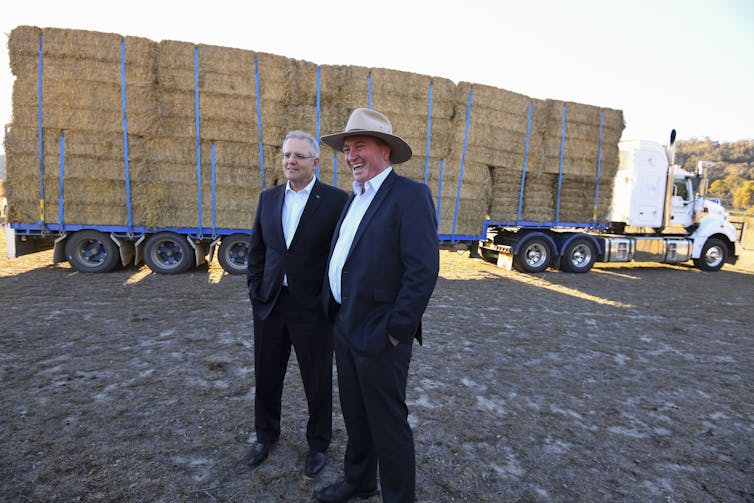 Drought envoy Barnaby Joyce says he has sent drought reports directly to Scott Morrison, but these have not yet been made public.
Lukas Coch/AAP
Drought envoy Barnaby Joyce says he has sent drought reports directly to Scott Morrison, but these have not yet been made public.
Lukas Coch/AAP
Providing meaningful, timely and predictable support
Much of the criticism levelled at the government’s response to the current drought relates to its ad hoc and knee-jerk nature. This reactive way of dealing with drought highlights the need to return to a more predictable approach. This would avoid perceptions of pork barrelling and provide certainty to farmers about what support is available and under what circumstances.
A new national drought policy needs to take several forms. First, it needs to support farmers to prepare for drought before it happens. This is one area where the current policy has been moderately successful.
As of August 2019, Australian farmers had set aside a total of $5.809 billion in farm management deposits. These deposits have encouraged farmers to manage financial risk by building up cash reserves in high-income years, which they could then use during times of drought.
Individual farmers can currently hold a total of $800,000 in deposits. One possible improvement is to raise the ceiling on annual deposits in the years following drought recovery to allow a rapid rebuilding of cash reserves.
Second, a strong drought policy needs to provide support to all farmers during drought, not just those who have accumulated sufficient deposits to help them ride out the lean years.
In recent years, many farmers have taken advantage of long-term, low-interest loans to help during drought, and some have called for zero-interest loans to be made available, as well. But loans are not an ideal solution, as repayments are generally required even when farm incomes remain low.
An alternative to low- or no-interest loans are income contingent loans. Similar to the HECS-HELP scheme in higher education, these types of loans only require repayment when the borrower can afford to do so.
This would not only give farmers greater flexibility when it comes to repayment, it would also greatly reduce the extensive red tape that strangled the old “exceptional circumstances” scheme.
Read more: Farm poverty: an area of policy aid built on sands of ignorance
Third, we need a serious rethink of the way we provide income assistance to farmers in a broader sense. Providing income support to farmers who are asset-rich, for instance, raises questions about fairness when compared with poor people in cities who are struggling to get by on Newstart payments.
This imbalance has come into stark focus in recent weeks, particularly on social media, as government ministers have discussed the introduction of drug testing for Newstart recipients, and in the debate around the Indue card.
There has been no serious attempt in the past 45 years to measure the extent of poverty among farmers. We can develop more appropriate and equitable income-support policies if we can better understand the genuine nature of their need.
The elephant in the room
While the government has assiduously avoided making the link, an effective national drought policy also cannot be divorced from discussions about climate change.
The 2008 Productivity Commission report was pretty clear in its conclusions about the impact of climate change on drought in Australia. A growing number of farmers are now acknowledging this reality. Denying the need for serious consideration of climate change is not doing our agricultural producers any favours.
Read more: Is Australia's current drought caused by climate change? It's complicated
Developing an effective national drought policy is hard work. But in another sense, it should also be easy. This is because, unlike many other areas of government policy, it can be bipartisan.
Although the National Party has historically been aligned with rural voters, all parties are broadly sympathetic to farmers and value their contributions to the economy and, importantly, our national identity. The public also generally regards farmers positively and is responsive to their plight when they are faced with hardship.
As such, this should be one area where our politicians can come together to develop a coherent national response — one that is known in advance, forward-looking, equitable with other income-assistance programs in the community, and provides meaningful support before, during and after drought.
Authors: Linda Botterill, Professor in Australian Politics, University of Canberra


 Daily Bulletin


