

We must rip up our environmental laws to address the extinction crisis
- Written by: Don Driscoll, Professor in Terrestrial Ecology, Deakin University
Humans are causing the Earth’s sixth mass extinction event, with an estimated one million species at risk of extinction.
Addressing this crisis requires transformative change, including more effective environmental law and implementation.
Improved legislation is one of five main levers for realising change identified in the recent United Nation’s global biodiversity report and the key lesson arising from the Senate’s interim report into Australia’s faunal extinction crisis.
Read more: 'Revolutionary change' needed to stop unprecedented global extinction crisis
The Senate’s interim report, based on 420 submissions and five hearings, shows Australia is a world leader in causing species extinctions, in part because Australia’s systems for conserving our natural heritage are grossly inadequate.
To allow the continued erosion of this continent’s spectacular and remarkable array of globally unique plants and animals is a travesty of the highest order.
Inadequate protections
One of the problems is species may decline from common to extinct quite rapidly – faster than the time it takes species to be listed as threatened under the federal Environment Protection and Biodiversity Conservation (EPBC) Act.
The Christmas Island forest skink was formally listed as a threatened species only four months before the last individual died in captivity, but 15 years after the decline was first reported.
Extinction of the forest skink, Bramble Cay melomys and Christmas Island pipistrelle between 2009 and 2014 may have been averted if the risk was formally recognised in a more timely manner and effective conservation actions, such as captive breeding programs, were implemented.
Currently, if a species is not listed, it is not a “matter of national environmental significance” and federal agency staff generally have no legal basis for acting to protect it.
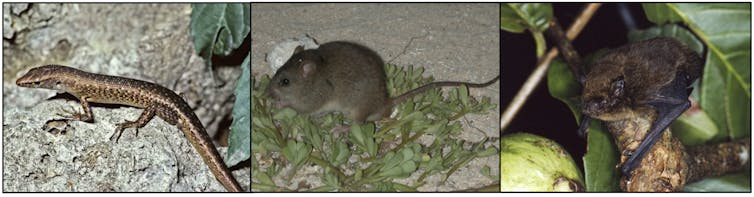 The Christmas Island forest skink (left), Bramble Cay melomys (centre) and Christmas Island pipistrelle (right) all became extinct in 2009-14.
Left: Hal Cogger; centre: Queensland Department of Environment and Heritage Protection; right: Lindy Lumsden.
The Christmas Island forest skink (left), Bramble Cay melomys (centre) and Christmas Island pipistrelle (right) all became extinct in 2009-14.
Left: Hal Cogger; centre: Queensland Department of Environment and Heritage Protection; right: Lindy Lumsden.
The black-throated finch has been listed as threatened on the EPBC Act for 14 years and during this time 600,000 ha of potential finch habitat has been destroyed. Worse still, five large coal mines, including the Carmichael Coal Mine, have been given approval (pending environmental conditions being met in Queensland) to clear more than 29,000 ha of black-throated finch habitat in one of its final strongholds, the Galilee Basin.
Coal mining will drive these finches into the critically endangered threat category, pushing them perilously close to extinction, and all with federal government approval.
Read more: Why Adani's finch plan was rejected, and what comes next
The controversial Toondah Harbour development in Brisbane is another example of how ministerial discretion can allow disastrous environmental outcomes. The project plans to build 3,600 apartments on wetlands that provide habitat for migratory waterbirds, including the critically endangered eastern curlew.
Despite being described as “clearly unacceptable” by the federal environment department and knocking it back twice, the minister allowed a third submission to proceed for further assessment.
It was reported this decision was made in the context of legal threats and donations from the developer in question. If true, this context would make it very difficult to make impartial decisions that protect biodiversity, as environmental law intends.
Increasing ministerial discretion was a key result of 2007 amendments to the EPBC act, which meant recovery plans were no longer required for threatened species.
The amendment allowed the minister to develop “conservation advices” instead of recovery plans. This amendment downgraded protections for threatened species because a minister can legally make decisions that are inconsistent with conservation advice, but not a recovery plan.
Read more: It's not worth wiping out a species for the Yeelirrie uranium mine
New environmental legislation
Based on these examples and many others that demonstrate the failings of current laws, the interim report concludes that we should rip up the EPBC act and develop stronger and more effective environmental legislation.
This includes establishing an independent Environmental Protection Agency to ensure enforcement of environmental laws, and, in a forward-looking addition by the Greens senators, an independent National Environmental Commission to monitor effectiveness of environmental legislation and propose improvements.
Australia needs a well-resourced, independent umpire for the environment, with powers to investigate environmental concerns and scrutinise government policy, akin to New Zealand’s Parliamentary Commissioner for the Environment. While Australia’s Threatened Species Commissioner is an excellent champion for the environment, this role provides no ability to question government actions regarding environmental protection and nature conservation.
Read more: Australia's species need an independent champion
Although replacing the EPBC act with new legislation may seem like a radical step to some (but not all), the interim Senate report, and the global UN report, have independently concluded major reform is essential. We are not in a moment of time when tweaking the current system will do the trick.
Changing Australia’s environmental legislation is a relatively minor update compared with the fundamental social and economic changes recommended by the UN report.
Such changes are already recommended by scientific societies like the Ecological Society of Australia, non-government organisations like Birdlife Australia and the Australian Conservation Foundation, and are demanded by a growing section of society. New, fit-for-purpose legislation must be enforceable, apolitical and responsive.
Read more: Australia's draft 'Strategy for nature' doesn't cut it. Here are nine ways to fix it
Opinion polls show that the level of environmental concern is higher in Australia than in other countries , while 29% of ABC Vote Compass respondents ranked the environment as the most important issue, up from 9% in 2016.
This groundswell of environmental concern has spawned mass protest movements like Extinction Rebellion. Young Australians also have shown their concern. In March 2019, thousands of school students took part in 50 rallies across the country to protest against “the destruction of our future”.
Decisions about what and how much we buy, what we eat, how much we travel and by what means, and family size, all contribute to our environmental footprints, and are the fundamental instigators of the biodiversity crisis.
However, we must also look to our political leaders to support effective change. The simplest and most powerful action you can take to reverse the extinction crisis is to vote for a party with policies best aligned with credible scientific advice on how we can get out of this mess.
Authors: Don Driscoll, Professor in Terrestrial Ecology, Deakin University


 Daily Bulletin


