

Don't forget our future climate when tightening up building codes
- Written by: Deo Prasad, Scientia Professor and CEO, Co-operative Research Centre for Low Carbon Living, UNSW
Too often it takes a crisis to trigger changes in legislation and behaviour, when forward thinking, cooperation and future planning could have negated the risk in the first place. Australia’s building and construction industry is under the microscope and changes in the law are in the wind, due to situations that could have been avoided. These include the evacuation of Sydney’s Opal building and the fires in Melbourne’s Lacrosse tower in 2014 and the Neo200 apartment building in February, both of which were fuelled by combustable cladding, as was the 2017 fire in London’s Grenfell Tower that killed 72 people.
The Shergold Weir report made 24 recommendations to improve the National Construction Code to ensure compliance, integrity and more. Commissioned by federal and state building ministers, the report was made public at the Australian Building Ministers Forum in April 2018. But implementation has been too slow to prevent the problems in the Opal and Neo200 apartment buildings. And it included no changes to climate-proof buildings.
Read more: Australia has a new National Construction Code, but it's still not good enough
A new National Construction Code comes into effect on May 1. Recent events have, however, exposed inadequate construction standards and increased public pressure for further change. This presents an opportunity to future-proof our cities as well as restore public confidence in our construction industry.
Construction codes were created to eliminate “worse practice”, but we are now in a position to make them “best practice”. Importantly, we must prepare for climate change. Australia is increasingly experiencing more extreme weather patterns, but are we ready?
The legislative overhaul must also include building sustainability and higher performance requirements. A low-to-zero-carbon future must be part of the picture.
Construction code changes are needed urgently, not just for increased safety, but to ensure future urban developments:
- are ready for higher energy demands to cool and heat buildings
- are designed to maximise sun and shade at the appropriate times to cool and warm both building and street
- use materials that reflect heat for hot climates and absorb it for cooler ones
- maximise insulation to reduce energy use
- provide enough green space to give shade, produce oxygen and sustain a healthy environment
- use water features to cool common and public areas
- install smart technology to monitor and manage buildings and precincts.
Read more: As climate changes, the way we build homes must change too
Many leading developers are taking the initiative to ensure projects include high-performance, zero-carbon, highly energy-efficient buildings, with top star ratings, but action needs to be across the board. This can only be done via tough legislation and enforced compliance.
The University of NSW’s Tyree Building is an excellent example of a high-performance building, as is One Central Park, Sydney, which features hanging gardens and an internal water recycling plant. But its most striking feature is its “heliostat”, a large array of mirrors that reflect sunlight to areas that would otherwise be in shadow.
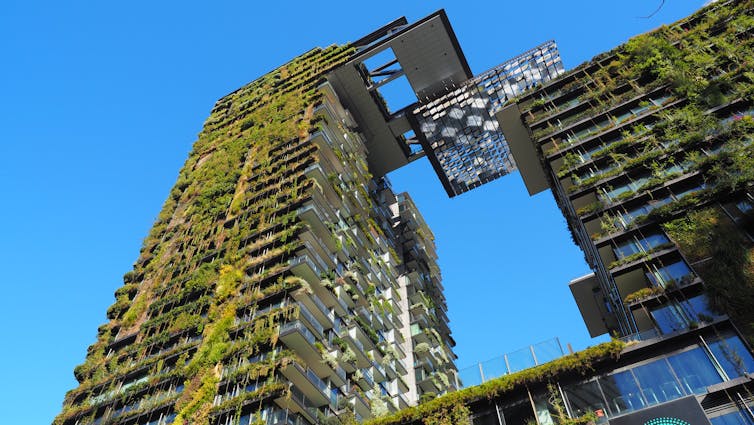 One Central Park.
SAKARET/Shutterstock
One Central Park.
SAKARET/Shutterstock
Around the world, high-performance buildings are on the increase, such as 313@Somerset in the heart of Singapore, and the Sohrabji Godrej Green Business Centre in Hyderabad – India’s first Leadership in Energy and Environmental Design (LEED) platinum-rated building. There are many more.
Changing the law
New building standards and compliance are required to ensure high-performance buildings are the norm, not the exception. The construction industry should fulfil a “cradle to cradle” objective for materials. This means accounting for:
- where materials come from
- how materials are made
- safety levels
- carbon component
- recyclability at demolition.
Laws covering low-carbon building design are imperative, setting standards for geography, maximising natural light, air flow, insulation and smart technology. Technology can monitor and run a building’s utilities to ensure it’s not only energy-efficient but also delivers a health standard that’s adaptable to the future pressures of climate change.
Read more: Green buildings must do more to fix our climate emergency
Sustainable buildings are achievable now
Current know-how makes all this achievable. Over the past seven years the Cooperative Research Centre for Low Carbon Living and its industry partners have funded research into most low-to-zero-carbon aspects of the built environment. This has led to many recommendations in reports like Built to Perform, produced by the Australian Sustainable Built Environment Council.
The many research projects include:
- 17 living laboratories providing cutting-edge data
- creating low-carbon communities
- developing tools to measure carbon outputs, from materials to services
- studying the effects of heatwaves in Western Sydney and ways to cool cities
- research into low-carbon concrete made of fly ash.
This plethora of data reveals that sustainable cities and precincts are achievable, while providing for a growing communities. Blockchain and solar technology, for example, is now proven for managing a precinct’s energy needs and can help turn energy users into providers.
Read more: Beyond Bitcoin: how blockchains can empower communities to control their own energy supply
Although we are more global than ever, online and social media have in turn made us locally focused. We can know what’s going on in our street at a click and this technology is applicable to the operation of our future, sustainable cities.
We have the data, expertise, tools and knowledge to make safe, low-to-zero-carbon cities part of our future. But there’s much work to do. We still need to implement this knowledge, use the tools, change behaviour and instil 100% trust in the design and construction process. There’s no time to waste.
Authors: Deo Prasad, Scientia Professor and CEO, Co-operative Research Centre for Low Carbon Living, UNSW
Read more http://theconversation.com/dont-forget-our-future-climate-when-tightening-up-building-codes-113365


 Daily Bulletin


