

The US-North Korea summit ends abruptly in Hanoi
- Written by: Benjamin Habib, Lecturer in International Relations, Department of Politics and Philosophy, La Trobe University
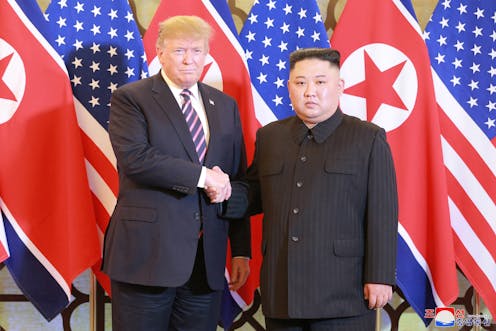
Korea-watchers around the world are scrambling to tease out the meaning of the abruptly concluded US-DPRK summit in Hanoi. I want to cast a critical eye on denuclearisation itself as the framing objective of the summit negotiations.
If we step back for a moment to look at the extraordinary developments in Korean Peninsula diplomacy over the past year, we see three parties who want different things.
The Moon Jae-in administration in South Korea remembers all too well the chaos of 2017 that brought Korea to the brink of war, and sees a permanent peace regime as the most important objective of its engagement efforts.
Read more: Economic growth and 'Trump-proofing' – why the latest inter-Korea summit matters
For their part, the North Koreans want to neutralise the military threat from the US, see sanctions lifted, and obtain economic assistance to accelerate the development of their economy. The Trump administration, and much of the broader US foreign policy establishment, remains attached to the denuclearisation of North Korea as the end game of this process.
But denuclearisation is a fantasy that is leaving Washington as the odd man out on the Korean Peninsula. The goalposts on the Korean Peninsula are changing as the momentum for inter-Korean engagement grows, while the importance of the US as the indispensable security guarantor is diminishing.
Who walked out on whom?
Like everyone else, I will be watching closely over the coming days as details begin to emerge about the sticking points that led to the abrupt conclusion of the summit.
In the lead-up to the Hanoi summit, the Trump administration did signal some flexibility on verification measures for full, independent accounting of North Korea’s nuclear program as a condition for further negotiation.
It is ironic that Trump’s apparent willingness to befriend authoritarian leaders has opened the door for negotiations for a permanent peace regime in Korea, which previous US administrations had kept quarantined behind the demand for “complete, verifiable and irreversible denuclearisation” (CVID).
However, in his final press conference in Hanoi, the US president indicated that the North Korean delegation asked for too much in requesting the lifting of all economic sanctions in exchange for the shutdown of the Yongbyon nuclear facilities.
Considering the enormous pressure Trump has come under from domestic quarters not to sell out the denuclearisation agenda, there was no way the US delegation could accept those terms.
But there is another possibility. The Congressional testimony of Michael Cohen from Washington may have created fresh doubts in the minds of the North Korean delegation about Trump’s ability to deliver on a deal. It is possible that Kim Jong-un presented terms they knew the Americans could not accept, to avoid the possibility of a lame-duck deal negotiated by a compromised president.
It is important to recognise that the US and North Korea run at different political speeds. Since 1945, North Korea’s three Kims have presided through 13 US presidents. US presidents are confined to term limits and captive to the political demands of relatively short election cycles. The now extreme polarisation of American politics ensures that promises made by Trump may not be honoured by an incoming administration.
With a US presidential election looming in 2020 and widespread criticism within the American foreign policy establishment of Trump’s negotiating position, and with recurring allegations of criminality fuelling calls for his impeachment, it is understandable that the North Koreans might be cautious about making concessions.
They will remember the failure of the US Congress to ratify the Agreed Framework when President Bill Clinton was facing impeachment during the 1990s.
The denuclearisation of North Korea is a fantasy
Regardless of who blinked first, the failure to reach agreement in Hanoi further demonstrates that North Korea will never willingly denuclearise. This is not a secret. It has been obvious for more than a decade, since the failure of the Six-Party Talks. Beyond the economic sanctions regime, there is very little the US can do about it.
It bears repeating why this is the case:
successive US administrations have considered and rejected the use of military force against North Korea on the grounds that it poses an unacceptable risk to its ally in South Korea
because of the longstanding sanctions regime, the US lacks sufficient economic leverage over the DPRK to bring it to heel, even with the expansive list of goods banned from export to the North, and the expansive powers of the Financial Action Task Force (FATF) to restrict financial flows in and out of the DPRK
North Korea is adept at sanctions-busting, in spite of the squeeze being placed on the country by existing measures.
Read more: As the shaky US-North Korea summit is set to begin, the parties must search for common interest
Holding out for denuclearisation as an end game is an exercise in futility. It is bad policy. It unnecessarily backs the US into a corner of weakness where it cannot bring its obvious strategic and economic advantages to bear.
Denuclearisation has been the obstacle that has kept the US and North Korea at the stage of talking about talking, halting progress on other confidence-building measures that could improve the relationship and take some of the heat out of the Korean Peninsula security dilemma.
Missed opportunity for a peace settlement
The dominant school of thought in disarmament circles is that states that acquire nuclear weapons are a threat to international peace and security, and so must be prevented from doing so. This is the denuclearisation perspective that has dominated the discourse on North Korea in the US and informed the longstanding CVID policy.
There is an clear logic here that stems from the terrible and awesome destructiveness of nuclear weapons, with which few could argue. From this perspective, any negotiations with North Korea that do not result in full nuclear relinquishment will be interpreted as a sell-out.
However, there is also an obvious hypocrisy in this position (and in the nuclear non-proliferation regime more generally) given the size of the US nuclear arsenal and the deliberate ambiguity of its doctrine around nuclear first-strike. It is this hypocrisy that the DPRK exploits in its official interpretation of denuclearisation as meaning the universal relinquishment of nuclear weapons by all countries.
There is another school of thought that it is not nuclear weapons per se that represent a threat to international peace and security. Rather, it is an international environment teeming with existential threats in which states feel compelled to acquire nuclear weapons to protect themselves.
From this perspective, a peace declaration could diminish the level of insecurity that feeds the desire for nuclear proliferation. If the perception of imminent threat lessens, then the probability of nuclear weapons use in the event of conflict is also reduced.
There is space within this perspective to work towards nuclear disarmament. But that goal is one element of a bigger picture. This is the essence of the South Korean position on inter-Korean summit diplomacy, and the fading shadow of a missed opportunity in Hanoi.
These summits are part of a long-term peace-building process. Clearly, Donald Trump and Kim Jong-un are not on the same page in their negotiating objectives.
If US-DPRK bilateral negotiations are to continue, they are going to have to find a lowest common denominator on which they can build. Regardless of how we feel about Kim Jong-un, the political system he presides over, and the abuses of his regime, denuclearisation is never going to be the lowest common denominator upon which the US-DPRK relationship can evolve.
Authors: Benjamin Habib, Lecturer in International Relations, Department of Politics and Philosophy, La Trobe University


 Daily Bulletin


