

Read The Times Australia

Daily Bulletin

Curious Kids: how do mountains form?

  • Written by: Patrice Rey, Associate Professor, School of Geosciences, University of Sydney

This is an article from Curious Kids, a series for children. The Conversation is asking kids to send in questions they’d like an expert to answer. All questions are welcome – serious, weird or wacky! You might also like the podcast Imagine This, a co-production between ABC KIDS listen and The Conversation, based on Curious Kids.

How do mountains get made? - Astrid, age 6, Marrickville

Hello Astrid. You may not believe this but when I was about your age my teacher (Mr Rouve) explained to the class how mountains get made.

He took a sheet of paper and put it flat on the table. Then, he put the tips of his right and left hands’ fingers on each side of the flat sheet and slowly moved his hands toward each other. Try to do it and you will see that the middle part of the paper will lift off the table to form a nice fold.

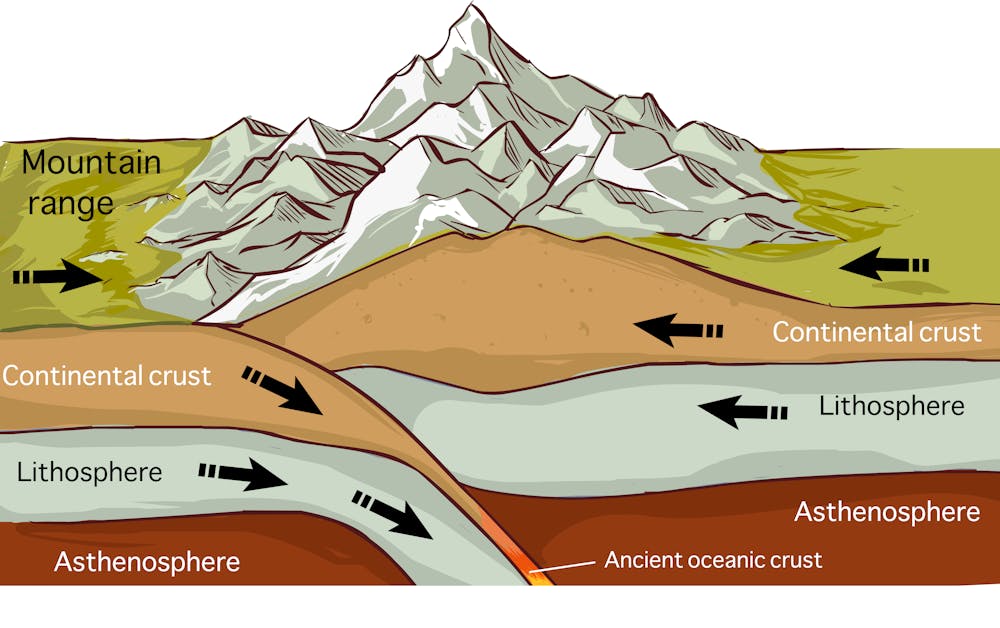
My teacher explained that mountains form in a similar way, when flat layers of rocks are pushed toward each other they move upward forming tall mountains.

My teacher was really exited by a discovery made by geologists at that time, when I was a kid. These geologists had figured out that the surface of the Earth was, like a giant jigsaw puzzle, made of pieces. Those pieces, called “tectonic plates”, move and bump into each other.

This bumping creates earthquakes, which slowly push the ground surface upward to make mountains. It happens so slowly that, in fact, you are getting taller faster than mountains do, except mountains keep growing and growing and growing for many millions of years until they are so heavy they can no longer grow taller, only wider.

Nat Geo simulation of mountains forming.

In fact, Australia and New Zealand are sitting on two different “tectonic plates” that move towards each other at the speed of a few centimetres per year. Where they bump into each other, the ground gets lifted to form the stunning New Zealand Alps, the top of which stands close to 4,000 metres. Can you imagine about 4,000 people as tall as you, standing straight up on each other shoulders? That’s how tall these mountains are.
Curious Kids: how do mountains form? Mountains also form when the Earth’s crust is pushed upward from underneath. Shutterstock

Mountains also form when the Earth’s crust is pushed upward from underneath. At the same time the New Zealand Alps started to form, a large hot bubble of rocks raising from deep in the Earth, like a giant air balloon, was pushing upward the surface of the eastern part of Africa forming a 4,000 metre high plateau. This plateau split to form what is known as the East African Rift, a valley twice as long as the New Zealands Alps.

There are many mountains at the surface of the Earth. Some we can see, some we can’t because they are under the sea. If you could take a submarine and dive under the sea, for instance in the ocean in between Australia and Antarctica, you could visit a long mountain where the Australian and Antarctica tectonic plates move away from each other.

Thank you again for your fantastic question.

Read more: Curious Kids: What existed before the Big Bang? Did something have to be there to go boom?

Hello, curious kids! Have you got a question you’d like an expert to answer? Ask an adult to send your question to curiouskids@theconversation.edu.au

Curious Kids: how do mountains form? CC BY-ND Please tell us your name, age and which city you live in. We won’t be able to answer every question but we will do our best.

Authors: Patrice Rey, Associate Professor, School of Geosciences, University of Sydney

Read more http://theconversation.com/curious-kids-how-do-mountains-form-108246

Business News

The Business Case for Choosing Australian Fabricators Over Imported Alternatives

For a long time, you might have defaulted to overseas suppliers when sourcing fabricated metal components for a project. The unit price was lower on paper, and the maths seemed straightforward. That...

Daily Bulletin - avatar Daily Bulletin

Australian organisations are relying on business continuity plans built for a far more predictable world

Tariff escalations, supply chain fragility, geopolitical events, and the ongoing threat of cyber disruption have reshaped the risk environment facing Australian organisations. The problem is that ma...

Daily Bulletin - avatar Daily Bulletin

How to Rent a Car for Uber in Melbourne: What Every New Driver Needs to Know

Starting out as an Uber driver in Melbourne is not as complicated as it sounds but getting the vehicle right is where most new drivers get stuck. Uber has strict requirements around vehicle age, condi...

Daily Bulletin - avatar Daily Bulletin

When Should You Speak to a Lawyer About a Legal Issue?

Legal issues can begin with a simple question, then become harder to manage once formal steps are involved. Many people wait until a matter feels urgent before seeking guidance, even though earlier ...

Daily Bulletin - avatar Daily Bulletin

The strategic rise of Bali as Australia’s next essential healthcare support hub

As Australian healthcare providers grapple with unprecedented operational bottlenecks, a new nearshore model is quietly transforming patient care delivery. Forward-thinking organisations,  including...

Daily Bulletin - avatar Daily Bulletin

Cost Savings and Benefits of Using Used Pallets in Logistics

In today’s competitive logistics and supply chain industry, businesses are constantly looking for ways to reduce operational costs without compromising efficiency and reliability. One of the most prac...

Daily Bulletin - avatar Daily Bulletin

How Fulfilment Services in Australia Help Businesses Scale Efficiently

The growth of e-commerce and modern retail has transformed customer expectations. Consumers now expect fast shipping, accurate order processing, and seamless delivery experiences regardless of where...

Daily Bulletin - avatar Daily Bulletin

Practical Ways Australian Workplaces Can Reduce Operating Costs

Reducing business costs doesn’t always mean cutting staff, shrinking services or making the workplace feel bare-bones. In many cases, the smarter savings are hiding in everyday operations: the light...

Daily Bulletin - avatar Daily Bulletin

Executive Recruitment Solutions That Help Organisations Secure Exceptional Leaders

Leadership has a direct impact on organisational performance, employee engagement, strategic growth, and long-term success. Businesses operating in increasingly competitive environments require experi...

Daily Bulletin - avatar Daily Bulletin

The Daily Magazine

Why Clearer Communication Still Matters in a Digital-First Business

It’s never been easier for businesses to communicate, but that doesn’t mean they’re always communica...

What Happens After You Lodge a BYDA Enquiry? The Step Most Excavation Projects Miss

Every excavation project in Australia — from a backyard deck footing to a multi-storey commercial bu...

How to Choose the Right Dentist on the Gold Coast

Finding a dentist you trust is one of those decisions that quietly affects your health for years, ...

The Hidden Engineering Problem Inside Australia's Older Housing Stock

A significant share of Australian homes were built for a way of living that no longer exists. Houses...

DIY Rodent Control Vs Professional Help: When Is It Time To Call The Experts?

Rodents are one of the most frustrating pest problems for Australian property owners. Rats and mic...

Lighting Shop in Perth: How The Right Lighting Can Transform Your Home And Business

The right lighting can completely change the look, feel, and functionality of any space. Whether it ...

Traffic Light System Solutions For Safer And More Efficient Traffic Management

Modern cities and growing communities rely heavily on effective traffic management to ensure safety...

Gold Migration Lawyers in Liquidation: How the Closure Affects Your ART Appeal

If your appeal was with Gold Migration Lawyers, a recent change to how the Tribunal decides cases ...

The pressure cooker: life in urban Australia in 2026

Australian cities have always been demanding. Long commutes, rising housing costs, busy schedules a...