

Elsie Masson, photographer, writer, intrepid traveller
- Written by: Jane Lydon, Wesfarmers Chair of Australian History, University of Western Australia
In a new series, we look at under acknowledged women through the ages.
In 1913, at the age of 23, Elsie Masson was travelling on a steamer near Port Essington, 150 miles from Darwin, when it was approached by a small lugger. The boat was manned by one white man and two black men. As she later recounted,
The white man raised a sunburnt face, fierce with grief and excitement, and shouted hoarsely, ‘My mate – Jim Campbell – speared by blacks at Junction Bay’. It was curious what a thrill of rage the words brought to the hearers – a sudden instinctive spasm of hatred of white for black.
Masson’s account of her own and the steamer’s other passengers’ visceral response to this event remains unusual and powerful in its candid confession of race hate. Like the moment in Heart of Darkness when an African “boy” announces, “Mistah Kurtz, he dead”, for Masson, this moment marked a shocking moment of reckoning with the other.
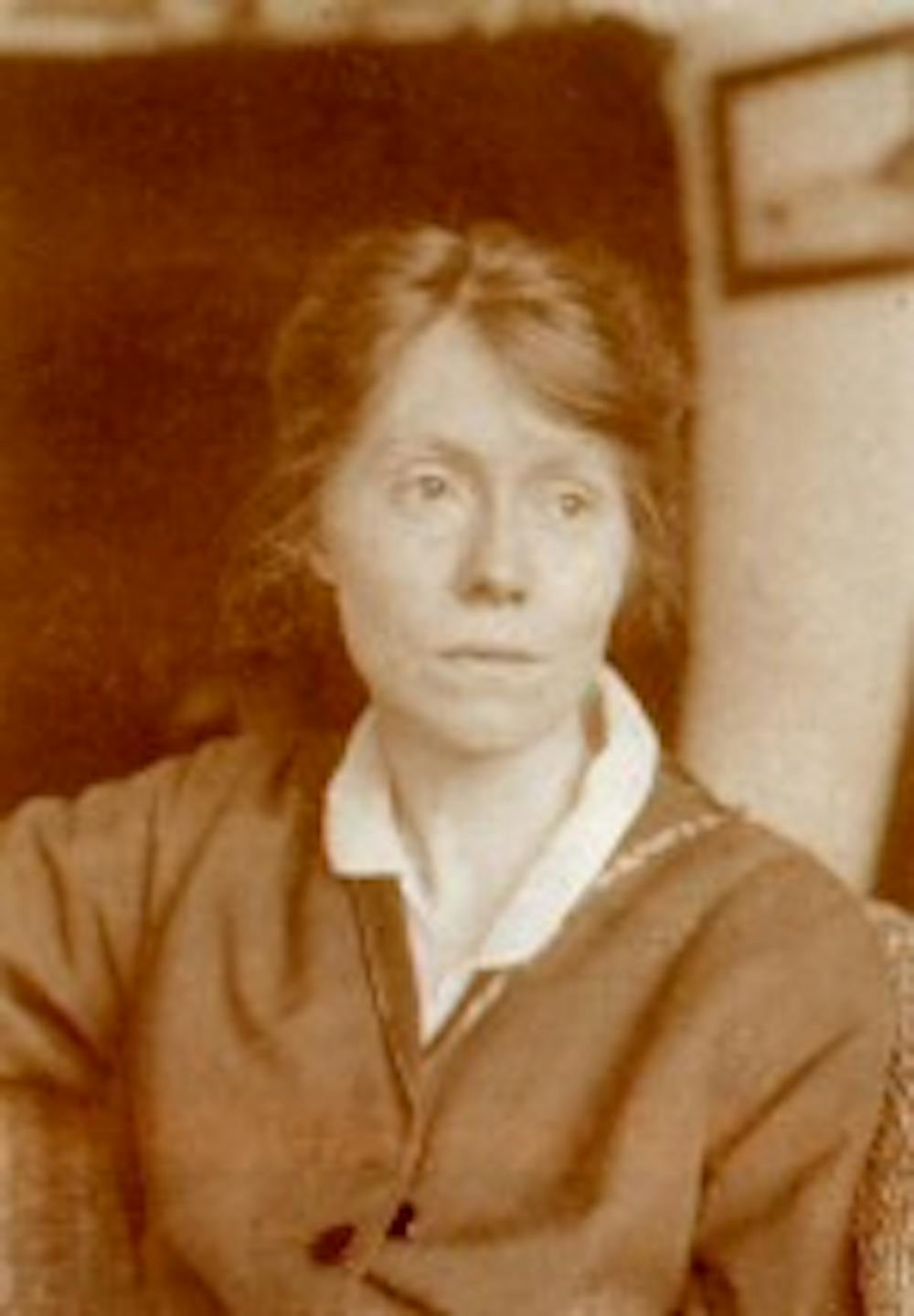 Masson in 1917.
Copyright unknown.
Masson in 1917.
Copyright unknown.
Yet Masson’s sympathy for the Territory’s Aboriginal people was actually awakened through this violent clash and its judicial aftermath. As a journalist, she attended the trial of those accused of murdering Campbell, reporting on the proceedings for the Northern Territory Times. Her growing advocacy for Aboriginal people expresses the contradictions of racial thought at this time.
As one of the “first white women” to travel in the Northern Territory, Masson’s newspaper articles and book An Untamed Territory - a profusely-illustrated narrative of life in the wild north - show how she popularized the “expert” views of her circle: an elite global network of colonial administrators, including the famous anthropologist Walter Baldwin Spencer.
Read more: How Conrad’s imperial horror story Heart of Darkness resonates with our globalised times
Who was Elsie?
Elsie Masson was born in Melbourne in 1890, the second daughter of Lady Mary and Professor Orme Masson, the chair of chemistry at Melbourne University. Masson senior was a close colleague and friend of Spencer, anthropologist and foundation chair of biology at the university.
Masson was clever and well-educated. At 16, she was taken to Europe for an extended tour with her mother and sister, studying music in Leipzig and art in Florence, and developing a good knowledge of French, German and Italian.
When the Commonwealth Government assumed control of the NT in January 1911, it appointed Spencer to lead a preliminary scientific expedition with three other scientists, including University of Melbourne veterinarian John Gilruth, a forthright Scot. Impressed with their findings, the government appointed Spencer to Darwin for a year as Special Commissioner and Chief Protector of Aborigines. Gilruth accepted the post of Administrator of the Territory in February 1912.
Elsie Masson joined Gilruth’s household as au pair in April 1913, departing toward the end of 1914. She was recruited on the promise of “pretty walks” and a comfortable verandah, but she managed to fit in considerable travel and observation of Territory life during this time, as well as taking and collecting many photographs now held by Oxford University’s Pitt Rivers Museum.
The ‘first white woman’
Masson’s life entailed daily interaction with a large, multiracial servant workforce, many of whom she photographed. These photos are unusual in that she named the subjects and sometimes recorded details about their lives.
However, they are also racially segregated, locating their subjects within their place of work. Her photos include Dhobie, the picturesque Chinese cook and laundryman; white Residence staff, and a labourer called “No More”, pictured with his buffalo.
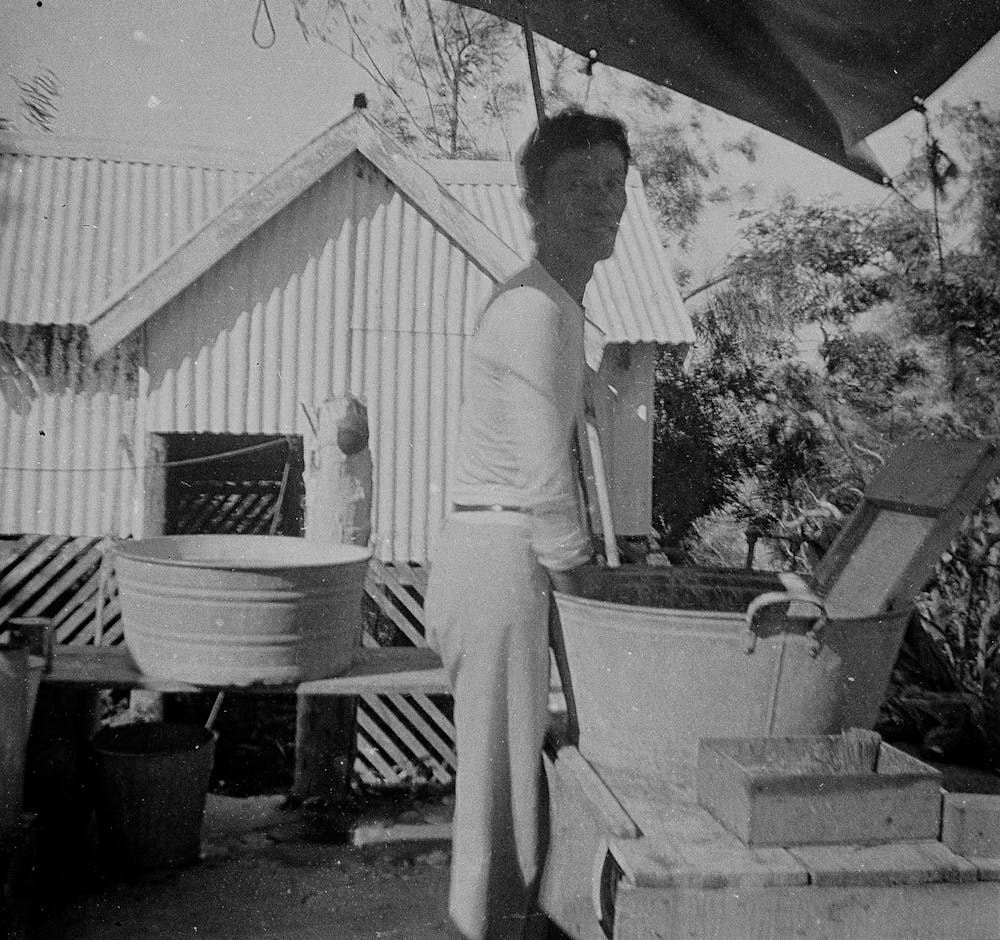 Masson’s photo of Dhobie.
Wayne Collection, Copyright Pitt Rivers Museum, University of Oxford
Masson’s photo of Dhobie.
Wayne Collection, Copyright Pitt Rivers Museum, University of Oxford
As the “first white woman”, Masson travelled to outlying parts of the Territory, such as Pine Creek Railway Line, the Daly River, Oenpelli (now Gunbalanya) in Arnhem Land, and as far as the Roper River in the Gulf of Carpentaria.
She wrote a report for Spencer on the Roper River Mission, established in 1908 by the Church Missionary Society at Mirlinbarrwarr, now known as Ngukurr.
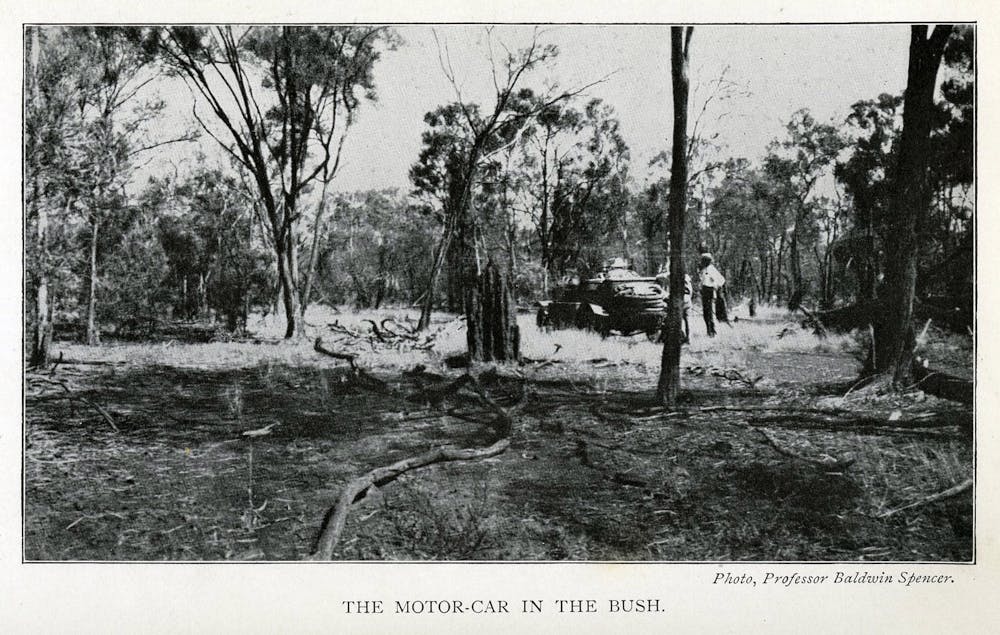 Baldwin Spencer, The Motor-Car in the Bush, in Masson’s An Untamed Territory.
Author provided.
Baldwin Spencer, The Motor-Car in the Bush, in Masson’s An Untamed Territory.
Author provided.
Masson’s relish of the exotic places and culture she saw disguised the harsh racial segregation implemented by Gilruth, Holmes and Spencer through new legislation and regulations. In her writings, Masson contrasted moments of modernity, such as the first car trip in the NT, with what she imagined to be a disappearing Indigenous way of life.
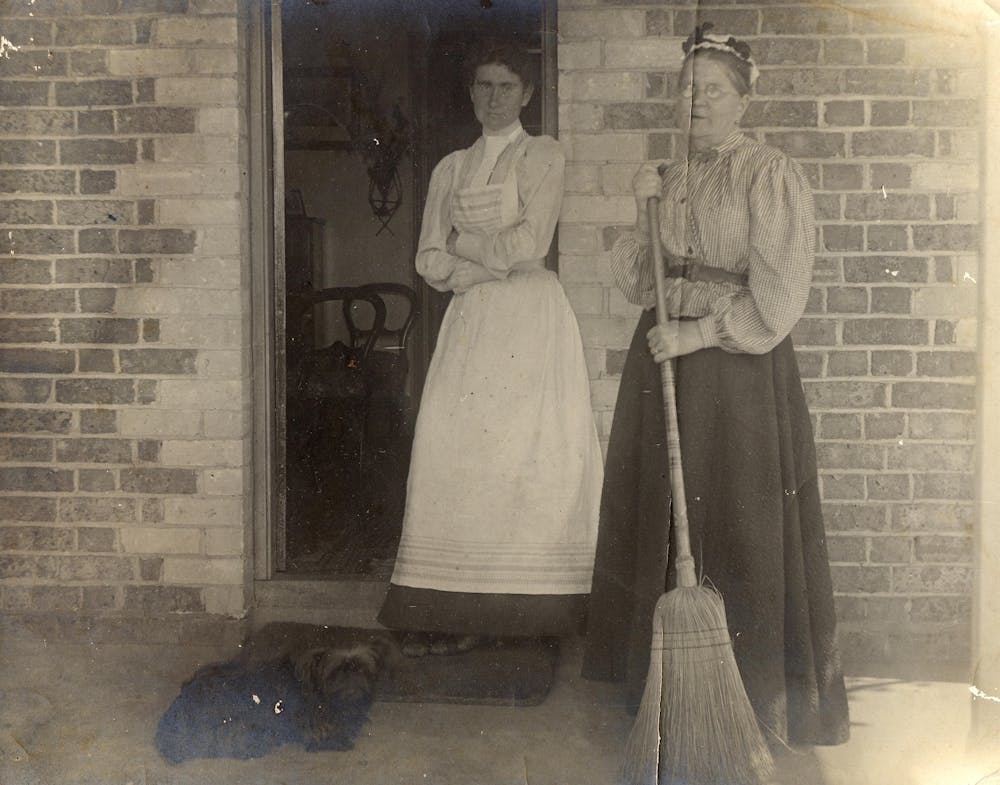 Household servants, Government Residence.
Wayne Collection, Copyright Pitt Rivers Museum, University of Oxford.
Household servants, Government Residence.
Wayne Collection, Copyright Pitt Rivers Museum, University of Oxford.
But today, the reader is struck most powerfully by Masson’s transition from dislike to respect, as she describes her developing relationships – with her Chinese hawker, whose strange vegetables the household learns to enjoy, the Aboriginal maidservants, and finally even black men accused of murder.
Her portrait of Aboriginal housemaid Nellie is framed by a humorous account of her “strange” dress sense. But Masson soon “forgets her first repulsion, and finds the good-humoured face almost comely, and an easy grace beneath”.
Recognising customary law
In 1913 Masson attended the trial of nine Aboriginal men accused of murdering James Campbell, a trepanger (fisher of sea cucumber). Despite her initial “thrill of rage” toward the accused black murderers, Masson’s views changed as she witnessed the men’s unfair treatment within the British legal system, due to the language barrier and cultural misunderstandings.
Masson’s account of this trial ultimately argued for the need to acknowledge the coherence of Indigenous tradition, and what today is termed customary law.
During the trial, one witness Ada, for instance, described how Campbell and his ten companions had been fishing one night when he was attacked. But she also explained that Campbell had been murdered in retaliation for his “punishing” an old Aboriginal man by putting him into a trepang boiler, causing a painful death.
Masson’s photograph of trepang boilers provided graphic testimony to this agonising assault, showing a crime scene, the aftermath of torture and death. Alongside portraits of the accused and their families, she effectively humanised these people for her audience, asking,
Who can blame them for what they did? … It is to be feared that only too often the savage black who commits an act of violence is only avenging equal outrages done to his own race by the savage white.
Many agreed with Masson. The judge sentenced five men to death, but after review, their sentences were commuted to imprisonment for life with hard labour. In the context of increasingly punitive “protection” policies, this was at least something.
While Masson never returned to the Territory, she married the famous Polish anthropologist, Bronislaw Malinowski, and they went on to live in six countries. Sadly her adventures ended all too soon, as Elsie was diagnosed with multiple sclerosis in 1928, and died in 1935.
More about Elsie Masson can be found in Photography, Humanitarianism, Empire (Bloomsbury, 2016).
Authors: Jane Lydon, Wesfarmers Chair of Australian History, University of Western Australia


 Daily Bulletin


