

The Army has a public perception problem. Here's how it can regain trust with society
- Written by: Marigold Black, AARC Research Fellow, Australian National University
“Do something for yourself, join the Army Reserve.”
This was one of the Army’s most iconic campaigns, broadcast on Australian television throughout the 1980s and 1990s. The advertisements were set to Tchaikovsky’s rousing battle hymn, the 1812 Overture, and portrayed an Army that was as comfortable displaying its militarism as it was exhorting the perks of enlistment.
But as every child of that era knows, the ads were particularly memorable because of the irreverent lyrics they inspired. In households across Australia, a chorus of children’s voices entered the refrain “join the Army get your head blown off” into the annals of Australian history.
‘Do something for yourself’ Army campaign.For a long time, the identity of the Army was inextricably connected to the landing at Gallipoli in 1915 and the sacred legends of the first world war. The institution stood for such ANZAC values as:
reckless valo[u]r in a good cause … enterprise, resourcefulness, fidelity, comradeship, and endurance that will never own defeat
This lore nourished the public’s broad-based support for the institution.
What Australians think of the Army today
But as the spectre of war has faded in recent years, the purpose of the Army has diverged from the priorities of broader Australian society. A tension between the two has become more apparent: civil society now has the expectation of peace, whereas the military is still preparing for possible war.
In truth, the process of dislocation was well underway when the “Do something for yourself” campaign was launched. Overall support for the armed forces was in decline, and a review conducted prior to the release of the 1987 Defence White Paper indicated the Army “was having difficulties adjusting to the post-Vietnam War era”.
As Australia’s strategic circumstances became more stable in the 1990s, the public shifted its focus to domestic priorities. National defence and security matters became detached from public discourse.
Today, the public’s connection with the Army is largely exercised through abstract or ceremonial means. ANZAC Day continues to capture the public’s imagination, as is demonstrated by the growing attendance at dawn services. This, however, has not translated into greater appreciation for the tasks and objectives of the institution. Australian society lacks an anchor by which to make sense of its own modern Army.
Under these circumstances, public attitudes towards the Army are influenced by ideology and politics, individual experience and contemporary values.
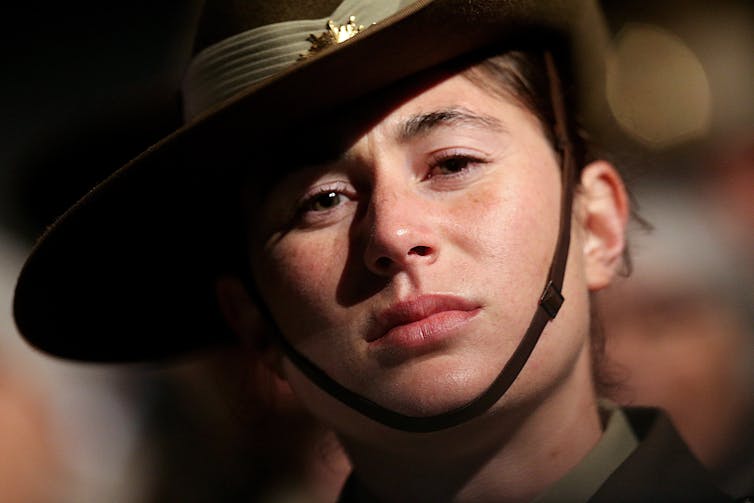 The Army is struggling to rebrand itself and attract new recruits.
Francois Nascimbeni/EPA
The Army is struggling to rebrand itself and attract new recruits.
Francois Nascimbeni/EPA
To be sure, the Army is still praised for its courage and integrity, its aptitude to “punch above its weight,” and its readiness to fight hostile nations and protect vulnerable people in the region.
Read more: Australia's naval upgrade may not be enough to keep pace in a fast-changing region
Extensive public consultations with everyday Australians prior to the release of the 2016 Defence White Paper showed that people viewed the armed services with a high degree of respect and took “pride in the professionalism, operational record and achievements” of military personnel.
Yet, the Army is also criticised for its adherence to outmoded traditions. As the media has exposed numerous scandals involving sexual harassment, bullying, hazing and allegations of rape in recent years, the Army has been chastised for allowing a toxic internal culture to develop.
In addition, the Army has increasingly been accused of involvement in “other people’s wars”, a reproach frequently heard during the conflicts in Afghanistan and Iraq. According to some historians, Australia’s participation in “unnecessary wars” is a distinguishing feature of the nation’s history.
Why this divide is problematic
Such conflicted characterisations are, in part, a product of the public’s segregation from military life. Unless one lives in Canberra or Townsville, where the Army is an ordinary and established part of daily existence, the military is seen as someone else’s remit.
This separation has been exacerbated by the Army itself. While the military shares the same core democratic values as civilians, it largely accepts the traditional ideological divide between its conservative leadership and liberal, individualistic civil society.
The Army remains a closed, insular system, committed first and foremost to producing first-class soldiers. The belief is the Army should operate in a separate domain so it can remain effective and apolitical. But as the inner workings of our liberal democracy become more convoluted, the disconnect is proving obstructive. For both sectors.
Read more: When Australia goes to war, public trust depends on better oversight
The public sees an institution inclined to living in its own myth, and more concerned with integrating with the wider Australian defence force and other allied armies than interacting with Australian society.
The Army sees a society that does not understand what it does, or what it needs. It believes there is general support for its role in counter-terrorism actions, border protection, peacekeeping and restoring order after natural disasters, but limited appreciation of its operational realities, resourcing and equipment challenges, or other activities that are absent from the public discourse.
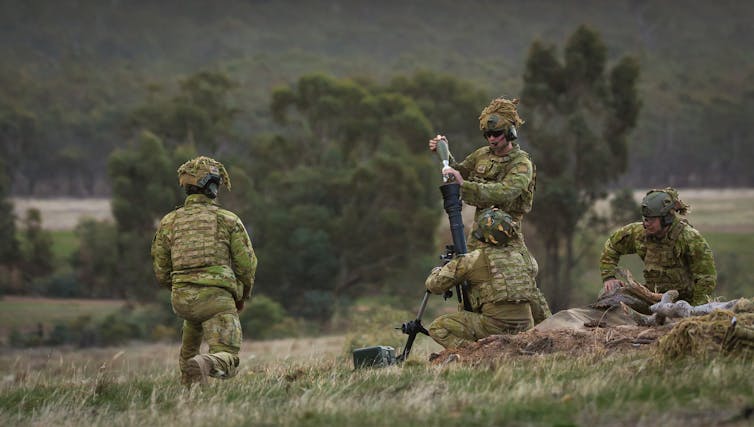 The public upholds the Army for its integrity and bravery, but doesn’t fully understand its role in modern society.
CPL Nunu Campos/PR handout
The public upholds the Army for its integrity and bravery, but doesn’t fully understand its role in modern society.
CPL Nunu Campos/PR handout
Solutions for re-engaging with society
So, how might this disconnect between the Army and society be ameliorated?
In an effort to keep pace with societal expectations, modern recruitment campaigns highlight a military that reflects the community it seeks to protect and the importance of a diverse and multicultural workforce with a broad skill base.
A Navy recruitment add emphasising the service’s multicultural make-up.Likewise, the military leadership’s strong condemnation of misconduct among some personnel suggests that the institution is committed to improving its image and being more in line with the nation’s norms and standards.
An approach embraced by other liberal democracies, including the UK, US and Canada is to work within the myth-making paradigm to construct a strategic narrative that emphasises the Army’s value to society. Although such a narrative is only likely to resonate with those who already have a vested interest in the Army, it may well produce greater general awareness of its roles and missions.
These methods ignore the key strength of the Army, however. The service is in the business of direct engagement. Even as scandal, exclusivity and a sense of disconnection have undermined its reputation in recent years, the public continues to admire the institution’s readiness to put boots on the ground.
Read more: With China-US tensions on the rise, does Australia need a new defence strategy?
Perhaps the answer, then, lies in an intensification of direct associations with society. A more visible presence in communities, an expansion of the reserves and more engagement in activities that foster shared experience could ease the degree of separation between the sectors, and rekindle mutual trust.
That trust needs to be present. The Army is reliant on society for its very existence. Indeed, if the Army becomes segregated from its future ranks, and from the society it is entrusted to protect, it has lost its raison d'être.
The bond between the Army and society should be carefully nurtured and protected as a vital element of national security.
Authors: Marigold Black, AARC Research Fellow, Australian National University


 Daily Bulletin


