

Why do people get cancer?
- Written by: Darren Saunders, Associate professor, UNSW
This is an article from Curious Kids, a series for children. The Conversation is asking kids to send in questions they’d like an expert to answer. All questions are welcome – serious, weird or wacky! You might also like the podcast Imagine This, a co-production between ABC KIDS listen and The Conversation, based on Curious Kids.
Why do people get cancer? – Sascha, age 8, Hurstbridge, Victoria.
This is a really tough question, Sascha. Lots of very clever people are working hard to try to answer it. I have worked on this problem for many years, and to be honest it still blows my mind to really think about just how complex it is.
Before we talk about why we get cancer, it helps to understand how we get cancer.
Read more: Interactive body map: what really gives you cancer?
All living things are made of tiny building blocks called cells. In humans there are hundreds of different kinds of cells, all with special jobs to do. They build our various organs like our skin, brain and bones. Some cells (such as brain and bone) can live for many years, while others (like red blood cells) live only a few weeks.
A human body is made up of trillions of individual cells, many more than all the stars you can see in the night sky.
As we grow, our body needs to make new cells. And as cells get old or damaged, they die and need to be replaced. That helps to keep us healthy.
The simplest way to think of a cancer is that sometimes, one of those trillions of cells starts to grow out of control and refuses to die. This out-of-control cell then divides and makes millions of copies of itself. It can grow to form a tumour - or, in some cases such as leukaemia, spreads through our blood.
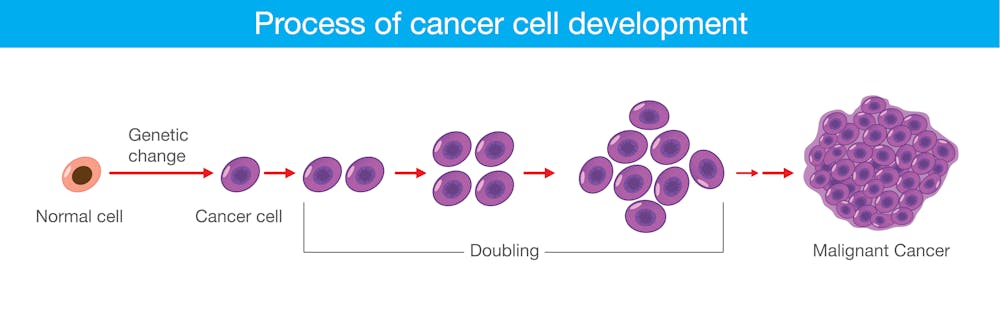 An out-of-control cell can divide and make millions of copies of itself, and can grow to form a tumour.
Shutterstock
An out-of-control cell can divide and make millions of copies of itself, and can grow to form a tumour.
Shutterstock
Cancer cells can also spread to other parts of our body where they would not normally be found. This can cause important organs to stop doing their job and make us very unwell, or die.
Copying the code - and making mistakes
The really incredible thing about cells is that they contain the instructions for making copies of themselves. These instructions are stored in a code called the genome, made of a quite beautiful chemical called DNA.
And if you took the DNA from all the cells in a human and lined it all up, it would stretch around the Moon and back six or seven times.
The alphabet cells use to write this DNA code is made of just four different chemical “letters”: A,C,T, and G. And the instructions in each cell are made of about 6 billion of these chemical letters, which need to be copied exactly every time a cell divides to make a copy of itself.
To help you understand this amazing feat of biology, imagine trying to copy the entire Harry Potter book series in handwriting a thousand times over. That’s what a cell needs to do every time it divides, and it’s happening millions of times every day in our bodies.
You can watch an animation of the incredible, tiny machine cells use to copy DNA here:
With all that DNA to copy, cells are bound to make the occasional spelling mistake - we call these mistakes “mutations”. Sometimes, those mutations change the meaning of a cell’s instruction book, causing it to grow out of control and form a tumour.
This is what we call cancer.
But why?
Now, back to the question of why we get cancer.
Different scientists are having a bit of an argument over this question, but it seems to come down to a combination of bad luck and various experiences you might have in life. Things like too much sunshine, certain chemicals (such as tobacco smoke), alcohol, some foods and even some viruses can increase our chances of getting mutations in our DNA.
Because those mutations in DNA take time to build up, cancer is most commonly seen in older adults. Children do sometimes get cancer but thankfully it is relatively rare. Usually, evolution would mean not many people would get such a horrible disease like cancer. But because most people get cancer after they have had kids, evolution is almost blind to cancer. People who might have a higher cancer risk because of their genes live long enough to pass those genes onto their kids.
You can reduce your chance of cancer by making healthy, sensible lifestyle decisions but it is not possible to completely prevent it. Unfortunately, as I said before, it’s at least partly down to bad luck.
Importantly, we can almost never say for sure why an individual person has cancer.
Read more: Curious Kids: Is there anything hotter than the Sun?
Hello, curious kids! Have you got a question you’d like an expert to answer? Ask an adult to send your question to us. They can:
* Email your question to curiouskids@theconversation.edu.au * Tell us on Twitter
 CC BY-ND
Please tell us your name, age and which city you live in. You can send an audio recording of your question too, if you want. Send as many questions as you like! We won’t be able to answer every question but we will do our best.
CC BY-ND
Please tell us your name, age and which city you live in. You can send an audio recording of your question too, if you want. Send as many questions as you like! We won’t be able to answer every question but we will do our best.
Authors: Darren Saunders, Associate professor, UNSW
Read more http://theconversation.com/curious-kids-why-do-people-get-cancer-106069


 Daily Bulletin


