

How to keep slave-caught seafood off your plate
- Written by: Jessica Meeuwig, Professor & Director, Marine Futures Lab, University of Western Australia
How would you feel if you knew that slavery had helped provide the fish on your plate? Our new research reveals that imported seafood raises the risk of Australians consuming fish caught or processed by workers under slave labour conditions by more than eight times, and identifies some of the warning signs to look out for on a global basis.
Our results are consistent with increasingly widespread reports of modern slavery in the oceans, as highlighted by the recent Global Slavery Index.
Recent cases record the abuse of Indonesian, Cambodian, and Myanmar nationals subjected to forced labour on vessels from countries including South Korea, Taiwan, and Thailand, in waters as far afield as New Zealand, Western Africa, Hawaii and the UK.
Read more: How to reduce slavery in seafood supply chains
Forced labour in fisheries is tied to the ongoing depletion of our oceans. Fish catches peaked in 1996 and have since declined. Compared with 1950, fishing fleets now travel twice the distance to catch a third of the fish. As remaining fish are harder and more expensive to catch, and with rising fuel costs, unscrupulous operators reduce costs by exploiting labour.
The use of refrigerated motherships (“reefers”) allows distant-water vessels to refuel and tranship catch at sea. Enslaved fishers thus might not see land for years, with the inability to oversee labour practices in offshore conditions providing fertile ground for labour abuses.
A globalised seafood industry with opaque supply chains makes it hard for consumers to avoid slave-caught seafood. The lack of “net-to-table” traceability compounds the challenge of assessing how prevalent slave-caught seafood might be in our grocery stores and restaurants.
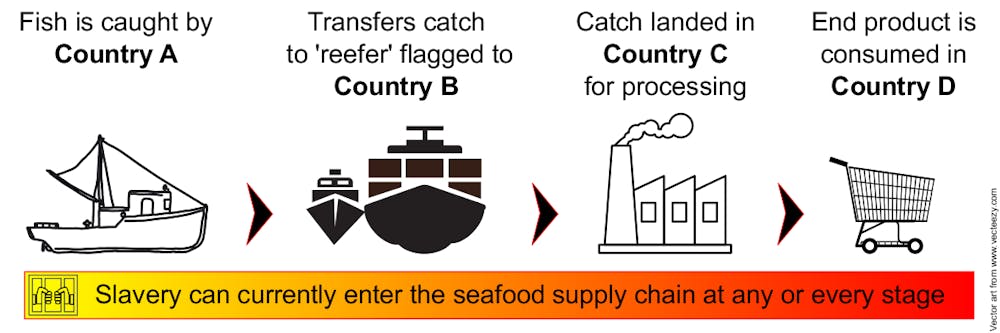 Steps in the seafood supply chain.
Our study, published in Nature Communications, used data on prevalence of modern slavery from the Global Slavery Index alongside fisheries catch data from the Sea Around Us to determine a set of risk factors that are associated with modern slavery in fisheries. We thus move from anecdotal reports to a global risk assessment.
We found that major fish producing countries with evidence of modern slavery share these characteristics:
high levels of vessel and fuel subsidies provided by national governments, indicating overcapacity and poor profitability
poor catch reporting, indicating lack of governance
dependence on fishing far from home ports and in other countries’ waters, beyond the reach of domestic enforcement
low catch value, which puts pressure on labour costs.
Slave-caught seafood affects us all
Seafood is the world’s most highly traded food commodity. To estimate how seafood involving forced labour might reach consumers in ostensibly slavery-free countries, we looked at trade flows of seafood between countries.
We found that imported seafood in US, European and Australian markets raised the risk of consuming slave-caught or processed seafood more than eight times. Increased vigilance over the provenance of seafood entering these markets is thus urgently required.
 Prevalence of slave-caught seafood based on domestic fisheries (left) vs combined domestic-caught and imported seafood (right).
Some people would argue that we can avoid forced labour in overseas fisheries by increasing fishing in Australia, but this logic is flawed.
Australia has already lost 30% of its large fish in the past decade. The annual assessment of 95 Commonwealth-managed stocks finds that roughly 20% are of concern because they are overfished or have uncertain status.
Expanding Australian fisheries is unlikely to reduce our reliance on imported seafood, given that higher overseas prices encourage Australian fishers to export their product rather than sell it into the domestic market, as is the case with rock lobster and tuna.
Most importantly, modern slavery in the fishing sector is a global scourge that will not be resolved by simply reducing foreign seafood imports. It needs Australian leadership in diplomatic and trading relationships.
Eliminating slavery from your plate
We suggest the following ways in which Australia can contribute to eliminating modern slavery from fisheries:
Support the federal government’s Modern Slavery Act, including the appointment of an independent commissioner to advise seafood companies on minimising risk of forced labour in their products. Australia’s regional leadership will help other countries shape their own slavery legislation.
Help seafood importers, processors and retailers target forced labour through initiatives such as the Seafood Business for Ocean Stewardship, which help and incentivise businesses to improve their supply chains and to evaluate risk.
Ensure our trading partners have fair labour laws that regulate hiring, payment and treatment of fishing crews. Thailand in particular has responded strongly to labour issues in its fisheries after being sanctioned by the European Union.
Support international efforts to eliminate harmful subsidies and reallocate these resources to rebuilding fisheries through well-enforced management, including fishing-free zones such as marine parks.
Choose carefully using consumer seafood guides that report on social justice along with environmental sustainability.
Very few people would intentionally buy seafood caught by slaves. But the lack of monitoring, transparency and sustainability in fisheries management keeps consumers in the dark and fishing crews vulnerable.
Overfishing damages our environment. Slavery causes immeasurable suffering. We can’t tolerate encouraging that by what we put on our plate. Ask your local seafood supplier: “where did this fish come from?” Ask your representative politicians too.
Authors: Jessica Meeuwig, Professor & Director, Marine Futures Lab, University of Western Australia
Read more http://theconversation.com/how-to-keep-slave-caught-seafood-off-your-plate-105861


 Daily Bulletin


