

the new eugenics is the same as the old, just in fancier clothes
- Written by: Ross L Jones, Honorary Senior Fellow, Department of Anatomy and Neuroscience, University of Melbourne; Associate, Centre for Health Law and Society, La Trobe University, University of Melbourne
This year marks the 60th anniversary of the ABC’s Boyer Lectures. Delivered by Professor John Rasko, the 2018 Life Engineered lectures explore ethical and other issues around gene therapy and related technologies, and their potential to cure disease, prolong life and change the course of human evolution.
The first lecture will be broadcast on RN’s Big Ideas at 8pm tonight. In this article, we explore the history of eugenics and the ethical implications of its resurgence with the evolution of genetic therapy.
News about the potential of genetic engineering to improve our lives is often compromised by problematic stories about its potential for misuse. Should couples be allowed to choose the gender of their offspring? Should the state intervene in the reproductive lives of its citizens?
We can see this most recently in the case of couples travelling to clinics overseas to use IVF to choose the gender of their child – a practice prohibited in Australia. Such case studies represent only the current point in a long history of the debate about “improving” humanity – the science of eugenics.
Some scientists and ethicists believe eugenics is a value-free science that got a bad name due to the practices in Nazi Germany.
Philosopher and bioethicist Julian Savulescu, for instance, has endorsed the “new eugenics”, claiming that in its previous incarnation it was sullied by bad science and state intervention. He has argued we have a moral obligation to overcome some limitations if science permits it, such as ensuring babies aren’t born with certain types of disabilities.
The argument follows that the new science is “good” science and the free market will lead to human improvement, not contravene fundamental rights.
Read more: Toby Young: what is 'progressive eugenics' and what does it have to do with meritocracy?
Eugenics not a Nazi creation
Discussing Nazi eugenics, however, misses the point. This is because German eugenicists actually learnt the craft from observing the extensive sterilisation programs in the US in the 1920s and ’30s that stopped tens of thousands of people from reproducing.
Legal oversight failed completely. The sterilisation program that targeted “inferior” Americans was endorsed by the Supreme Court in Buck v Bell in 1927. Carrie Buck was surgically sterilised at the age of 22 using fabricated evidence of her, her mother’s and her seven-month-old daughter’s mental incapacity. The reason given in the leading judgment was that “three generations of imbeciles is enough”.
The Rockefeller Foundation funded the pre-second world war work of Josef Mengele (a doctor who later performed human experiments on prisoners at Auschwitz concentration camp) on genetics and disease. Along with the Carnegie Foundation and the Harriman family, millions of dollars went into research programs used to justify the sterilisation of people in the US with disabilities.
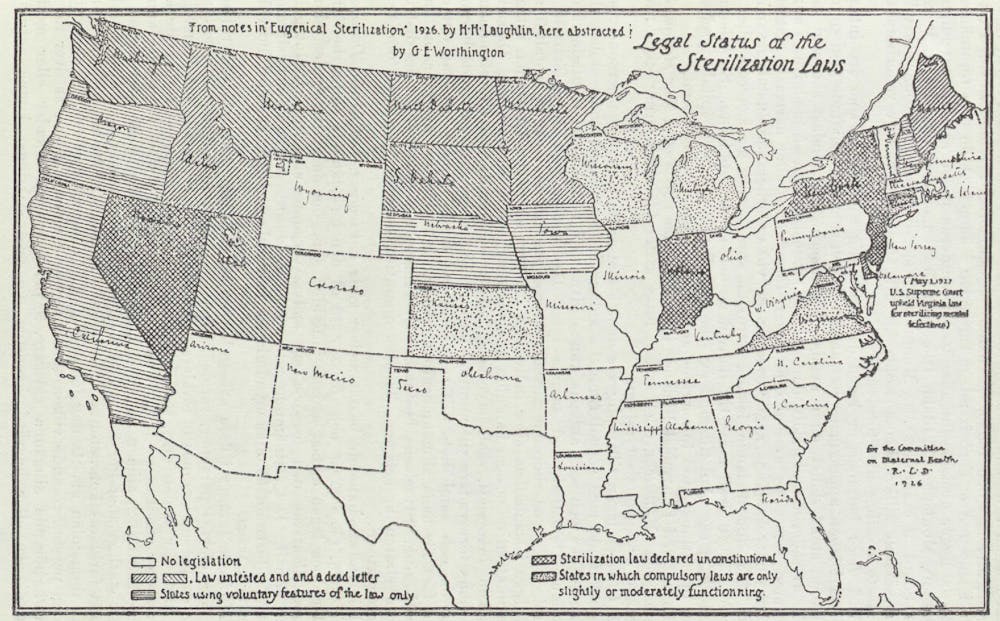 The US sterilised tens of thousands of people with disabilities in the early 20th century.
(taken from1929 Swedish royal commission report) Wikimedia Commons
The US sterilised tens of thousands of people with disabilities in the early 20th century.
(taken from1929 Swedish royal commission report) Wikimedia Commons
Leading scientists and eugenics
Not that we can point the finger just at the US. Charles Darwin’s cousin Francis Galton founded the modern eugenics movement in Britain. He set the ball in motion for the Eugenics Society to be born in the early 1900s. It supported policies that reduced the breeding rights of “inferior” members of society – ranging from birth-control clinics in the slums of major cities and severe restrictions on immigration, through to state-imposed sterilisation.
The first Galton Chair of Eugenics at University College London, Karl Pearson, discovered many of the most important principles underlying modern statistics. Central to his development of statistics was his work in establishing methods of measuring biological normality for the purposes of breeding “better” humans.
Many leading biological scientists and Nobel laureates were members of the society – the brightest minds of generations, who were thought leaders of the time. These included Ronald Fisher, the founder of modern evolutionary biology (who argued that the poorer classes are genetically inferior to the middle classes), the Nobel Prize-winning immunologist Peter Medawar and IVF pioneer Robert Edwards.
Read more: Boyer Lectures: gene therapy is still in its infancy but the future looks promising
Leading scientists still preached the eugenic message of the biological inequality of humans after 1945, as well as the need to restrict the reproductive rights of such people. For example, in the late 1950s and early 1960s Australia’s own Nobel laureate, virologist McFarlane Burnett, pointed out the danger in letting less intelligent members of society have larger families in an article of the Eugenics Society magazine, the Eugenics Review.
Even more controversially, James Watson, who with Francis Crick and, with a very belated acknowledgement, Rosalind Franklin, discovered the double-helix architecture of the chromosome in 1953, argued recently that blacks are less genetically intelligent than whites, and that women are less able in the sciences.
Read more: Eugenics in Australia: The secret of Melbourne's elite
But we’re ‘better’ now
Maybe the science is much “better” now, as Savalescu claims – but there have been concerns about that as well.
Perhaps the most important consideration when evaluating the benefits of the new eugenics is the vexed question of what makes a human “better”.
Certainly if we take deafness, there is an important movement of the deaf that sees deafness as a culture, not a disability. Advocates of this view argue that deaf people aren’t lacking in a way that makes them inferior, they are just different and society should accommodate such difference, not “cure” it, in the same way homosexuality has been de-medicalised.
Can this be said of other so-called disabilities? Is having a higher IQ “better”?
The founder of social Darwinism, Herbert Spencer, coined the term “survival of the fittest”. Interrogating this statement actually shows its a tautology.
Question: Who survives?
Answer: The fittest
Question: Who are the fittest?
Answer: Those who survive.
A tautology is a meaningless formula for future action as it only describes what has gone on in the past. We know who “survived”, it’s the story written by the “winners”. For Spencer, middle-class white males were the “fittest”. Have we just replaced “fittest” with “best”?
We need to think clearly about the consequences of the new genetic technologies and not blindly embrace them in the name of “betterment” if we don’t scrupulously interrogate why such “improvements” are necessary. This was a problem with most of the definitions of the unfit by eugenicists in the past.
If significant funding is to be allocated to the modern eugenics, policymakers must be involved in finding solutions to these problems, otherwise the “new eugenics” is just the old one in new clothes.
Authors: Ross L Jones, Honorary Senior Fellow, Department of Anatomy and Neuroscience, University of Melbourne; Associate, Centre for Health Law and Society, La Trobe University, University of Melbourne


 Daily Bulletin


