

Social media entertainment could be the future of the screen industry, so let's not strangle it with regulation
- Written by: Stuart Cunningham, Distinguished Professor, Media and Communication, Queensland University of Technology
Until 2010, the pathway to success in the screen industry depended on convincing broadcasters and film producers to give to you airtime or production resources. These days, all you need is an internet connection and a laptop or smartphone.
A new creative industry has been born in the last decade called “social media entertainment”. It’s peopled by young entertainers and activists who you may never have heard of: Hank Green, Casey Neistadt, PewDiePie and Tyler Oakley.
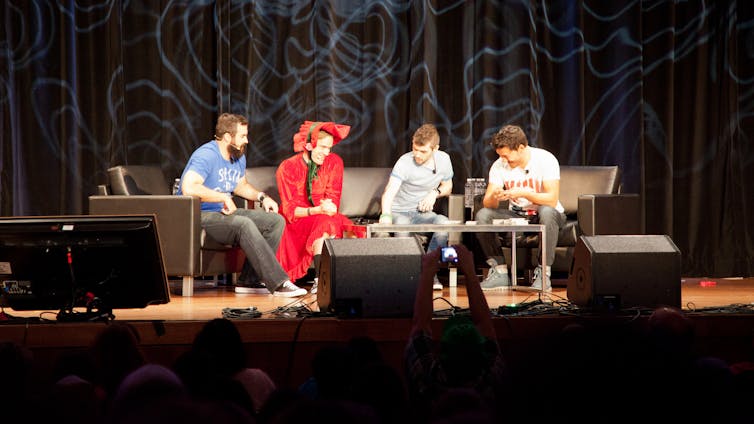 PewDiePie on a panel with fellow creators at a gaming culture festival in 2015.
camknows/Flickr, CC BY-NC-SA
PewDiePie on a panel with fellow creators at a gaming culture festival in 2015.
camknows/Flickr, CC BY-NC-SA
These creators started out as amateurs, but have evolved into media professionals who make money from content they publish on social media platforms. They are incubating their own media brands, building global fan communities, and enhancing Australia’s profile among young people around the world.
The Australian government is currently conducting separate inquiries into the future of film and television content in this country, and the market effects of digital platforms. Any decisions we make in these domains could affect social media entertainment, so it’s critically important we understand the industry lest we inadvertently strangle it as it’s just getting started.
Read more: How social media stars are fighting for the Left
The Australian market is growing
Social media entertainment emerged soon after Google acquired YouTube in 2006 – around the same time as the launch of Twitter, and their counterparts in China, Youku and Weibo.
It can be a lucrative profession. More than three million YouTube creators globally make money from the content they upload. Then there’s Facebook, Instagram, Twitter and Twitch, among others. The larger the audiences, the more money to be made. In 2016, content creators earned more than US$5.9 billion across nine digital and social media platforms in the United States alone.
The majority of the highest paid creators are based in the US, but popular Australian creators include the Van Vuuren brothers, Wengie, and the SketchShe group. Estimates suggest the number of content creators in Australia has more than doubled in the last 15 years. That increase is almost entirely driven by an extra 230,000 creators of online video content entering the industry.
SketchShe’s ‘Mime Through Time Video’ has been viewed more than 42 million times.A new kind of revenue model
Social media entertainment is certainly part of the gig economy. It’s inherently unstable, with huge growth over a ten year period. But the business models of social media entertainment have undergone fundamental changes during that time.
Creators have learned how to manage risk by diversifying their offerings in response to platform competition. For example, instead of making money from a single source – such as advertising income from YouTube – creators now earn revenue from multiple sources, including merchandising, licensing, crowdfunding and live appearances.
One of the biggest changes has been the rise of the “influencer” making money from brand integration. For example, when an Instagram star is paid to post pictures of themselves using a company’s product.
Read more: How copyright law is holding back Australian creators
Successful creators of social media entertainment engage in a model of entrepreneurial practice that pays as much, if not more, attention to building and maintaining a subscriber community as they do to actually creating content. These fan communities are passionate enough to follow creators through thick and thin. And feedback is in real time, constant, fulsome and often confronting. This includes negatives, such as trolling.
Every kind of revenue model in this practice depends on activated community support. Mainstream arts, culture and screen industries, with all their talk of audience building, have a lot to learn about this from creators.
Of course, this takes a lot of work. Creators often upload content several times weekly, build and maintain their communities, deal with the vagaries of algorithms, and risk-manage their authenticity with demanding brands, and even more demanding communities. But still they enter the industry, in their thousands.
A new kind of engagement
It’s premature to bracket social media entertainment in the same category as traditional entertainment formats, such as film, television, print and radio – all of which are subject to Australian content regulation or receive public subsidy. Nevertheless, there’s still a lot for industry, policymakers and regulators to get their heads around.
One difficulty is where to draw the line between amateur creators and professionals, which isn’t always clear. Taste and quality are firmly in the eye of the beholder when it comes to screen content. But to be useful for policy makers, debates about quality need a much stronger dose of demand-side thinking. It’s not only about the quality of the content, but also the quality and diversity of engagement.
The younger generation has largely switched off from linear television. But these young people, from eight to 22 years of age, constitute a huge video market – around 20% of the Australian population.
Social media entertainment engages this demographic. It also provides production and career building opportunity for new voices. That includes young, culturally, racially and ethnically diverse creators and audiences – most of whom have never been near a screen production course or a funding agency.
Read more: Rude comments online are a reality we can’t get away from
And there is a lot of social innovation practice going on. For example, Nerdfighters is a global online community of young people that sprung up around a YouTube video series. Several thousand Australians are Nerdfighters, who often get together in real life to support each other.
Social media entertainers have arguably achieved levels of entrepreneurial professionalisation greater than many mainstream screen businesses. So it’s a mistake to perpetuate the “us professionals” versus “them amateurs” line, even if, for regulatory purposes, you have to draw the line somewhere.
Supporting content creators
There has been a great deal of movement globally around screen, broadcasting and arts agency support for social media entertainment. And support and enablement programs in this arena can afford to be more immediately responsive and experimental due to much lower production costs.
In 2016, RackaRacka, run out of Adelaide by brothers Danny and Michael Philippou, were beneficiaries of the Skip Ahead program. By then, their work making action-packed videos full of choreographed fight scenes, comic violence, and pop culture references was already reaching a wide audience. Their Marvel VS DC video alone boasted some 37 million views (it now has nearly 60 million).
Graeme Mason, the CEO of Screen Australia, has described RackaRacka as Australia’s most successful content creators, and they were rated 5th on Australia’s Cultural Power Index in 2017, ahead of screen icon, Nicole Kidman.
RackaRacka’s Marvel VS DC video has had almost 60 million views on YouTube.How social media regulation could hurt
The big digital platforms that host these creators have been a provocative influence in the Australian communications and cultural policy space, to say the least. We have now entered a new era of potential regulatory oversight of the platforms.
While it’s not at all clear what benefits regulation might bestow on social media entertainment, it is abundantly clear how it could harm it.
Let’s not forget the “adpocalypse” and its unintended, but very unfortunate, consequences. In 2017, the revenue streams of numerous creators were lost when Google and Facebook changed the rules around the kinds of videos that could be monetised. It was done in response to some major brands withdrawing their advertising from the platforms after their ads were sometimes placed by algorithms beside extremist content.
RackaRacka’s content was caught up in the adpocalypse and the brothers lost hundreds of thousands of dollars of revenue. They are now in Los Angeles pursuing international opportunities.
Read more: Art, activism and our creative future
Policymakers should tread carefully
The rapid response of the platforms was necessary to protect their major advertisers, but the consequences demonstrate how seemingly minor policy decisions can have widespread detrimental effects on this nascent industry, and the people driving it.
In media policy, we need better demand-side understanding of what young people have substituted for linear television. In screen support policy, we need greater attention to business model innovation, some of which must be modelled on social media entertainment.
We must take these creators seriously. With better recognition and support, the new voices found in social media entertainment will help to secure the generational future of Australian screen
Authors: Stuart Cunningham, Distinguished Professor, Media and Communication, Queensland University of Technology


 Daily Bulletin


