

Communist aristocrat, Soviet spy and activist filmmaker
- Written by: Russell Campbell, Adjunct Associate Professor of Film, Victoria University of Wellington
A little more than a century ago, with the Great War raging, Admiral of the Fleet Lord Jellicoe paid a visit to a 13-year-old schoolboy.
He had come to play a naval war game the boy had invented, involving the movement of the opposing fleets by mathematical calculations of speeds and distances, with visibility conditions to be determined by the umpire.
Impressed, Jellicoe invited the precocious lad to lecture on his brainchild to the Naval Staff College. The invitation, however, was not taken up. In the interim, the youthful inventor had become a socialist and decided he was against war.
The boy was the Honourable Ivor Montagu, third son of the second Baron Swaythling, scion of a prominent Jewish banking dynasty and one of the richest men in Britain. The aristocrat Montagu would go on to become a pioneer of film culture, a collaborator of two of the most famous directors of the era, an activist documentary maker and an ardent supporter of Soviet communism.
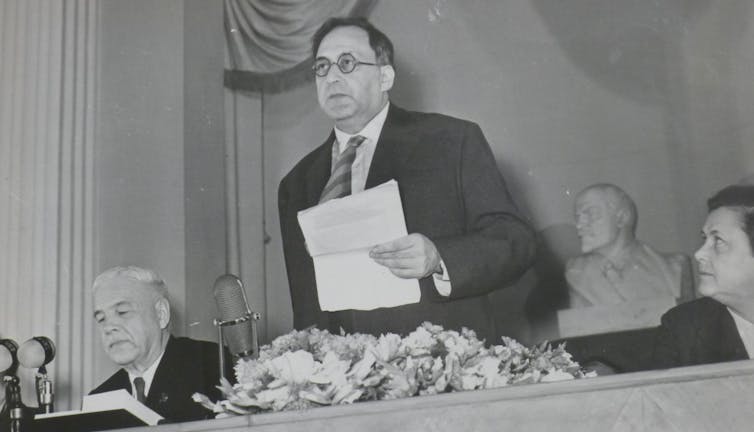 Ivor Montagu accepting the Lenin Peace Prize in 1959.
People's History Museum, CC BY-ND
Ivor Montagu accepting the Lenin Peace Prize in 1959.
People's History Museum, CC BY-ND
The making of a socialist
Intelligent and committed to his beliefs, young Ivor joined the Marxist-oriented British Socialist Party and helped the cause by hiding contraband copies of Lenin’s State and Revolution on the landing of his lavish Kensington Court home, in London’s West End. At war’s end, when police attacked a protest march of discharged soldiers, Ivor joined the fray as a top-hatted public schoolboy, bringing down a copper by striking him on the ankle with his silver-tipped ebony cane.
Horrified to discover they were harbouring a teenage radical, his parents insisted that he cut back on his political involvements until he turned 21. More or less, according to Ivor’s later account, he did.
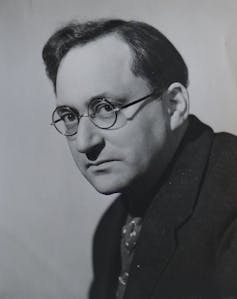 Ivor Montagu, around 1930.
People's History Museum, CC BY-ND
Ivor Montagu, around 1930.
People's History Museum, CC BY-ND
Montagu’s privileged background and his rebellion against it were to mark him for life. A representative of the left-leaning British intelligentsia of the interwar years, he was deeply immersed in the political dramas and cultural ferment of the times.
In researching his biography – now published as Codename Intelligentsia: The Life and Times of the Honourable Ivor Montagu, Filmmaker, Communist, Spy – I was struck by the man’s passion for social justice, his energy and initiative, and the sheer variety and multiplicity of his projects. I was also appalled, as I dug deeper, by his blindness towards the murderous criminality of Stalin’s regime in the Soviet Union.
Read more: What eastern bloc dissidents can teach us about 'living in truth'
Ping pong and rare fauna
One of Montagu’s enthusiasms, and the one for which he is probably best known, was table tennis. He revived the game as a competitive sport and in 1922, at the age of 17, he founded the (English) Table Tennis Association, and in 1926, the International Table Tennis Federation.
This story is told in Nicholas Griffin’s Ping-Pong Diplomacy: The Secret History Behind the Game That Changed the World (2014), and I touch on it only in passing in my book.
Another of his passions was zoology, which he studied at Cambridge. Each summer in his university days, he would traverse remote regions in a scientific hunt for the always elusive small burrowing mammals that were his speciality. In 1925, with the help of local peasants high in the Caucasus mountains, he was able to lay his hands on a few specimens of the rare mole vole Prometheomys.
Getting them back to Britain, however, proved a challenge. On the long train journey back to Moscow, the Prometheomys fought and killed one another, escaped from their cages in the goods van, had to be recaptured with the assistance of a squad of Red Army men, got infested with parasites (as did their handlers), and began to die of disease.
Montagu hastened the process with one creature by coating it in alcohol to kill the bugs. It was mortally chilled and died within ten seconds. None of the menagerie was alive by the time he set sail from Leningrad. Post mortems indicated lung infection. Ivor did not pursue zoology as a profession.
Film culture
The cinema was to prove a more lasting preoccupation. Michael Balcon, the renowned film producer, called him “one of the first real intellectual artists of the cinema”, and Rachael Low, doyenne of British film historians, “an exceptional man in many ways and a brilliant film maker”. He was, according to the critic Geoff Brown, “the period’s most dynamic, visible, and well-connected fighter for art cinema”.
His first foray into the field was as founder (in 1925) and chairman of the (London) Film Society. Negotiating censorship hurdles and distribution hassles, he and his colleagues brought to the English screen - for a select coterie only, to be sure - previously unseen examples of imaginative and audacious cinematic art from around the world, shaking up what was otherwise a deadly bland filmic culture.
Becoming film critic for the The Observer, he stepped up his subversive stirring. In his first column, he launched a ferocious attack on the Rudolph Valentino vehicle The Eagle (Clarence Brown, 1925):
The picture has no merit of any kind whatsoever. A fast, exciting, if hackneyed story is made dull, slow, inconsequent, and every dramatic situation is bungled, set out without being led up to climactically … . Everyone’s acting was preposterous. Mr Brown must have found directing Mr Valentino rather like directing a sack of potatoes.
Montagu had only intermittent stints as a reviewer, but his observations were characteristically marked by acute insight, mordant wit and a pioneering application of Freudian and Marxist concepts.
The film industry
Montagu got started in filmmaking himself when he was asked by Balcon to take a look at Alfred Hitchcock’s The Lodger whose release had stalled because of misgivings on the part of the distributor. He made some modest alterations, chiefly concerned with cutting down the large number of intertitles. The film made it into theatres to become a critical and commercial success.
Before long the tyro found himself heading up both the scenario and editing departments at Balcon’s Gainsborough company. A disagreement with Hitchcock over the cutting of Downhill led to his departure from the studio to concentrate on his work in the editing firm run by his friend Adrian Brunel, in which he soon became a partner.
In years to come Montagu would direct three short silent comedies from story ideas by H.G. Wells, collaborate on scripts in Hollywood with Sergei Eisenstein, team up again with Hitchcock as his producer at Gaumont-British, and co-direct a documentary, Wings Over Everest, which won an Academy Award.
The 1933 documentary Wings over Everest charts the first flight over the world’s highest mountain.Montagu was about to direct his first feature, King Solomon’s Mines, when he fell ill and had to withdraw. However, the Spanish Civil War had broken out, and he seized the opportunity to leave Gaumont-British and fly to the war zone with a young Norman McLaren as his cameraman. His documentary The Defence of Madrid, shot and edited at breakneck speed, was released in December 1936.
It was far from a perfect piece of work, yet it provided for many Britons their first chance of seeing close-up images of the impact of aerial bombardment on a civilian population. Later, Montagu produced and distributed several more documentaries on the conflict.
Communism
The films took, of course, the Republican side. By now, Montagu was a leading figure in the Friends of the Soviet Union and heavily invested in promoting anti-fascist and Communist causes. He had, for a time, been close to Leon Trotsky, corresponding regularly, lobbying for his admission to the UK, and striking up a friendship when he interviewed the exiled revolutionary in Turkey. But in 1931, he joined the Communist Party, and the two grew apart.
When Trotsky was accused, in absentia, at the first of the Moscow show trials in 1936, of taking part in a terrorist conspiracy against the Soviet leaders, Montagu joined in the chorus of denunciation of his former friend. As a journalist for the Daily Worker and other left-wing papers, he stridently upheld the probity of the judicial process and vehemently attacked those who questioned it.
When the Great Terror, a brutal political campaign led by Soviet dictator Joseph Stalin to eliminate dissenting members of the Communist Party, erupted in the Soviet Union in 1937, Montagu likewise belittled anyone attempting to expose the truth. His commitment to Stalin’s USSR was such that in 1940 he was happy to be enlisted as a spy for the Soviet military intelligence, the GRU.
During the postwar years, Montagu returned to filmmaking, directing an exposé of Nazi ideology, Man – One Family, and co-scripting the well-received Scott of the Antarctic. Later, he worked in the secretariat of the Moscow-backed World Peace Council.
In 1964, he published Film World, which revealed, sadly, how unresponsive the erstwhile champion of experimentation in the cinema was to the French New Wave and other exciting new developments in film from elsewhere in Europe.
In reflecting on his life story, I could not help but meditate on where his creative energies and generosity of spirit had led. In joining the Communist Party and becoming a propagandist for the Soviet Union, Montagu surrendered his intellectual and moral integrity. His cultural thinking became ossified, his political thinking warped.
His biography is a tale of corruption, but it is not his alone. It is the melancholy story of the havoc wreaked by Soviet Communism on the progressive causes of the 20th century, and of the individuals who espoused them.
Authors: Russell Campbell, Adjunct Associate Professor of Film, Victoria University of Wellington


 Daily Bulletin


